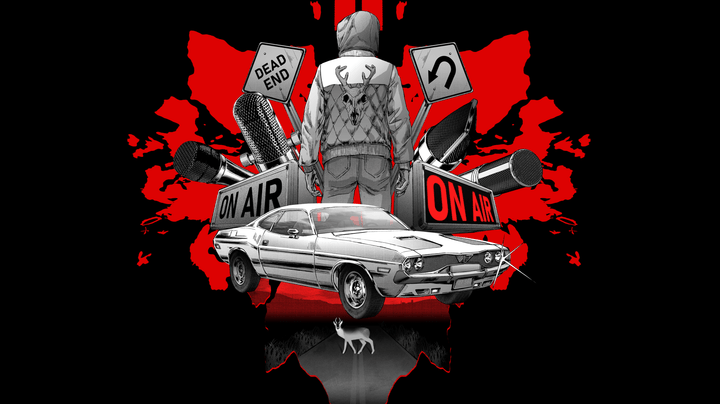
Have you ever just wanted to run away from it all? When you’re dealing with mounting problems at home, the idea of jumping in a car and driving away as far as possible sounds appealing. What better way to leave the past in the dust than to hit the open road and go wherever your wheels take you?
That idea is at the heart of Heading Out, a new narrative racing game that’s unlike anything I’ve played before. Inspired by classic road films like Easy Rider, the upcoming game combines racing, visual novel decision-making, and a roguelite structure into a single eclectic project featuring a stark black-and-white art style that calls back to PlatinumGames’ Mad World. It’s the kind of left-field project that needs to be on your radar this spring.
My demo would take me through the first act of the story, giving me a sense of how Heading Out‘s unique “run” structure works. There’s a lot to explain. When I begin, I’m asked to answer some prompts that determine my outlaw antihero’s personal life. Those decisions define what the character is running away from and what will eventually come back to haunt him in the cross-country story.
From there, I’d get a sense of the genre-melding structure of the journey. After an introduction to its racing segments, which have me speeding through different landscapes and avoiding road hazards, I’m dropped onto a map of the United States. My drive begins around Ohio and my goal is to follow routes to get up to North Dakota. Rather than driving in real time, I select a route on the map and accelerate to quickly move my car along that route. As I drive, I’m pulled into randomized events, from narrative decision-making to road races that put me back in control of the actual car. It’s sort of like taking Kentucky Route Zero and turning it into a roguelike.
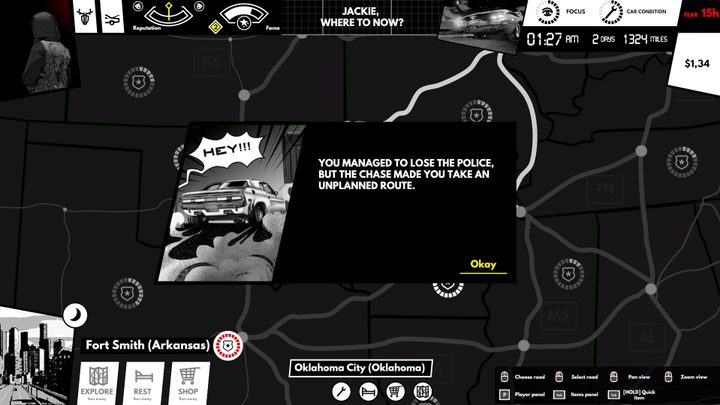
I’d experience a variety of possible events along my trip. One comic narrative section would find me outside of an abortion clinic as a couple is harassed by a religious fanatic. I’m given the option to help them out or leave. You bet your butt I beat the snot out of a priest, raising my fame level. In another, a cop would challenge me to a street race. If I won, he promised to tell his boys to back off my case a bit, decreasing my wanted level.
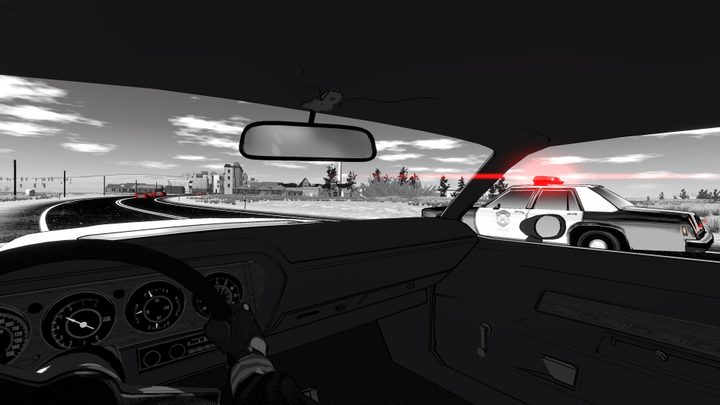
As you can tell, there’s a bit of survival game-like management at play here. I need to keep an eye on my fame, wanted level, and the little money I have. Driving off the road can raise my fear level, while crashing can cause damage that needs to be repaired. If I speed too fast on the overworld map, my wanted level will rise and cops will be harder to shake off (to avoid them, I need to slow down when I see one passing on the map or else enter into a chase sequence). I also need to take time to sleep, which can only be done in select cities. I can also buy usable items that can help manage all of that. It sounds like a lot to juggle, but I quickly got the hang of it all.
The main draw, though, is the racing game core that’s unique in its own right. When I initiate a race, I’m dropped into a countryside or city as a song plays on my radio. There aren’t laps. Instead, the song determines how long the race goes. I simply need to be in first place when it ends to beat street racers or get away from the cops. It’s an ingenious use of music that has me paying closer attention to the soundtrack, which is filled with smooth jazz and road trip-worthy butt rock.
In addition to the music, each race ends with another bit of crucial audio: radio broadcasts. The last minute or so of any drive I take is soundtracked by a ranting AM radio host that you’d likely hear if you were driving through the heart of America. One broadcast seemed like a clear Alex Jones send-up, with a deranged man screaming about patriotism. Heading Out isn’t shying away from satire here, taking aim at America’s divided political landscape in a way that’s reminiscent of the Grand Theft Auto series.
Racing itself brings some creative twists. Road signs, rather than a mini-map, telegraph upcoming turns. Some signs will even clue me toward a detour, letting me go on an off-road shortcut. Visuals like that are a key part to reading the road. For instance, while the art style is primarily black-and-white, obstacles like traffic cylinders appear in color. That makes it easier to see what’s coming from afar, something that feels genuinely innovative for the genre.
Even with laying all this out, it feels like I’m still leaving out so much. Heading Out packs a ton of ideas into what initially might look like a small package. What’s more impressive is that it doesn’t appear to be compromising on any of its various genres — racing, roguelite, survival — to pull off its hybrid gameplay. I know I’ll be jumping back in the driver’s seat when it launches on May 7 for PC.