1. Home
  2. Space
  3. News

This is how the world ends: swallowed or shredded by a dying sun

Add as a preferred source on Google

One of the stranger facets of astronomy is contemplating what the fate of the Earth will be when the sun dies. Eventually, in billions of years’ time, the sun will inevitably run out of fuel and enter the final stages of its life, puffing up to a huge size called a red giant. When it does this, the sun will swallow Mercury and Venus completely — but the status of Earth is not quite so certain.

Researchers recently studied the status of dead stars called white dwarfs, which are the cores that remain after a red giant collapses. This gives a glimpse at what our own solar system will look like in 5 billion years. Earth may or may not be engulfed by the sun, but it certainly won’t be habitable any longer.

Recommended Videos

“Whether or not the Earth can just move out fast enough before the Sun can catch up and burn it is not clear, but [if it does], the Earth would [still] lose its atmosphere and ocean and not be a very nice place to live,” said researcher Boris Gaensicke of the U.K.’s University of Warwick in a statement.
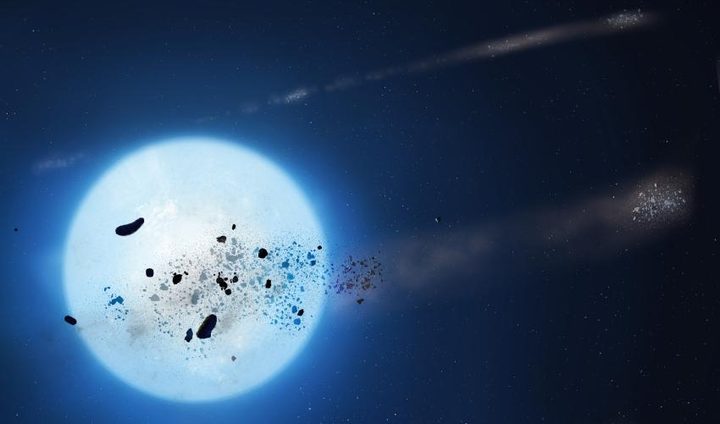
Clumps of debris from a disrupted planetesimal are irregularly spaced on a long and eccentric orbit around the white dwarf. Individual clouds of rubble intermittently pass in front of the white dwarf, blocking some of its light. Because of the various sizes of the fragments in these clumps, the brightness of the white dwarf flickers in a chaotic way.
Clumps of debris from a disrupted planetesimal, or minute planet, are irregularly spaced on a long and eccentric orbit around the white dwarf. Individual clouds of rubble intermittently pass in front of the white dwarf, blocking some of its light. Because of the various sizes of the fragments in these clumps, the brightness of the white dwarf flickers in a chaotic way. Dr Mark Garlick/The University of Warwick

The researchers looked at three particular white dwarfs for evidence of whether they had swallowed up other bodies in their systems such as asteroids, moons, and planets. These white dwarfs had fields of debris orbiting around them, and by studying this debris, the researchers could learn where it likely came from. These bodies get torn apart when they come too close to a white dwarf due to gravity, lead researcher Amornrat Aungwerojwit of Naresuan University in Thailand explained.

Pieces of the debris orbit the white dwarfs and cause dips in their brightness that can be seen from Earth. One surprising finding is that the conditions of these white dwarfs changed so quickly, according to the 17 years that the data covered.

“The simple fact that we can detect the debris of asteroids, maybe moons or even planets whizzing around a white dwarf every couple of hours, is quite mind-blowing, but our study shows that the behavior of these systems can evolve rapidly, in a matter of a few years,” Gaensicke said. “While we think we are on the right path in our studies, the fate of these systems is far more complex than we could have ever imagined.”

Applying this research to our own solar system, the Gaensicke speculated about the fate of our planet: “The sad news is that the Earth will probably just be swallowed up by an expanding sun, before it becomes a white dwarf. For the rest of the solar system, some of the asteroids located between Mars and Jupiter, and maybe some of the moons of Jupiter. may get dislodged and travel close enough to the eventual white dwarf to undergo the shredding process we have investigated.”

The research is published in the journal Monthly Notices of the Royal Astronomical Society.

Georgina Torbet
Georgina has been the space writer at Digital Trends space writer for six years, covering human space exploration, planetary…
Space is becoming Bezos and Musk’s next data center site, and we have every reason to worry
The AI boom is coming for the night sky
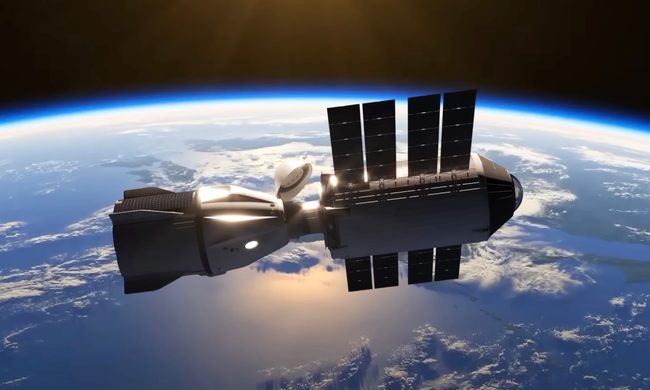
How Vast's space station will look in orbit.

AI data centers already consume vast amounts of electricity and water on Earth, so Silicon Valley has begun looking somewhere considerably more spacious... literally.

Elon Musk's SpaceX and Jeff Bezos' Blue Origin, along with several other companies, have proposed enormous constellations of satellites designed to operate as orbital data centers. However, environmental groups and former space officials are now warning that putting them into orbit at the proposed scale could have severe consequences for Earth's atmosphere and the night sky.

Read more
The first possible exomoon is here, and it makes our Moon look hilariously tiny
Scientists may have found the first exomoon, except this one is the size of Jupiter
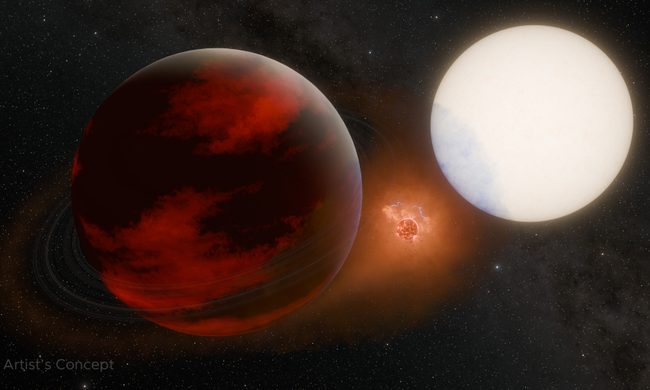
This artist’s concept depicts a potential volcanic moon between the exoplanet WASP-49 b, left, and its parent star. New evidence indicating that a massive sodium cloud observed near WASP-49 b is produced by neither the planet nor the star has prompted researchers to ask if its origin could be an exomoon.

We have already discovered more than 6,000 planets outside of our immediate neighborhood. Yet, finding a moon orbiting one of those distant worlds has proved considerably harder. Astronomers may finally have something close to the real deal, but this particular object stretches the word “moon” almost beyond recognition.

Using the European Southern Observatory’s Very Large Telescope in Chile, researchers detected strong evidence for a moon-like object in the CD-35 2722 system. Further observations are still necessary to confirm the discovery, but it could become the first confidently detected natural satellite outside our solar system. There is still one tiny complication though. This moon is apparently massive.

Read more
China’s answer to SpaceX’s reusable rockets literally catches boosters in a net
SpaceX catches boosters on legs. China just used a net.
Ammunition, Missile, Weapon

SpaceX's playbook for recovering a rocket booster generally involves legs, a precisely controlled vertical landing, and either a concrete pad or a drone ship. 

China just managed to pull off something similar, but in a slightly different way, and on July 10, it tested the method as well.

Read more