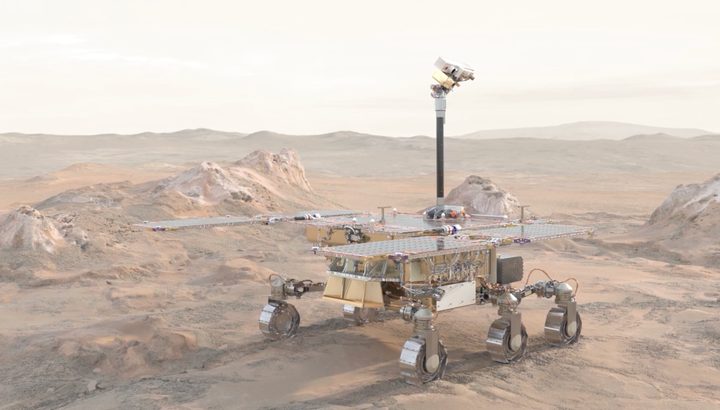
Europe’s unlucky Mars rover, known as Rosalind Franklin, has gotten a boost thanks to a new cooperation agreement with NASA. The European Space Agency (ESA) had previously partnered with Russian space agency Roscosmos on the rover project, but that was suspended following Russia’s invasion of Ukraine. Now, NASA has formally agreed to contribute launch services and parts of the landing propulsion system to the project, aiming for a 2028 launch.
Part of Europe’s ExoMars program, the rover was originally intended for launch in 2020, but that was delayed because of the coronavirus pandemic. Then with Russia no longer a partner, ESA was searching for launch options to carry the rover to Mars as well as working on its own lander. Now, with NASA’s help, the project appears to be back on track for a visit to Mars.
“This pivotal agreement strengthens our collaborative efforts for the ExoMars programme and ensures that the Rosalind Franklin rover will set its wheels on martian soil in 2030,” said Daniel Neuenschwander, ESA’s Director of Human and Robotic Exploration, in a statement. “Together, we are opening new frontiers in our quest to uncover the mysteries of Mars. We demonstrate our commitment to pioneering space exploration and expanding human knowledge.”
As well as launch services, with an American commercial launch partner working on carrying the rover, NASA will also provide part of the heating system for the rover. It will be complementary to NASA’s own Curiosity and Perseverance rovers, as Rosalind Franklin will drill deeper into the Martain surface, down as deep as 2 meters (6.5 feet). It will be able to collect deeper samples, including ice that exists beneath the Martian surface.
“The Rosalind Franklin rover’s unique drilling capabilities and onboard samples laboratory have outstanding scientific value for humanity’s search for evidence of past life on Mars,” said Nicola Fox, associate administrator, Science Mission Directorate at NASA Headquarters in Washington, D.C. “NASA supports the Rosalind Franklin mission to continue the strong partnership between the United States and Europe to explore the unknown in our solar system and beyond.”
The key instrument on the rover will be the Mars Organic Molecule Analyzer, a tool built by the German and French space agencies, which will look for the building blocks of life called organic molecules, in the samples.
Now engineers on the rover program are working toward a review this summer to check that the system is meeting requirements before planning begins for the launch.