  1. Home
  2. Computing
  3. News

Nvidia and Microsoft are solving a big problem with Copilot+

Add as a preferred source on Google
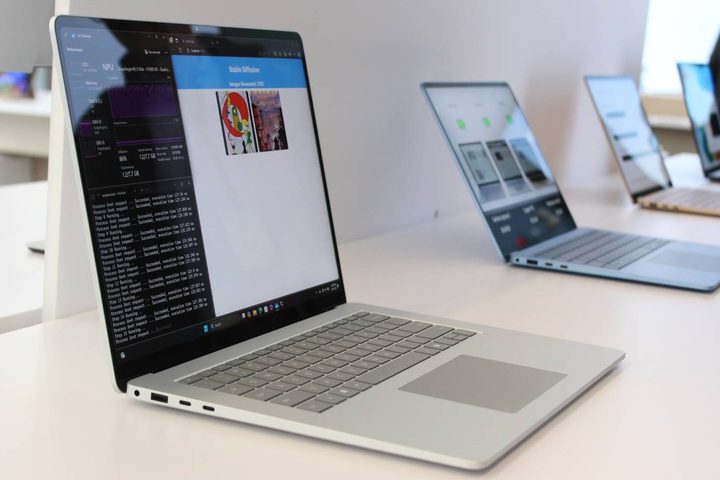
The Surface Laptop running local AI models.
Luke Larsen / Digital Trends

When Microsoft announced Copilot+ PCs a few weeks back, one question reigned supreme: Why can’t I just run these AI applications on my GPU? At Computex 2024, Nvidia finally provided an answer.

Nvidia and Microsoft are working together on an Application Programming Interface (API) that will allow developers to run their AI-accelerated apps on RTX graphics cards. This includes the various Small Language Models (SLMs) that are part of the Copilot runtime, which are used as the basis for features like Recall and Live Captions.

Recommended Videos

With the toolkit, developers can allow apps to run locally on your GPU instead of the NPU. This opens up the door to not only more powerful AI applications, as the AI capabilities of GPUs are generally higher than NPUs, but also the ability to run on PCs that don’t currently fall under the Copilot+ umbrella.

It’s a great move. Copilot+ PCs currently require a Neural Processing Unit (NPU) that’s capable of at least 40 Tera Operations Per Second (TOPS). At the moment, only the Snapdragon X Elite satisfies that criteria. Despite that, GPUs have much higher AI processing capabilities, with even low-end models reaching to 100 TOPS, and higher-end options scaling even higher.

In addition to running on the GPU, the new API adds retrieval-augmented generation (RAG) capabilities to the Copilot runtime. RAG gives the AI model access to specific information locally, allowing it to provide more helpful solutions. We saw RAG on full display with Nvidia’s Chat with RTX earlier this year.
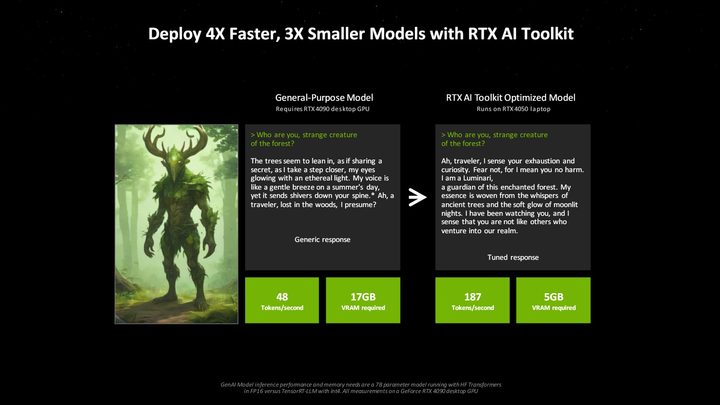
Performance comparison with the RTX AI toolkit.
Nvidia

Outside of the API, Nvidia announced the RTX AI Toolkit at Computex. This developer suite, arriving in June, combines various tools and SDKs that allow developers to tune AI models for specific applications. Nvidia says that by using the RTX AI Toolkit, developers can make models four times faster and three times smaller compared to using open-source solutions.

We’re seeing a wave of tools that enable developers to build specific AI applications for end users. Some of that is already showing up in Copilot+ PCs, but I suspect we’ll see far more AI applications at this point next year. We have the hardware to run these apps, after all; now we just need the software.

Jacob Roach
Former Lead Reporter, PC Hardware
Jacob Roach is the lead reporter for PC hardware at Digital Trends. In addition to covering the latest PC components, from…
AI’s energy tax was already concerning. Research says AI agents are over hundred times worse
AI agents could consume 136 times more energy than today's AI, study finds
AI agents

The AI industry's soaring electricity demand has already become a growing concern for governments, utilities, and technology companies. But a new study suggests the next generation of artificial intelligence could make that problem significantly worse.

Researchers from the Korea Advanced Institute of Science and Technology (KAIST) have published what they describe as the first comprehensive analysis of the energy cost of AI agents - AI systems capable of reasoning, planning, and completing tasks autonomously. Their findings show that these systems can consume up to 136.5 times as much energy per query as conventional generative AI models, raising fresh questions about whether the infrastructure supporting tomorrow's AI is ready for what's coming.

Read more
I hope Apple keeps the MacBook Neo away from the AI hype and preserves its true identity
The cheapest MacBook beats the cheapest AI MacBook.
Computer, Electronics, Laptop

If there's one thing that has disrupted consumer tech economics over the last year while changing how we understand and recommend products, it's the ever-rising cost of memory and chips. 

The desperate need to scale up AI infrastructure has pushed major manufacturers to prioritize enterprise demand, leaving everyday consumers with far fewer choices. Those available cost significantly more than they did a year ago.

Read more
I let Radial menu take over my Mac, and I’m never going back
One mouse jiggle, endless shortcuts. My Mac has never felt this fast.
Radial app running on Mac

I have been testing Radial for the past week, and it's quickly become one of those apps I didn’t know how I could live without. It's a radial menu for macOS that puts your shortcuts, scripts, and automations right where your cursor is, so you never have to go hunting through menus to find what you need.

The app just received its 5.0 update, adding AI actions powered by Claude, window layouts, variables, a redesigned settings interface, a new Atmosphere background effect, and a squircle menu shape. I got to try most of these, and here's what I found.

Read more