1. Home
  2. Computing
  3. News

Believe it or not, AMD and Nvidia are teaming up

Add as a preferred source on Google
AMD presenting its new Turin CPUs.
AMD

They’re mortal enemies. Sworn rivals. The two top names when it comes to the best graphics cards, duking it out even over petty performance difference. And yet, AMD and Nvidia are partnering for the launch of Team Red’s 5th-gen Epyc server CPUs, code-named Turin.

Through what AMD called a “technical partnership,” Nvidia is providing guidance on how to pair its HGX and MGX data center GPU clusters with AMD’s new Epyc CPUs. Despite the fact that AMD makes its own Instinct AI accelerators, the partnership seems like a read on reality. Customers will want to use Nvidia GPUs with AMD CPUs, and the two companies came together to provide that guidance.

A slide showing the partnership between AMD and Nvidia.
AMD

And that’s a good thing because AMD’s new data center chips look mighty impressive. The bedrock they are built on is the Zen 5 architecture that we saw in CPUs like the Ryzen 9 9950X and Ryzen 9900X, but massively expanded. You can see the dizzying product stack below, which ranges from CPUs from eight cores all the way up to a massive chip packing 192 of AMD’s Zen 5c cores. And as a cherry on top, the sweet spot 64-core 9575F can hit 5GHz — a first for AMD’s data center chips.
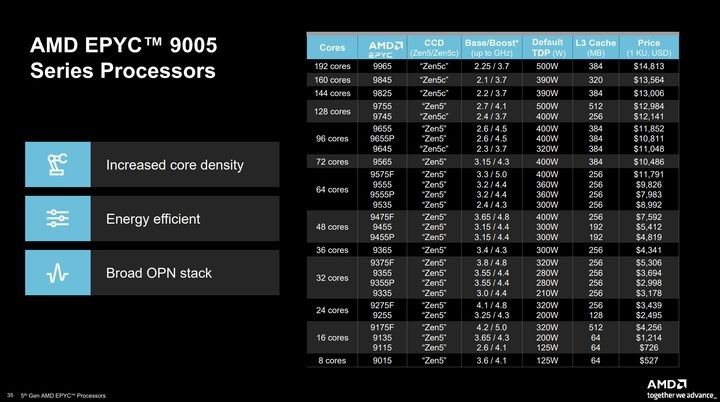
Product stack for Epyc 9005 CPUs.
AMD

AMD is showing some pretty massive performance gains, too — 2.7x the performance on the SPEC CPU benchmark compared to an Intel Emerald Rapid Xeon CPU, and up to four times the enterprise performance, which looks at transcoding video. Intel just recently launched its Granite Rapid Xeon CPUs, but AMD didn’t share any performance numbers for those chips.
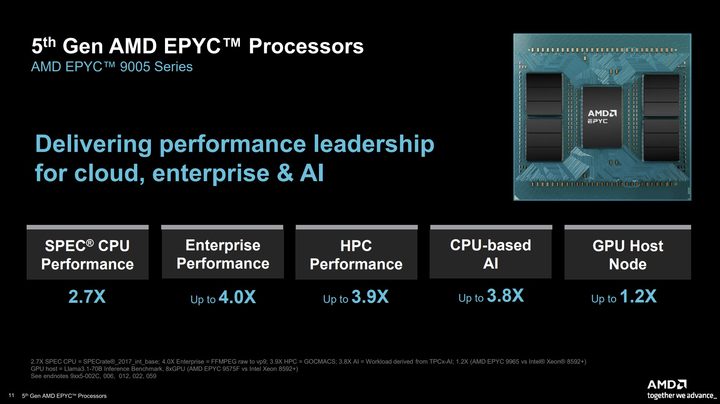
Performance of Epyc 9005 CPUs.
AMD

Turin CPUs are massive, and it’s no wonder that Nvidia is working with AMD to provide guidance to customers. Still, AMD isn’t down for the count when it comes to data center GPUs. The company formally launched its new Instinct MI325X AI accelerator alongside Turin CPUs, which it previously previewed at Computex earlier this year. A single GPU packs 256GB of HBM3E memory, and when organized into a cluster, AMD says the platform can support up to 2TB of HBM3E memory and 48TB/s of memory bandwidth.
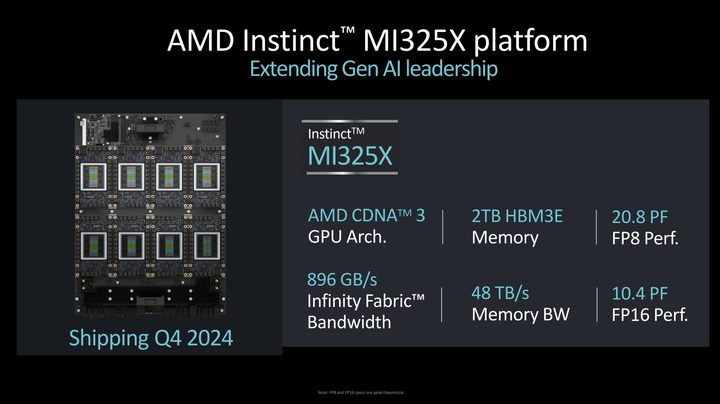
Specs for AMD's MI325X platform.
AMD

AMD is still gunning after Nvidia’s AI crown with the GPU, too. The company showed the MI325X outperforming Nvidia’s H200 in AI inference and providing performance parity in AI training. Nvidia has moved onto its Blackwell data center GPUs, but the H200 comparison is still fair given how rapidly AI hardware is rolling out these days.
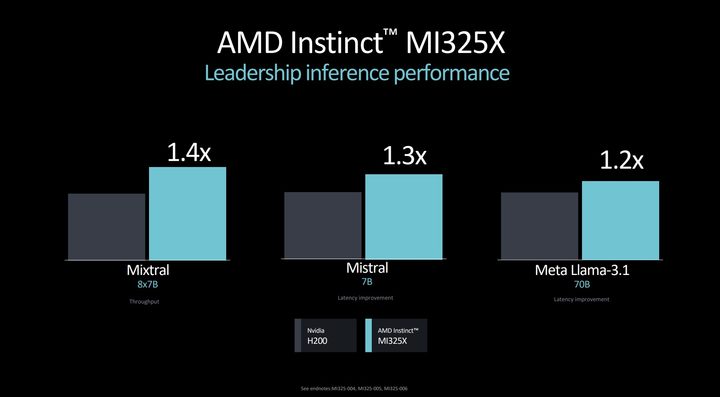
Performance of AMD's MI325X.
AMD

Although most of the readers here at Digital Trends will never interact directly with this hardware, it’s still nice to look and gawk at just how much power companies like AMD can squeeze onto a CPU. Behind the scenes, AMD’s Epyc CPUs help power dozens of services we all interact with every day, from Netflix to Snapchat and beyond.


Jacob Roach
Former Lead Reporter, PC Hardware
Jacob Roach is the lead reporter for PC hardware at Digital Trends. In addition to covering the latest PC components, from…
macOS clipboard app Maccy has a fake out there stealing passwords
PamStealer malware is disguising itself as Maccy to target Mac users
Depicting of the Maccy clipboard app for macOS on a laptop with letters inb the background.

A fake version of Maccy, a popular clipboard manager for macOS, is being used to deliver a newly discovered Mac malware strain called PamStealer. Researchers at Jamf say the malware impersonates the real open-source app, but its actual purpose is to steal data and capture a victim’s login password.

PamStealer arrives as a disk image containing an AppleScript file that impersonates Maccy. Once the user opens that file, macOS launches it in Script Editor, where the on-screen instructions tell them to press Command-R. To someone expecting a normal app installer, that may look like an odd setup step. In reality, that action runs hidden malware code and starts the attack.

Read more
A new technology teaching drones to feel pain could stop your self-driving car from harming itself
Drones first, autonomous cars next. A pain-sensing system that detects failure before it happens has real stakes for self-driving vehicles.
Transportation, Vehicle, Car

When you sprain your ankle in the middle of a run, your body sends a pain signal to your brain, forcing you to stop. Essentially, the ability to sense pain stops you from pushing through the injury and causing further self-harm.

Researchers at Delft University of Technology and Wageningen University have applied this exact concept to drones, giving them a digital equivalent of a nervous system that recognizes a faulty part and triggers a pain-like warning signal. What's even more interesting is that the technology could find use in self-driving cars.

Read more
Claude Fable 5 is leaving subscriptions, but maybe not for good
High demand is pushing Claude Fable 5 out of subscriptions for now
Claude Fable 5 and Claude Mythos 5 Official Render

Anthropic’s most advanced publicly available Claude model is still leaving standard subscription access after July 7, but the company is now trying to calm fears that the move is permanent.

Fable 5 recently returned to Claude after drawing scrutiny from the U.S. government. Anthropic said it would be included on Pro, Max, Team, and select Enterprise plans for up to 50% of weekly usage limits through July 7. After that date, the model is set to move to usage-credit billing, meaning users will pay for access outside their regular plan limits.

Read more