

AMD hasn’t had much of a presence lately in any of the best gaming laptops — at least not in the graphics department. However, according to a new leak from Golden Pig Upgrade Pack on Bilibili, AMD isn’t giving up on its laptop GPUs, and is in fact readying four discrete graphics cards made for laptops. The top configuration may actually rival one of Nvidia’s next-gen top GPUs, but that doesn’t mean it’ll be equally as good.
The leaker shared a slide detailing the four laptop GPUs that AMD is said to be planning to release in its upcoming RDNA 4 lineup. Although it doesn’t reveal the actual names of the graphics cards, it does show the chip names, as well as power consumption ranges and memory configurations.
The flagship card, dubbed R25M-E6 (the M tells us that this is indeed a laptop GPU), is said to come with a power range of 80 watts to 175W, combined with 16GB of VRAM spread across a 256-bit memory bus. This is where it might rival Nvidia’s RTX 5090, as the Nvidia RTX 50-series flagship is said to feature 16GB of memory in its laptop configuration, too. However, newer leaks place it at 24GB of VRAM thanks to the use of newer memory modules, so this could still change.
Of course, even if both the AMD flagship and the Nvidia laptop flagship have the same memory configuration, Nvidia’s RTX 5090 is a high-end GPU and it will likely outperform AMD’s halo card for this generation.
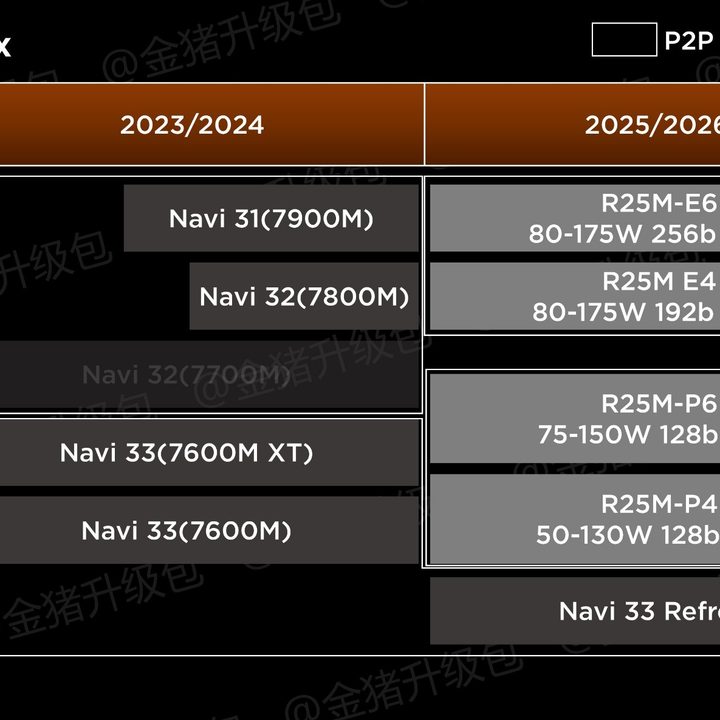
The next GPU in the stack is the R25M-P6, and it sports a total board power (TBP) of 80W to 175W, as well as 12GB of VRAM across a 192-bit memory bus. Then, we’ve got the lower-end cards, the R25M-P6 and the R25M-P4, equipped with 8GB VRAM, a 128-bit bus, and TBPs in the 75W to 150W and 50W to 130W range.
It’s hard to say how reliable this information is at this point. This leaker is fairly reputable, but AMD’s RDNA 4 is still a couple of months away at best, so everything is subject to change. AMD may also not announce its laptop graphics cards right away; the company’s CEO, Lisa Su, only confirmed that RDNA 4 is on track to launch in early 2025, so it’s a guessing game right now. The leaked slide also pins the GPUs for a 2025/2026 release, so it could be a while before they’re actually available to buy.
We might actually see the Radeon 8000 branding appear in the Strix Halo APU before we ever see it in laptops. According to Wccftech, the RDNA 3.5 graphics that will appear in AMD’s next-gen Ryzen AI 300 Max APUs will use a similar naming scheme to its discrete GPUs. The integrated GPUs are said to sport anywhere from 16 to 40 compute units (CUs), making them capable of rivaling some discrete graphics cards.
Reportedly referred to as Radeon 8060S and Radeon 8050S, the iGPUs may have a similar naming scheme to the discrete RX 8000 series — which could be a little misleading given that Strix Halo will run on RDNA 3.5 architecture as opposed to RDNA 4.
RDNA 3 was not very easy to find in laptops, but according to Golden Pig Upgrade Pack, AMD is still planning to launch a Navi 33 refresh for laptops in 2025 or 2026. As a result, at least five laptop GPUs are said to be on the horizon. Let’s hope they’ll be easier to come by in consumer laptops than their RDNA 3 counterparts have been.


