Every now and then, you look up in the sky and you might catch a message in the clouds. Usually it’s an advertisement, or clouds shaped like animals, or some guy proposing to this girlfriend in a grand gesture. Certainly nothing in this scale of geeky. This past Wednesday, as part of the 2012 ZERO1 Biennial — a Silicon Valley contemporary art showcase — a team of skywriters were sent out over the Bay Area to transcribe the first 1,000 digits of the mathematical constant Pi. The resulting script ran approximately 100 miles roundtrip, from San Jose to San Francisco and back.
To make this “Pi In The Sky” art installation possible, a team of five synchronized skywriters were sent into the air using “dot-matrix technology” to create numeric shapes resembling digits you’d find in on a retro phone screen. The project initially began on Kickstarter, but despite missing its funding goal, creator and artist known as ISHKY still made the show possible. Viewers in San Jose, Palo Alto, San Mateo, Oakland, San Francisco, and neighboring parts of the Bay Area were all urged to stop by their nearest view points at specified times of the day to catch a glimpse of the many digits of Pi.
“The conceptual work, Pi In The Sky, explores the boundaries of scale, public space, impermanence, and the relationship between Earth and the physical universe,” ISHKY writes. “Pi In The Sky has two unique interpretations: one within Earth’s atmosphere and one well beyond it… In outer space, miles above our atmosphere, a second interpretation of Pi In The Sky will include a constant string of pi emitted from a satellite.”
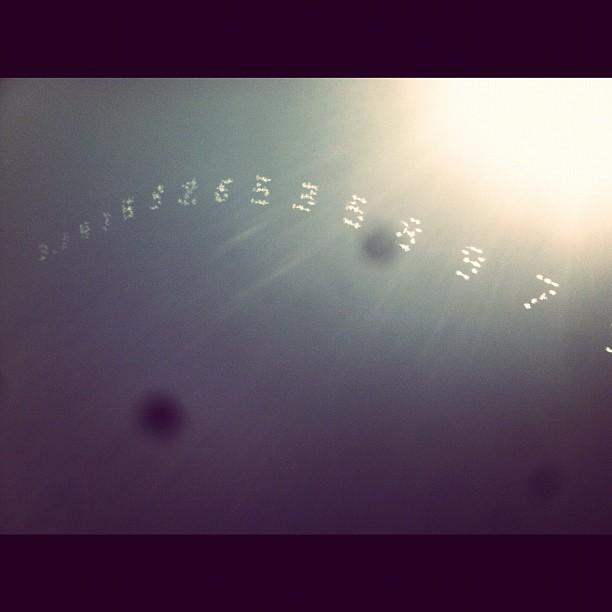 Unfortunately, since the project spanned so many miles, by the time the skywriters reached the next city, the first few digits of Pi had already vanished into thin air. This was to be expected, of course, since the installation lasted two hours.
To refresh your high school math memory, Pi is often shortened as 3.14 and is the numerical value for the ratio of the circumference of a circle to its diameter. If you’re way out of high school like the rest of us at Digital Trends, we usually celebrate Pi on March 14, an unofficial holiday for the math term where you geek out, watch Pi, and eat a bunch of delicious pies. ZERO1 and ISHKY might be six months late on the celebration, but we still think it’s a pretty neat art installation that made great use of the open California air.
Watch the video below to see some residents of Fremont ponder whether they’re looking at an international calling code for someone’s number, only to be confused by the digits just won’t end. Note: Some light NSFW language.
Instagram Image Credit: @becauseimsuperdiane