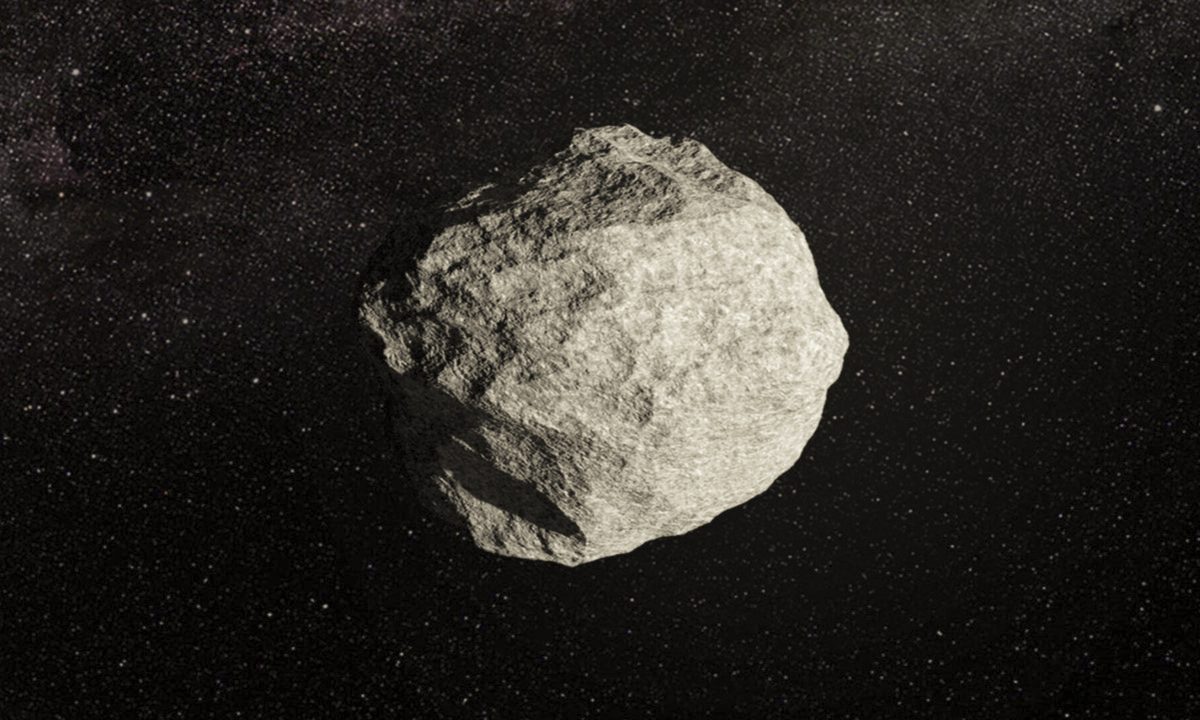
If you’ve been following the story of an asteroid that could hit Earth in 2032, there’s bad news and good news. The bad news is that the likelihood of the asteroid striking the Earth has now risen slightly, but the good news is that astronomers are using tools like the James Webb Space Telescope to track it in more detail.
The probability that Asteroid 2024 YR4 will impact Earth on December 22, 2032 has now risen to 2.3%, according to NASA. The asteroid is being observed by ground-bases telescopes that are part of the International Asteroid Warning Network, which will be following the it for as long as it continues to be visible — which should be through April this year. After that, it will be too faint to observe until 2028.
These observations are important for astronomers to accurately pin down the orbit of the asteroid, which will allow them to say with more certainty if the object threatens Earth. Because of the uncertainties involved in spotting an incoming asteroid, it is not uncommon for the probability of an Earth impact to drop to very low or no risk as more observations are made.
As alarming as a possibly incoming asteroid sounds, experts are clear that there’s no need to panic. “As more observations of the asteroid’s orbit are obtained, its impact probability will become better known,” NASA writes. “It is possible that asteroid 2024 YR4 will be ruled out as an impact hazard, as has happened with many other objects that have previously appeared on NASA’s asteroid risk list, maintained by NASA’s Center for Near-Earth Object Studies. It is also possible its impact probability will continue to rise.”
However, another factor to consider about this asteroid is its size. The first rough estimate put its size at between 40 and 90 meters long, but further observations have not helped to refine this number more precisely.
“It is very important that we improve our size estimate for 2024 YR4: the hazard represented by a 40 m asteroid is very different from that of a 90 m asteroid,” the European Space Agency (ESA) writes. That’s why the James Webb Space Telescope will be observing the asteroid using its infrared instruments.
“Webb is able to study the infrared light (heat) that 2024 YR4 emits, rather than the visible light it reflects. Infrared observations can offer a much better estimate of an asteroid’s size,” ESA explains, pointing to a recently published paper showing how Webb’s infrared capabilities can be used to measure asteroid sizes.
Webb’s MIRI and NIRCam instruments will observe the asteroid in early March, as that is the first time that the asteroid will be visible to the telescope, with another round of observations in May.
Normally observing time on a space telescope is booked up years in advance, but there is a small amount of observing time set aside each year for discoveries made which need critical observations right away. Planetary defense experts proposed using some of this “Director’s Discretionary Time” to observe the asteroid, including taking the final measurements of it until it returns closer to Earth in 2028.