
  1. Home
  2. Emerging Tech
  3. Legacy Archives

Muse brain-sensing headband invites you in for a little mind game

Add as a preferred source on Google
Image used with permission by copyright holder

In the future, we’ll all be doing brain exercises that stem beyond your average Sudoku puzzles or memorization games. At this year’s CES, exhibitors want to get inside your head, and Muse brain-sensing headband aims to do just that while providing a place where you can measure concentration levels to train those membranes.

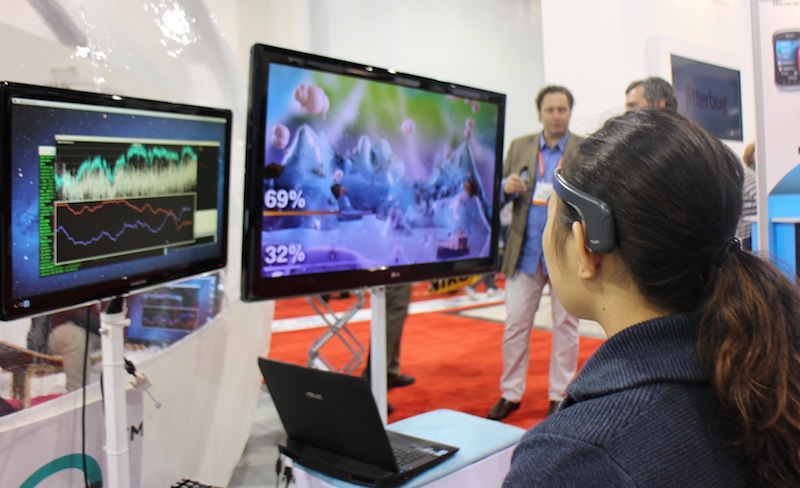
Unlike the simpler brain sensor headbands we’ve seen on the show floor this year, Muse’s gear features four EEG sensors and two ear conductors to get the most accurate read. The Bluetooth-transmitted data divides to two categories, Focus and Relaxation, and these levels are pretty self explanatory. When you’re sitting there and let your mind float to space, the blue relaxation percentage rises while the red focus level drops. Conversely, pay attention to what you’re looking at or who you’re talking to and the red lines jump up. We should also mention that the headband is extremely flexible and comfortable to wear, and after the first few seconds, you’ll barely even notice it’s there.
Recommended Videos

The sample game being demoed is a basic interface that required users to focus in order to move a moon over the sun to form an eclipse. For each successful attempt, you try to beat the pace from the last session to form patterns of how to relax and focus in a matter of seconds. Another game is audio-based; the more focused you are, the louder the music becomes. If you are relaxed, you”ll be treated with the calming sound of violin strings. The audio game seems significantly more difficult given how easily humans can get distracted by sound, and it’s certainly a novel take on how to help us learn to block white noise and cool down.

It’s a simple concept that aims to help people at home train their mental focus and help researchers learn more about how to diagnose and treat ADHD and stress-related patients. Theoretically, the more people learn to calm and concentrate their minds with frequent Muse exercises, the faster they are relived of anxiety, fear, and negative thoughts. Instead, users can become more productive, focused, and heighten their memory capacity. Because most of us can admit we’re perpetual procrastinators who easily forget what day of the week it is.

Muse originally began as an IndieGoGo project, and will complete its development this June, when the headband will be available for $200.

Natt Garun
An avid gadgets and Internet culture enthusiast, Natt Garun spends her days bringing you the funniest, coolest, and strangest…
Robot dogs were supposed to help humans. Now humans are being asked to babysit them
One startup offered $20 an hour to walk its robots, with some heavy lifting required when the dogs overheat
GO2 robot dog

San Francisco startup Dimensional advertised for people to walk robot dogs through city streets. The New York Times reported that the job could include carrying a roughly 33-pound robot back to the office if it overheated. A lift home is an awkward requirement for a labor-saving machine.

Keeping the hardware running is only one challenge. Anthropic's robotics tests found that language models mostly failed when controlling joints directly, but did better when directing trained controllers. Giving an AI agent a body doesn't teach it to handle ordinary household objects.

Read more
Forget smartwatches; this smart bed could soon help keep you safe from being a fall risk
Who needs another wearable when your mattress could help spot fall risks?
Bed

Soon, a mattress protector may be more than a bed cover. Australian medtech company Sleeptite and researchers at RMIT University have received a US patent for FlexiSense, a smart bedding technology that tracks body position and posture to help caregivers identify when older residents may be at risk of falling.

The technology is being developed for Sleeptite’s in-bed monitoring system, REMi, and was recently on display at The MedTech Conference in Boston. A peer-reviewed study in Flexible and Printed Electronics says the sensors can also be made at scale without sacrificing performance or durability.

Read more
Anthropic’s sensitive internal data was exposed, and AI helped make it happen
Even the company behind Claude isn't immune to AI-powered security threats, as researchers discovered some worrying vulnerabilities.
Claude Anthropic Featured

AI companies spend enormous amounts of time convincing us their technology is safe and secure. But what happens when those same companies become targets of increasingly sophisticated AI-powered attacks? Anthropic, the company behind Claude, is now facing that question. According to a Washington Post report, cybersecurity startup Cathedral discovered vulnerabilities that let its researchers access sensitive information in Anthropic's internal systems.

The researchers used AI agents to identify potential entry points in less than 12 hours. Interestingly, they didn't need to crack Claude itself. Instead, they exploited weaknesses in third-party business applications that Anthropic uses for everyday operations. Anthropic's security testing program disclosed the findings, which allows outside researchers to identify and report vulnerabilities.

Read more