
  1. Home
  2. Emerging Tech
  3. Web
  4. Legacy Archives

World’s first complete ‘bionic man’ goes on show in the UK

Add as a preferred source on Google

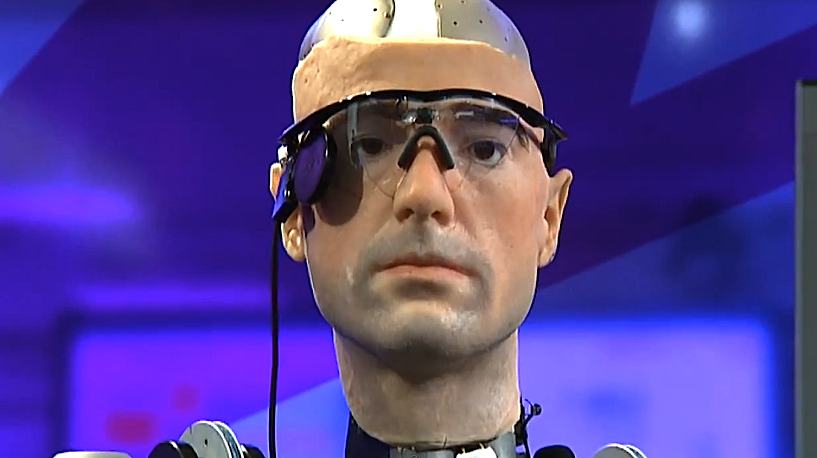
rex bionic manMeet Rex. According to his creators, he’s the world’s first bionic man, comprising artificial organs, synthetic blood, robotic limbs and a human face. And as if that’s not enough, he can speak and listen, too.

Unveiled at a special exhibition at London’s Science Museum this week, the artificial human was created for a Channel 4 documentary called How to Build a Bionic Man. The project cost £640k ($1m) and showcases the latest achievements and advancements in bionicbionic man rex technology and prosthetic science.

Recommended Videos

“Strictly speaking, he’s not a robot,” Channel 4’s science editor Tom Clarke says in a report (below) about the bionic creation. “His parts aren’t designed to work together, but each one either is, or soon could be, part of a living human being.”

Rex’s two-meter-tall ‘body’, built with currently available bionic and prosthetic technology, includes a prosthetic face, hands, hips, knees and feet as well as cochlear implants which enable him to hear and retinal implants that allow him to sense objects in front of him. Speech synthesis technology means Rex can make sense of simple statements and even respond to some questions.

Artificial blood pumps through his artificial organs, which include a heart, kidney and pancreas. He also has a spleen and trachea. The stomach is missing, but one imagines it won’t be too long before the science boffins fix him up with one of those, too.

“Throughout history people have always sought to enhance themselves to overcome disabilities or to become bigger, better, stronger and faster,” Clare Matterson of the Wellcome Trust, which is funding the exhibition, told Sky News.

“Science is making aspirations and even fantasy ever more possible. We only have to look back at last summer’s Paralympics to see how transforming technology has become.”

Rex is on display at the Science Museum as part of the How Much of You Can Be Rebuilt? exhibit, which runs until March 11. Entry is free.

Trevor Mogg
Contributing Editor
Not so many moons ago, Trevor moved from one tea-loving island nation that drives on the left (Britain) to another (Japan)…
Hyundai isn’t giving up on hydrogen cars, but don’t expect one in your driveway anytime soon
Hydrogen gets a maybe; hybrids get a warning.
Hyundai Ioniq 3 EV

Hydrogen cars have spent years in the same waiting room as flying taxis. They’re always almost here, but no commercially available product exists for interested buyers. So when a Hyundai manager pushed back on the obituary, I was immediately curious.

To be clear, Hyundai hasn’t announced a new car. The big news here is that its Australian arm says hydrogen is “not dead” for passenger cars. Apparently, the automaker is still evaluating a next-generation hydrogen fuel-cell car if it can find buyers (via CarExpert).

Read more
AI doesn’t have to turn evil to put you at risk 
emo-robot-that-can-lip-sync

An AI assistant that agrees with everything you say might feel like the perfect companion — until you need someone to tell you you’re wrong. That’s one of the more immediate dangers behind the idea of AI “going rogue.” A chatbot can cause harm without developing intentions of its own. It can reinforce a false belief, encourage an unhealthy attachment, or follow instructions planted by someone trying to hijack it.   

On October 15, AI safety company Alice announced new software to address those everyday risks. Working separately with Inflection AI and AI21, the company says it helped train NVIDIA’s Nemotron models to resist harmful conversational behavior and malicious instructions while preserving their usefulness.  

Read more
Elon Musk says Neuralink’s brain implants could help people with paralysis and blindness
Neuralink's Telepathy helps people control computers through thought, while Blindsight aims to restore visual perception.
elon-musk-neuralink-brain-implant

Elon Musk has revealed ambitious plans for Neuralink, and they go beyond controlling computers with your thoughts. The company is developing two brain implants, Telepathy and Blindsight, aimed at helping people with paralysis and severe vision loss. Musk also believes future advances could help people regain control of their hands and legs by reconnecting the brain with their limbs.

How Neuralink's Telepathy can help people with paralysis

Read more