

Some say the electric car will save the world, others say it will tie humanity to electrical sockets like a pack of caged animals. Either way, carmakers, the government, and consumers are giving the EV a try. That being the case, why not have a little fun with them?
Today’s practical midsize sedans and crossovers are shadowed by sports cars, sports sedans, hot hatchbacks, and other cars that emphasize speed and the joy of driving. Electric cars are slowly proving that they can be practical, but can they be fun to drive too?
 Fast EVs

Electric cars have only been available in large quantities for a few years, but there have already been a few attempts to make them sporty. Speed, after all, is a good way to counteract the EV’s reputation as a nerdy eco-car.
Nissan is known for injecting a bit of sportiness into nearly everything it makes, so it’s not surprising that the Japanese carmaker tried the same with its Leaf EV.
The 2011 Leaf Nismo RC definitely looks fast. If you want your performance car to be taken seriously, flaring out the body and adding a huge rear spoiler is a good way to start. However, under the racy bodywork, Nissan kept the stock Leaf’s 107 horsepower motor.
The Model S is seriously quick, but it also behaves better in corners. With only 53 percent of its weight over the rear axle, the five-door Tesla has been more to most road testers’ liking.
A car like the Nismo RC was obviously never going to go into production, and the Leaf Nismo people actually can buy isn’t as interesting. Changes for the production Leaf Nismo due out this summer are limited to 18-inch wheels and an aerodynamic body kit.
The Tesla Roadster was a much better attempt at a performance EV. Tesla Motors’ first car — and the world’s only production electric sports car to date — the Roadster was based on one of the best gasoline-powered sports cars around, the Lotus Elise.
It’s electric motor (with 288 horsepower and 295 pound-feet of torque in the final 2.5 Sport model) also made the Roadster quick: in a Motor Trend test, a 2010 Roadster 2.0 Sport hit 60 mph in 3.7 seconds, thanks to the motor’s literally instantaneous torque. Unlike internal combustion engines, electric motors produce all of their power from zero rpm, so there’s no need to wait for revs to build.
The Roadster wasn’t all good, though. Its top speed was electronically limited to 125 mph, and the software also prevented it from doing burnouts (admittedly, not the worst thing in the world). Things also got a little less nice when the driver turned the steering wheel.
When being wired isn’t a good thing

Like many performance hybrids, the Tesla Roadster suffered from the unholy trinity of low rolling resistance tires, regenerative brakes, and electric power steering. They numbed the feedback from the road, making the Roadster less than satisfying in the bends.
Adding to the problem was the way the Roadster’s battery pack upset weight distribution. With 65 percent of its weight over the rear axle, it behaved like an early Porsche 911.
The Model S appears to be a competent electric sports sedan, but why stop there? What would it take to build a pure performance EV?
Luckily, it’s not impossible to overcome this problem. For its clean sheet Model S, Tesla mounted the batteries in the floor, (it’s only four inches thick) lowering the center of gravity and distributing the weight more evenly.
The Model S is seriously quick, but it also behaves better in corners. With only 53 percent of its weight over the rear axle, the five-door Tesla has been more to most road testers’ liking.
The Model S’ regenerative brakes are also controlled by the accelerator, not the brake pedal; lifting off activates regeneration. As counterintuitive as that may seem, it actually helps the brakes feel less jarring because the driver isn’t using two systems (one hydraulic, one electric) when he or she brakes.
Electric Utopia?
The Model S appears to be a competent electric sports sedan, but why stop there? What would it take to build a pure performance EV?
Sometimes it takes more money than the average buyers is able to spend in order to bring a new technology to the world of fast driving. That seems to be the case with hybrid performance cars, and it may be why a couple of carmakers have tried to produce electric supercars.
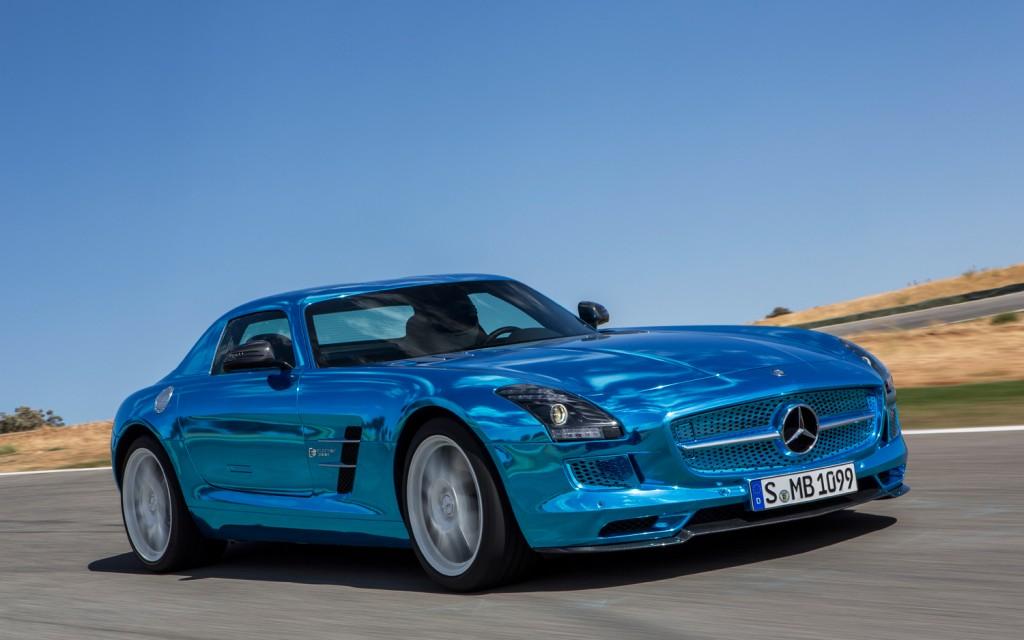
At the 2012 Paris Motor Show, Mercedes-Benz unleashed the SLS AMG Electric Drive, a battery-powered version of its gull-winged sports car. A massive 60-kWh lithium-ion battery pack connected to four electric motors (one for each wheel), which produce a combined 740 hp and 738 lb-ft.
Considering that a stock SLS AMG GT only has 583 hp and 489 lb-ft, it seems like Mercedes might be on to something. The bearers of the three-pointed star say the Electric Drive will do 0 to 62 mph (0 to 100 kph) in 3.9 seconds, and its top speed is electronically limited to 155 mph.
However, that huge battery pack takes three hours to charge with a 22-kW quick charger, and 20 hours with a standard household outlet. The car it’s attached to also costs over $500,000, almost 2.5 times the cost of a regular SLS.

That might explain why Audi decided to axe its own electric supercar, the R8 e-tron, even after it set a world lap record for electric cars at the Nürburgring. It had two electric motors producing a combined 376 hp and 605 lb-ft.
It’s possible to go even faster. Toyota sent a prototype around the ‘Ring in 7:22, handily beating the Audi’s 8:09. “Fast electric car” is not an oxymoron.
The question is: Are these types of cars feasible? With so many amazing sports cars on the market already, it’s hard to imagine many people paying a big premium, and subjecting themselves to “range anxiety,” just to go fast on volts.
While it’s hard to divine the future of electric performance from the handful of cars we’ve seen so far, they do seem to be following a familiar pattern. Like regular electric cars, the technological challenges of performance EVs don’t seem insurmountable, but they will need to get cheaper and more practical to gain mass acceptance.


