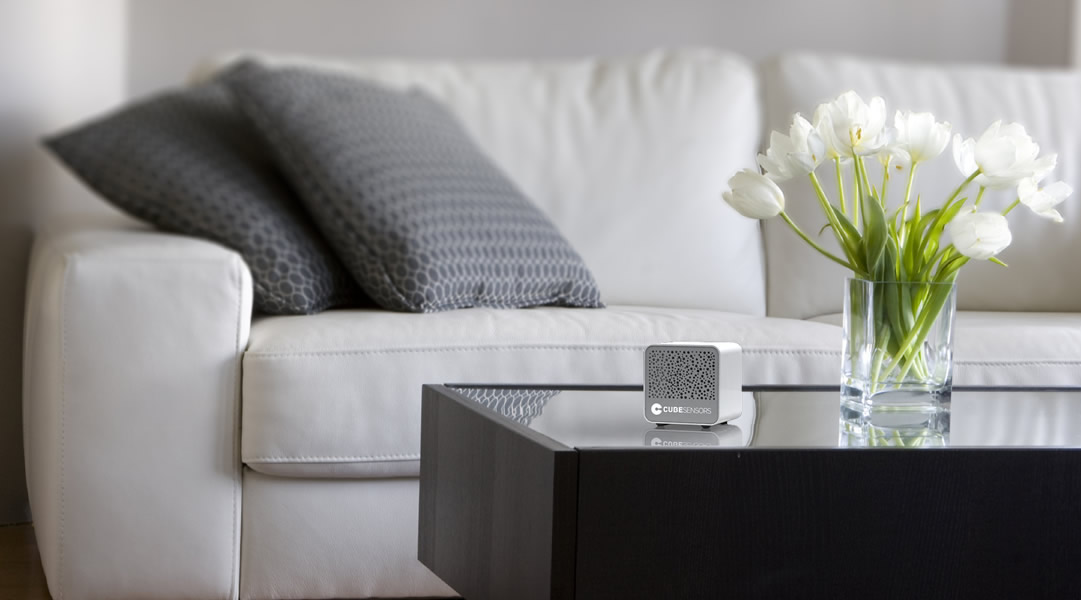
Covered in extensive detail on the project page, CubeSensors are small two-inch cubes that contain a variety of sensors in order to help consumers monitor their indoor environment. Powered by an internal, rechargeable battery, the CubeSensors contain a thermometer, a barometer, a light meter, a sound meter for noise detection, moisture sensors to detect changes in humidity, an accelerometer for vibration detection and an organic compounds sensor to measure indoor air pollution levels. Information gathered by the sensors is constantly streamed through a base station over Wi-Fi and can be viewed within a mobile iOS application on a iPod, iPhone or iPad.
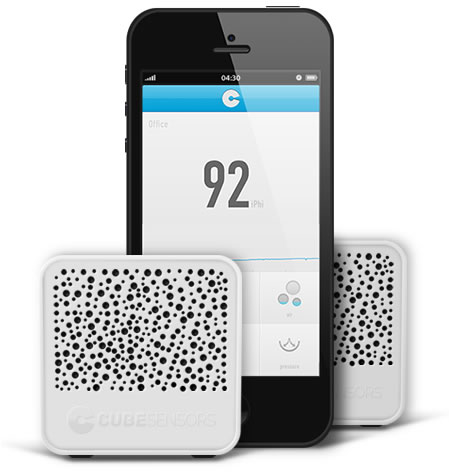 Each CubeSensor is designed to monitor a single room in the household, but multiple CubeSensors can be placed around a home in order to feed all that data into a single dashboard. When accessing the dashboard, the user will find suggestions on how to improve the living environment.
For instance, the software may recommend opening a window in a particular room or shutting off the air conditioner in order to improve the air quality. The dashboard also includes a history of the environmental conditions within the room as well as an analysis on how changes made to the room have positively or negatively altered conditions over time.
In addition, the mobile application can alert the user when living conditions deteriorate in a specific room. This feature could be particularly helpful to parents with children that have severe allergies triggered by problematic air quality. The CubeSensors could also be useful in the work environment in order to keep employees alert in meetings and focused at their desk.
For example, if the CubeSensors showed significant levels on the sound meter at a specific location within an office, this could be a trigger for management to visit that section of the office in order to help keep employees on task. Data collected by the cubes can be displayed publicly or set to private in order to limit the number of people with access. In addition to the alerts system, the user can create custom alarms that trigger when specific positive or negative conditions within a room have been met.

On a single charge, the battery within a CubeSensor will continue to monitor the environment and stream data for approximately two months. When the CubeSensor alerts the user to low battery power, the device can be plugged into a charger via the micro USB cable as well as a computer or the ZigBee-enabled base station. As mentioned previously, the base station acts as a bridge between the CubeSensors and the wireless network in a home or office.
Rather than utilizing a funding site like Kickstarter or Indiegogo to launch the project, the team that’s building the CubeSensors has setup a preorder process that’s very similar to the team that developed Lockitron. Requiring an initial $10 payment up front to reserve a preorder, interested consumers can order a two-pack of the CubeSensors for $249 or a four-pack for $349. Both packs come with the base station and additional cubes will be sold for $99 each. According to the project page, the team is targeting a shipping window of Summer 2013 for customers that preorder one of the bundles.