  1. Home
  2. Mobile
  3. Android
  4. Legacy Archives

Who’s that actor? Google Play movies can now tell you who’s on screen

Add as a preferred source on Google
jack-black
Image used with permission by copyright holder

We’ve all been there: sitting around with a couple of friends, watching a movie, and an actor comes onto the screen, and you just know, without a shadow of a doubt, that you have seen this actor before. But you can’t figure out where, and you certainly can’t remember their real name. You raise the question to the rest of the group, and whether it’s because you asking gave them a mental block, or they just don’t know, you sit there trying to figure it out until someone finally pulls up IMDB and digs through the cast list.

Sure, looking it up on IMDB may not be the most taxing of tasks, but how much better would it be if all you had to do was hit pause? According to Google’s official Android blog, the Google Play store will soon have such functionality.

Recommended Videos

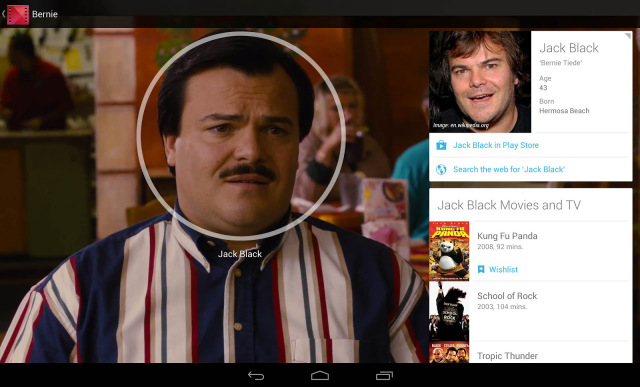
The feature, which (for now) will only be made available on Android tablets, takes advantage of the company’s Knowledge Graph. While the software traditionally grabs information from metadata, this new feature will actually utilize facial recognition technology to figure out who each actor is. (Think: when you drop a photo into Google search and it pulls up all images in its database with a likeness, including people.)

Once you pause, all you have to do is tap on a person’s face; a circle will be drawn around it (so you know you’ve tapped the right person, if you happened to pause on a crowded scene), and on the right, two tiles will appear. The top will be a headshot of the actor, with some basic information (name, age, place of birth). The bottom will be a list of the actor’s filmography.

For its launch, the app will only work in the U.S. on devices running Android 4.0 and higher, and work with hundreds of movies. It promises to add more every day, and to eventually branch out to other countries and devices.

Joshua Pramis
Spending a childhood engrossed in such technologically inspiring television shows like Voltron, Small Wonder, and Power…
Snapchat Planets Meaning: Order, Rankings, and How Friend Solar System Works
Snapchat Planets turns your best friends list into a solar system, and yes, your orbit says a lot
Snapchat Planets being shown on the Snapchat app on iPhone.

Snapchat+ includes several exclusive features, but few have generated as much curiosity as Snapchat Planets. Part of the app's Friend Solar System, it transforms your Best Friends list into a planetary ranking, assigning each of your top eight friends a planet based on how often you interact.

From Mercury, which represents your closest friend, to Neptune, which represents your eighth closest, the system offers a quick visual snapshot of your interactions. But what do the different planets actually mean, and how does Snapchat decide who gets which one?

Read more
How to use WhatsApp Web
We'll show you how to use WhatsApp on your desktop or laptop
WhatsApp Web

As one of the most popular messaging services, you’ve already heard of WhatsApp. From its humble beginnings in 2009—two years before Apple introduced iMessage—to its acquisition by Facebook (now Meta) in 2014, WhatsApp has become the dominant messaging platform around the globe.

In recent years, it's grown even more potent with new features like video messages, self-destructing voice messages, the ability to edit sent messages, and more. We even finally got an WhatsApp iPad app in May 2025.

Read more
What is WhatsApp? How to use the app, tips, tricks, and more
From setting it up to mastering hidden features, here is your complete guide to WhatsApp.
WhatsApp app store listing open on iPhone

There's no shortage of messaging apps out there. The past decade has given us more options than we know what to do with, largely because smartphones demanded something better than plain old SMS.

Both the App Store and the Play Store are packed with apps that promise to revolutionize the way we communicate. Most of them didn't make it. The truth is, a messaging app is only as good as the number of people using it, and most apps never cross that threshold.

Read more