Congratulations, world: You’ve successfully managed to avoid – or at least ignore – ads on your mobile device to a degree where advertising companies have to invent a new ways to bring some eyeballs back to the products they’re trying to sell. Of course, there’s a downside to this victory: In the future, you won’t just have to look elsewhere to avoid the ads of tomorrow – you’ll have to turn the sound off your device, as well.
According to a report on AdWeek earlier this week, Nuance – a Burlington, MA software company – has come up with a novel new solution of how to convince potential customers to pay attention to their advertisements: Talk to them. And, yes, they mean that literally: They have created technology that will allow people to hold (admittedly limited) conversations with advertisements before the ads go in for the hard sell.
Discussing the need for this new approach, Nuance’s chief marketing officer Peter Mahoney said that, historically, “mobile advertising hasn’t worked well” because “engagement has been a challenge, and we think that’s where voice ads come in.” On the Nuance site, the company goes into more detail about its new idea. “Mobile devices are with us all the time, but there’s a specific time and place for rich media ad experiences,” the company explains. “Nuance Voice Ads solve that problem by changing the dynamic of the ad itself. Instead of trying to push information onto a limited screen, advertisers are now free to let the user pull information onto the screen using their voice.”
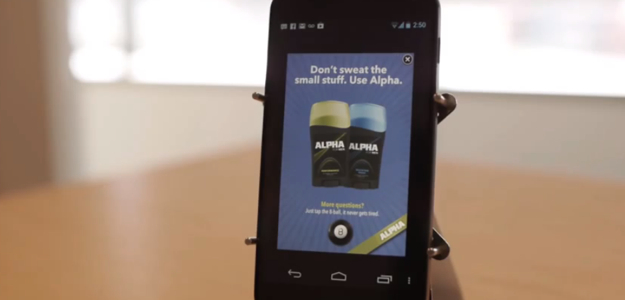
There’s even a proof of concept video to demonstrate how the voice ads would work. In the video, Nuance VP of advertising Mike McSherry has a conversation with a fake ad for a fake brand, Alpha deodorant, in which he asks a virtual eightball whether or not he should “buy that ring.” The conversation is short, and hardly complex – You get the idea that it’s so identikit that it would’ve had similar responses no matter what McSherry said. Still, there’s definitely an Siri-esque novelty appeal that most ads don’t have.
Telling potential advertisers that “it’s time to rethink engagement with consumers in the context of today’s technology,” Nuance points out with Mad Men Don Draper-style flair that “for decades, the industry has talked about listening to consumers, and giving brands a voice. With Nuance Voice Ads, these are no longer metaphors.” The question is, once the novelty of a talking ad wears off, are customers going to be so involved with this new format to make it worth the time and effort for companies to produce?