
 Science fiction is pretty darn good at predicting the tech of our future. We’ve gotten used to carrying around objects that are, for all intents and purposes, identical to what the crew of the Enterprise used in Star Trek: The Next Generation just 25 years ago. Additionally, the advent of Siri and other voice activated assistants in our phones meant that we can use our phones without touching them beyond an initial button press. Now comes another technological advancement that seems as if it should only exist in pulp fictions: The tablet that you can control with your mind.
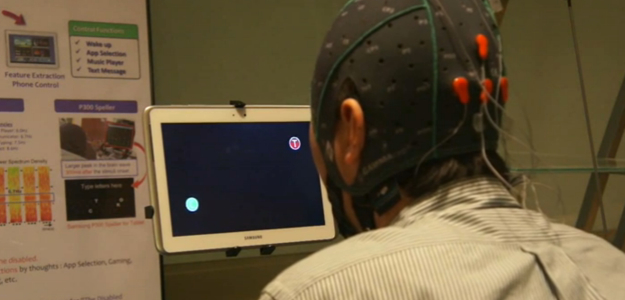
There are already prototypes of this uncanny device in existence, as the result of research carried out by Samsung. The modified Galaxy tablets are able to launch applications based upon the user simply concentrating on a blinking icon – and, even more impressively, it’s technology that appears to actually work.
Samsung lead researcher Insoo Kim explained that thought control was merely the next step in an increasing move away from traditional – that is, tactile – control of such devices. “Several years ago, a small keypad was the only input modality to control the phone, but nowadays the user can use voice, touch, gesture and eye movement to control and interact with mobile devices,” he told MIT Technology, noting that “adding more input modalities will provide us with more convenient and richer ways of interacting with mobile devices.”
The system doesn’t require the user to have X-Men-style super powers; instead, the user wears a specially-created headcap covered in EEG-monitoring electrodes that measure the brain’s activity during usage. The current incarnation of the caps will have to be streamlined before the system is available for home use, as it uses “wet contact electrodes” – which require the user to apply liquid to their head before wearing – in order to work.
In tests, the system has allowed users to activate different applications on the modified Galaxies, including a music application that allows them to select, play, and pause specific tracks. According to Kim, during the tests, users were able to make one selection every five seconds with an accuracy rate of 80 to 95 percent – something that becomes even more impressive when you remember that they’re making these selections just by thinking really hard about it.
The plan is, unsurprisingly, to look into uses this system could have for those with physical disabilities or mobility issues. Even with the system ways away from being widely available, it’s nonetheless still staggering to think about the potential implications in what such technology could mean for people in the future… especially the germaphobes or perpetually lazy.


