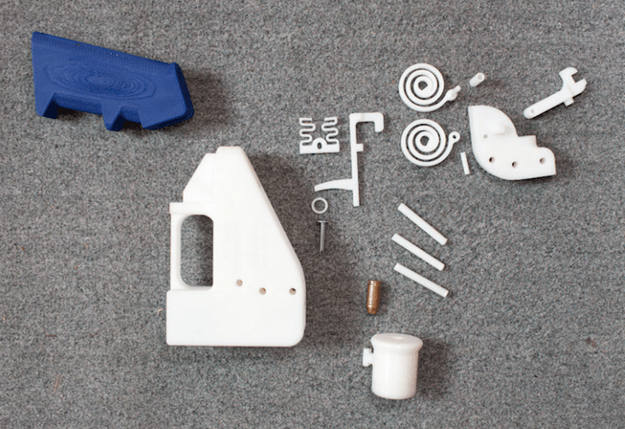
 Over the weekend, Forbes was on the scene as the first handgun constructed entirely from plastic 3D-printed parts was fired. Prior to this event, skeptics claimed that such an act was impossible, arguing that a firearm made with plastic parts simply couldn’t withstand the heat and pressure associated with firing a bullet. And yet, here we are with footage on YouTube for everyone to see, and schematics online for anyone to print.
Not surprisingly, this has ruffled some feathers up on Capitol Hill. It’s not that lawmakers are suddenly worried that 3D printers are the spark that will ignite World War III – 3D printed guns have been in the news before without much of a response from Washington. What’s troubling about this particular gun is that, unlike all previous 3D-printed guns we’ve seen, this one (called the Liberator) is made almost entirely from plastic parts, rendering it invisible to metal detectors.
Technically, this is a violation of federal law under the Undetectable Firearms Act of 1988, but as a second-year law student at University of Texas at Austin, designer Cody Wilson was well aware of this, and made sure to retrofit the pistol with a 6-ounce chunk of steel to make it legal. It was a quick fix, but there are a few senators in Washington that are concerned not everyone will take the extra step, and are currently pushing new legislation to make Wilson’s design illegal. On Sunday, Sen. Chuck Schumer (D-N.Y.), endorsed a bill entitled the Undetectable Firearms Modernization Act, that would bring the 1988 law up to date by banning 3-D-printed guns that “have no metal and could therefore slip through a metal detector.”
 This isn’t the first time Wilson has come up against opposition for his project. Initially, he attempted to raise funds for his “Wiki Weapon” project on the popular crowdfunding site IndieGoGo, but the site suspended his campaign just three weeks in, citing a terms of service violation as the reason. But that didn’t stop Wilson. After being denied access to the funds he had already raised, he began accepting donations on his website, DefenseDistributed.com, via PayPal and BitCoin, and eventually reached his goal of $20,000 in September of 2012.
With all the necessary funds to embark on his project, Wilson purchased a Stratsys uPrint SE – a high-end 3D printer – and got to work on a prototype. Everything seemed to be on track, but when Stratsys caught wind of what Wilson was doing with the printer and realized that he wasn’t a licensed firearms manufacturer, they immediately took action to repossess the machine. In a statement to the press, Stratsys explained that it was not willing to allow its hardware to be used for a project that violated federal firearms laws.
So, rather than risking the possibility of being arrested, Wilson decided to jump through all the necessary hoops to avoid any legal repercussions by obtaining a firearm manufacturer’s license and incorporating Defense Distributed into a company. A few months later, and with a new printer at his disposal, Wilson’s idea has finally materialized – but more legal struggles undoubtedly lie ahead of him.
We can’t predict the outcome of Senator Schumer’s proposed legislation, but regardless of what happens on Capitol Hill, Wilson still has problems with Google to worry about. The name “The Liberator” was intended to pay homage to the mass-produced pistols that were air-dropped by the Allies into France during its Nazi occupation in World War II, but that’s not the liberator that’s popular on search engines. If you search for “the Liberator” online, Wilson’s 3D printed pistol ranks second on Google – just below the popular sex pillow of same name, which seems to suggest “make love, not war” by some sort of divine serendipity.