There’s a saying that you hear around Hollywood anytime something unexpected happens: “Nobody knows anything.” Very Los Angeles, I know. But it’s also ironically astute.
As more people start to watch shows and movies on their computers rather than in theaters or on TV, the corresponding new ways Hollywood is developing and producing that content are starting to prove that very LA statement true. Which is maybe why some old guys think that the studios are dying.
Amazon Studios gives the little guy an opportunity. And you’d have to be some kind of monster not to hope it’s ultimately successful…
Netflix obviously comes to mind as one company that’s trying to do it on its own, but I’m not sure you can say that its model gives opportunity to fresh faces. Arrested Development is a well-known property, and House of Cards is an adaptation of a British show that stars Kevin Spacey, hardly a newcomer to the entertainment industry. Netflix’s model seems to take chances on content that conventional networks find too risky, too specific, too… I don’t know, good?
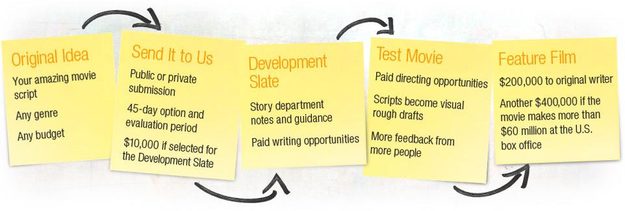
But Amazon Studios, unlike its competitors, seems intent on developing content directly from its online community, offering open submissions to anyone with a script and a dream. By uploading, you give Amazon exclusive rights to option your story for 45 days. After, you can yank it from the site or leave it up and cross your fingers. This democratized access to creative types is not unlike what Amazon already offers to authors through its Independent Publishing arm, which allows anyone to self-publish on the Kindle or even traditional paperbacks.
Amazon Studios encourages script feedback from everyone in its community, even engaging in a game of “Premise War,” where titles and loglines are matched mano y mano and chosen with all the focus and discernment of “Hot or Not.”
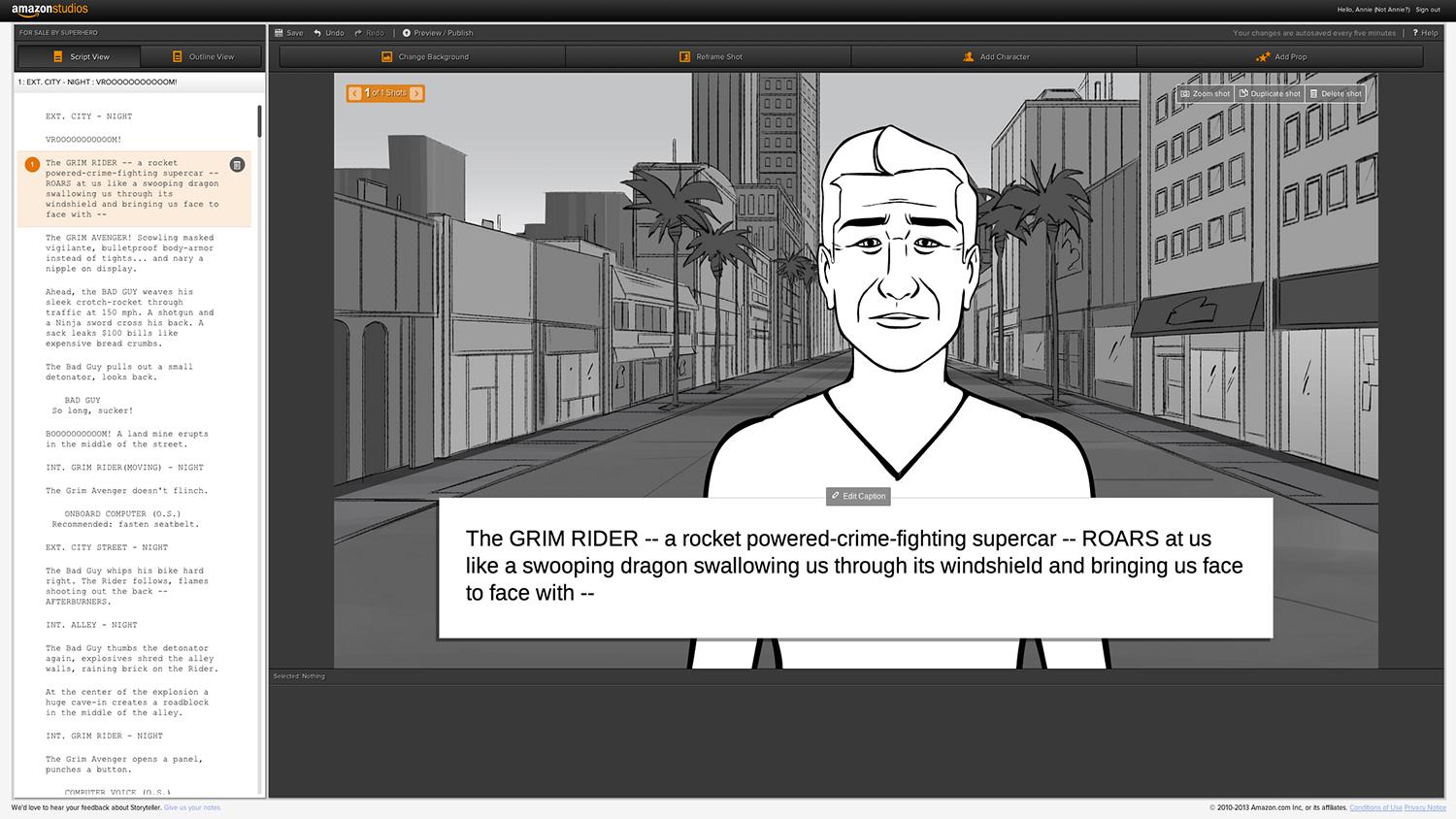
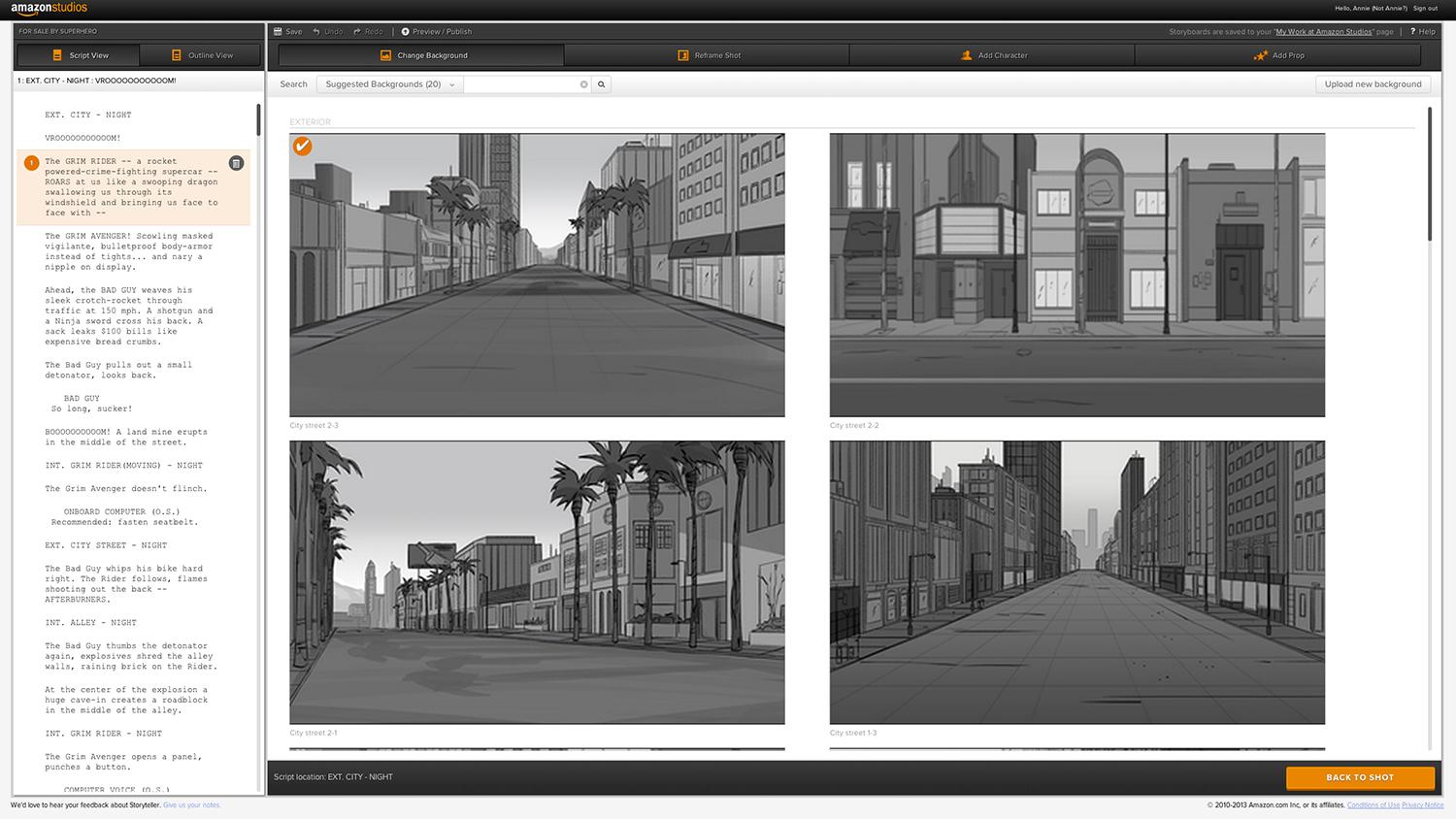
In the spirit of giving access to the “little guy,” the studio has now launched a beta version of Amazon Storyteller, a tool that allows writers to turn their scripts into storyboards. It pulls from a library of characters, props, settings, etc. and matches items from the library to the writer’s script. Putting the boards together is definitely a tedious process, but then again, so is doing it the old-fashioned way. That’s why storyboard artists get paid.
But I have to admit, the end product isn’t bad. It’s just … well, a little pointless. Not pointless; useless is the better word for it. These storyboards will never be used for what storyboards are used for. They’re typically tools for directors, not writers.
In exchange for the free tool it offers, Amazon gets both more scripts and more feedback on them. Amazon Storyteller brings new writers into the fold, because it’s a tool – useless or not – that they usually don’t have access to. So they’re more willing to dust off that seven-year-old script to utilize it. After they do, more users will interact with it, because they’re more likely to scroll through a picture book of various projects than to read the full scripts (sadly). That spurs more discussion, which can help Amazon spot which ideas deserve a closer look.
But this is also a reminder that making a film is now a more individual and less collaborative process than ever. And that’s both good and bad. The good is the access that new technology provides. And that allows us to find new voices. The bad is that access doesn’t necessarily mean an upgrade in quality.
The truth is that most aspiring filmmakers are aspiring for a reason. Watch Project Greenlight. Their stuff is not (yet) good enough. If you have a band and you’re unsigned, chances are you suck. As grueling and as unfair as the process is to get your film, your script, your demo seen by the right people, that process also has some worth. You get better the more you do it, and critical feedback is… well, critical.
As much value as there is to a fellow user in the Amazon Studios online community giving you feedback on your script, it pales in comparison to the response from someone at a studio who gives notes for a living. And not just because they get paid to do it. It’s because they see thousands of scripts and they’ve seen what works and what doesn’t. There’s a reason that Amazon Studios has a development deal at Warner Bros.
So if you’re a writer, why participate? Why subject your material to Amazon’s version of Screenplay Thunderdome if the value of the feedback and the storyboard tool are both questionable? (Many scripts enter, one script leaves!) Well, because Amazon’s giving real money away. At least it claims it is: $200,000 for a feature screenplay and $55,000 for a pilot TV script, to be exact. If your script is the next Fast & Furious 6, then obviously $200,000 isn’t that great of a deal. But let’s be honest: If you’re submitting material over the Internet, you’re at the point in your career where it’s more about getting your foot in the proverbial door than a payday. American Idol contestant contracts are notoriously crappy, but I don’t think you’d hear Kelly Clarkson complain. She’s too busy wiping her ass with gazillion dollar bills now. Besides, $200,000 and $55,000 are well above Writer’s Guild of America minimum. We should all be so lucky.
Amazon’s trying to find a diamond in the rough, but diamonds don’t just appear. It takes years of pressure make that shit shiny. And how much rough is worth digging through? I guess we’ll know that once we get to view their first production. But if nothing else, Amazon Studios gives the little guy an opportunity. And you’d have to be some kind of monster (like a Deadline.com commenter) not to hope it’s ultimately successful.
Who knows? Maybe the next Jerry Seinfeld already has a little Internet show, just waiting to be discovered.