Nvidia doesn’t just make some of the best graphics cards, but it also absolutely dominates the entire GPU market. This is no news, but recent data from Jon Peddie Research shows just how vast the gap between AMD and Nvidia really is right now.
According to the report, AMD is losing GPU market share by the quarter. This is bad news for everyone except Nvidia. There are a few key reasons that I believe might have contributed to this data, though.
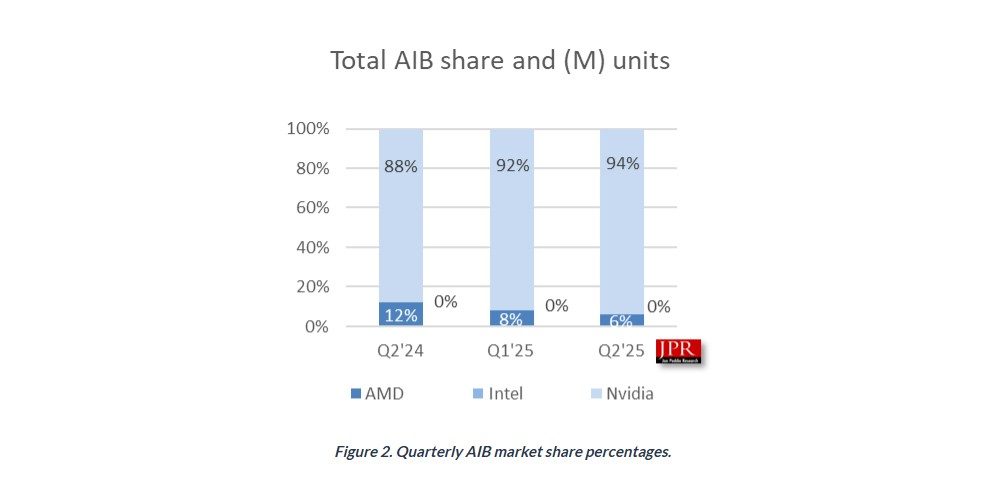
Nvidia’s GPU market share is staggering, and AMD is down year-over-year

Jon Peddie Research (JPR) regularly showcases the latest shipment data on graphics cards and processors. Before we dive in, keep in mind that shipments don’t equal sales, so this doesn’t mean that either company actually sold this many GPUs to consumers. A lot of them end up in prebuilt PCs or in stores. However, the data does suggest that GPUs have been flying off the shelves in record time, so I wouldn’t be surprised if sales figures were doing well, too.
Surprisingly, the market at large is on the rise. The global PC-based graphics add-in board market (which refers to discrete GPUs) achieved a massive 11.6 million shipments in the second quarter of 2025. Meanwhile, desktop CPU shipments rose to 21.7 million units. This makes sense — many CPUs offer integrated graphics, and those CPUs are used in both gaming desktops and office computers.
How do those shipments align with the split between Nvidia, AMD, and Intel? Well, suffice it to say that things aren’t looking good (unless you’re Nvidia).
AMD’s overall add-in board market share decreased by 2.1% from last quarter, and by a whopping 6% year-over-year. Intel’s share remains at 0%, which means that its market presence is essentially non-existent, even though the recent B580 was a superb GPU.
Dr. Jon Peddie, president of JPR, said: “AIB prices dropped for midrange and entry-level, while high-end AIB prices increased, and most retail suppliers ran out of stock. This is very unusual for the second quarter. We think it is a continuation of higher prices expected due to the tariffs and buyers trying to get ahead of that.”
The GPU attach rate increased in comparison to the previous quarter, too, now reaching 154% for a 2.3% increase. Meanwhile, the CPU market dropped by 4.4% year-to-year, but it also noted a massive 21.6% quarter-to-quarter increase. AMD is bound to be doing better in the CPU segment, but JPR didn’t publish any recent data on that.
Why is AMD falling behind?
Shipment numbers may be less fluid than sales, and less indicative of the market situation as a whole. After all, these shipments take place long before a sale can even happen. However, it’s impossible to deny the fact that AMD’s GPU market influence has dropped by a lot over the past year.
I’m not a market analyst, but I’m a tech journalist with a decade of experience. I always keep tabs on the rivalry between Nvidia and AMD, and based on the current situation, I have a few insights as to why AMD might be falling behind.
Its lineup is smaller
AMD ships fewer GPUs than Nvidia by default — that much is clear, given the numbers. However, AMD also has a much smaller lineup this time around, which might translate to even fewer shipments.
AMD’s RDNA 4 generation only consists of four GPUs right now: the RX 9070 XT and non-XT, as well as the RX 9060 XT and non-XT. The latter isn’t really available on the DIY market, but that doesn’t matter, as it’d still show up in these shipment figures. However, by the end of the second quarter, the RX 9060 XT had just launched, so shipments may have been limited.
Meanwhile, Nvidia’s RTX 50-series was quicker to launch and expand. The lineup now consists of the RTX 5090, RTX 5080, RTX 5070 Ti, RTX 5070, RTX 5060 Ti (in two variants), RTX 5060, and the RTX 5050. Not all of them made it to market within the second quarter, but many of them did, which makes for a more robust lineup and more shipments as a result.
The RX 9070 XT had a difficult launch
In this generation, AMD chose to stick firmly to the midrange part of the market. While rumor has it that RDNA 5 might turn the tide, the current reality is that AMD’s flagship can only compete against Nvidia’s RTX 5080 on a good day, leaving the RTX 5090 entirely uncontested at the top of the GPU food chain.
This, on its own, shouldn’t be a problem. Most gamers play at 1080p and 1440p, so there’s a lot of demand for graphics cards like the RX 9070 XT — which is, by the way, an excellent GPU. AMD not aiming for the top isn’t an issue; the availability and the pricing are.
While the first batch of the RX 9070 XT and the RX 9070 non-XT were priced at $599 and $549 according to the MSRP, the cards haven’t been seen at those prices ever since. Although retailers caught up on stock levels, the cards are still sold at high prices, which makes them difficult to recommend.
Nvidia’s shipments are also likely to be inflated not just by the demand from gamers, but also — if not chiefly — the AI sector. The RTX 5090 is as much an AI GPU as it is a gaming beast, which allows Nvidia to tap into a different part of the market.
These issues, already present in the second quarter, might have affected the number of shipments.
Will AMD be able to win back some market share?

Nvidia has dwarfed AMD in GPU sales for many years, so the fact that AMD is playing catch-up is not unusual. However, seeing it lose 6% market share over the course of a year is alarming.
Will things get better? I hope so. AMD is said to be cooking up quite an interesting generation of GPUs with RDNA 5, and it may not have said the last word with RDNA 4 yet, either. If we could get more AMD cards on the shelves at reasonable prices, this might translate to an increase in shipments, too.
I always root for AMD, and I know that it can bounce back. These figures are not the end-all, be-all of GPU sales, and while that 94% figure for Nvidia is intimidating, AMD has a good product on its hands. It’s all about getting it out there where other people can benefit from it.
If you’re looking for an AMD graphics card, make sure to keep an eye on our GPU price tracker so that you can score a rare good deal.