1. Home
  2. Social Media
  3. Web
  4. Legacy Archives

Facebook is axing an old feature, meaning you once again need to review your privacy settings

Add as a preferred source on Google

For a widely used social network such as Facebook, it’s very easy to become the object of an online stalking session. The platform actually has a ton of information about you already and while your account can be amply safeguarded by being vigilant about your security settings, there still are Facebook functions that may be unknown even to the most attentive user. One such function is called, “Who can look up my timeline by name?” which is on its way out.

The removal of the setting – which is still currently being used by a “small percentage of people” – was announced last year, but the earlier change only affected those who didn’t have the function activated at all. According to the recent update, those who have it enabled will see a reminder about its complete removal in the next few weeks, and it looks something like this:
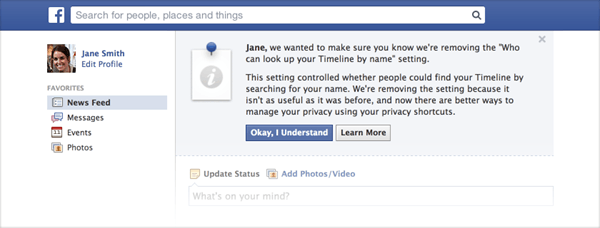
facebook who can look up your timeline
Image used with permission by copyright holder

The setting was created during a time when Facebook was a mere directory of people’s profiles. Now that it’s way easier to stalk and troll people by searching for them through Graph Search, there’s a need for a more pro-active way to protect your Facebook privacy – instead of using “Who can look up my timeline by name?” to stop people from having the ability to look you up, users can control who has access to your Timeline by limiting what your audience can see under the Privacy Settings and Tools tab. Facebook says the no-longer-needed setting is also being removed because users had difficulty finding people they already knew. Basically, it’s yet another signal that you cannot avoid the powers of Graph Search, especially not with one fell swoop asking to make your Timeline unsearchable – now, you more than ever need to review what you’re showing and with who. For instance, maybe everything on your profile is private except your check-ins and location are public; that means if someone searched for “People in Austin,” you could come up even though you thought your account was locked down. 

Recommended Videos

Additionally, if you have posts that are on public view, you will also get sent a notification reminding you that your posts can also be seen by people you don’t know and how you can change the audience for each post (If your post has an icon of a globe next to it, it means it’s public. You can change it by clicking on the icon and choosing one of the other remaining options. Friends only is often the safest choice.)
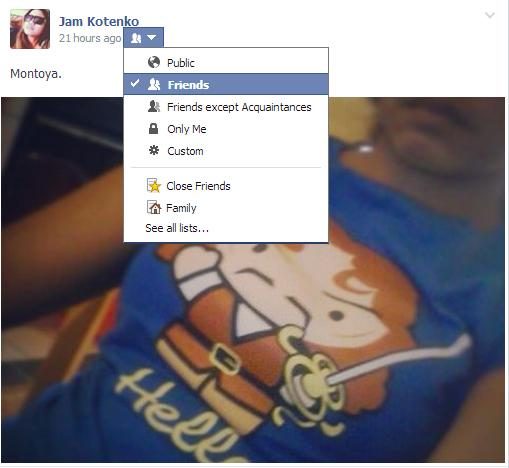

facebook limit post audience
Image used with permission by copyright holder
Jam Kotenko
When she's not busy watching movies and TV shows or traveling to new places, Jam is probably on Facebook. Or Twitter. Or…
As AI turbocharges digital abuse, UK agencies urge parents to limit who sees kids’ photos online
The National Crime Agency and Internet Watch Foundation are asking parents to tighten privacy settings as AI-generated abuse material rises.
Social Media

Parents who post pictures of their kids online are being told to rethink the habit. The UK's National Crime Agency and the Internet Watch Foundation have issued new guidance urging families to lock down their social media accounts, warning that publicly shared photos are increasingly being pulled and altered by AI tools to create child sexual abuse material.

The two organizations say most parents have no idea this is happening. Criminals no longer need to contact a child directly to generate such material. They can scrape an ordinary photo and run it through widely available nudify apps.

Read more
Google Maps could soon order food for you using Gemini
Your next takeaway order could start inside Google Maps
Google Maps

Google Maps has steadily evolved from a navigation app into an AI-powered discovery platform, thanks to Gemini integration and features like Ask Maps. Now, the app could be preparing to take the next step by letting users order food directly through conversational AI.

According to Android Authority's Authority Insights, the latest beta version of Google Maps for Android contains references to an unreleased feature that would allow users to ask Maps to place food orders on their behalf. While the functionality isn't live yet, newly discovered code strings suggest Google is actively developing the feature.

Read more
Most Americans want kids off social media before 16, new survey shows
A new Pew Research Center survey has found broad support for banning social media for kids under 16, with even stronger backing for age verification and parental consent rules.
Child using a blue phone

A majority of US adults now support banning social media for anyone under 16, according to a new Pew Research Center survey. The finding puts American public opinion roughly in line with countries that have already acted on the idea, including Australia, which has enforced a ban, and the UK, which is currently considering one.

Support holds steady across party lines and age groups

Read more