Well, now this is something I didn’t have on my bingo card for 2025. Nvidia, the company behind some of the best graphics cards, and Intel, known for some of the best processors built on the x86 architecture, are planning to combine their CPUs and GPUs to build something entirely new.
“Nothing of its kind has ever been built before for the x86 market,” said Jensen Huang, Nvidia CEO, during a press conference. But what does this mean for PC gaming? Here’s everything you need to know.
Nvidia and Intel just revealed an entirely unprecedented deal

Nvidia and Intel made a joint announcement about a collaboration that will result in “multiple generations of custom data center and PC products.”
That’s not all. Nvidia will be investing $5 billion in Intel’s common stock (at $23.28 per share) if everything goes according to plan, as the investment is subject to regulatory approvals. Reuters pegs that investment at ~4% stake after issuance.
What exactly will this epic deal involve? The two companies will develop entirely new products, connecting Intel’s x86 chips to Nvidia silicon via Nvidia’s proprietary NvLink technology. While Nvidia has already collaborated with MediaTek to create an AI PC, this venture would be something entirely separate, given the difference in architecture.
The deal with Intel is split into the data center and personal computing markets.
The two companies say that they’ll build x86 system-on-chips (SoCs) that combine Intel’s tech with Nvidia’s RTX GPU chiplets. These future SoCs will then end up in “a wide range of PCs that demand integration of world-class CPUs and GPUs,” says Nvidia.
The rest of it is light on detail. We know from the press conference (via Wccftech) that Jensen Huang and Lip-Bu Tan (Intel CEO) held together that Intel will still continue making its own discrete GPUs, so the likes of the Arc B580 can rest easy for now. But what exactly are the companies hoping to achieve together, other than further data center dominance?
What does this mean for PC gaming?
Although this news is majorly exciting for all kinds of different reasons, I am primarily a PC gamer, so I can’t help but wonder: what are we getting out of this massive deal?
The wording in the announcement is fairly ambiguous. It does sound like the companies are planning to launch new consumer products together, but they don’t exactly indicate what we can expect.
PC Gamer points out that Nvidia and Intel might be cooking up a different iteration of Nvidia’s GB10 “Superchip,” which is a joint effort produced with MediaTek and Arm. The hint here is that the GB10 chip also relies on the NvLink interface to connect the CPU and the GPU die, which is something Nvidia is planning to do here, too.
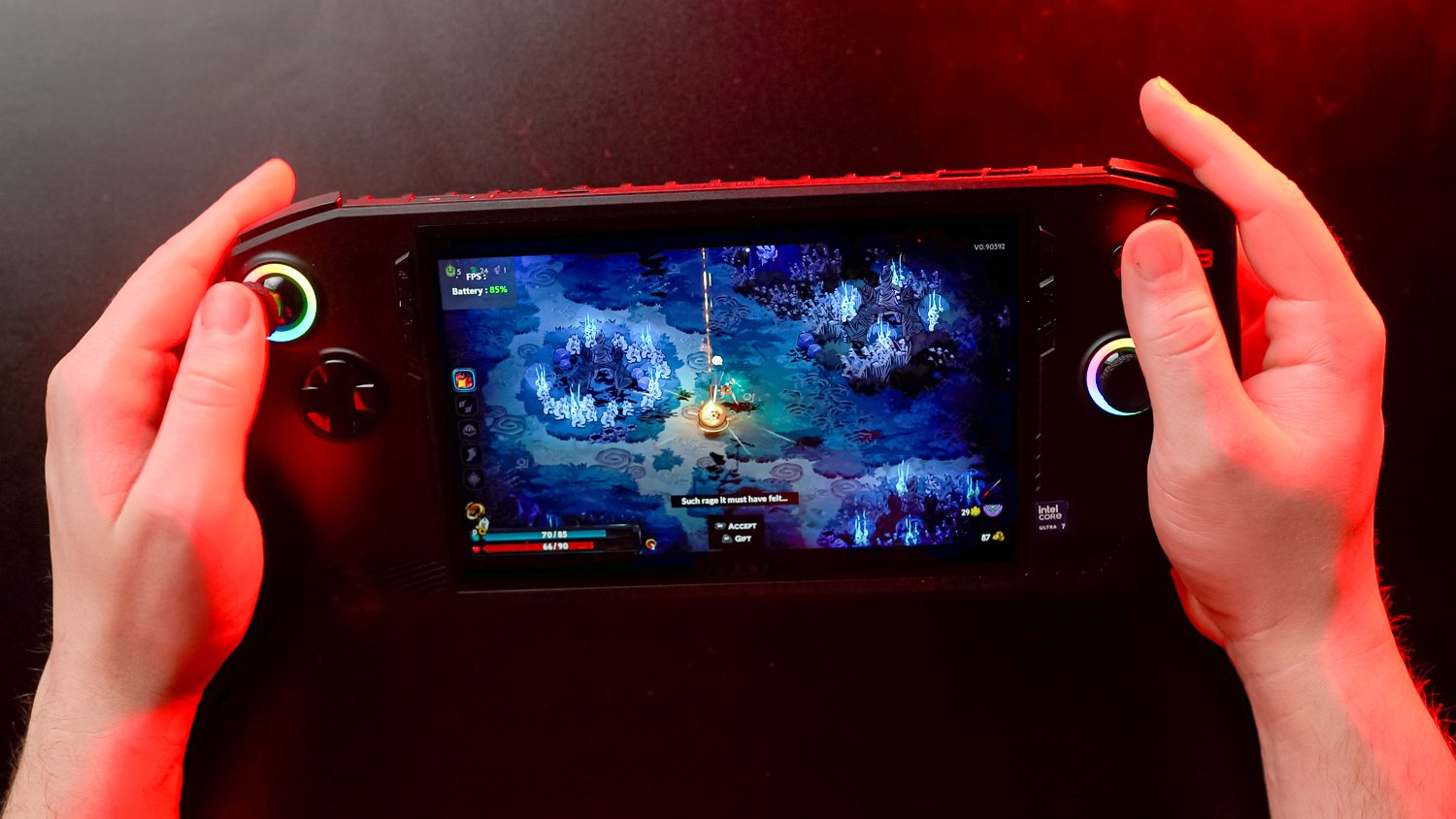
This type of chip would be of little interest to consumers, but there are other possibilities here that rely on that same technology. Intel and Nvidia could finally develop something that would be a threat to AMD, which dominates the gaming handheld segment.
AMD’s APUs, which combine a Radeon GPU with an AMD CPU in a single chip, are a similar concept with different execution. We don’t know yet what exactly will come of the collab between Nvidia and Intel, but it does sound similar: Both put the CPU and GPU together, reducing latency and offering better performance per watt. Keep in mind that this is speculation; we don’t know what Nvidia is doing.
However, Nvidia’s take on these SoCs could take it a step further. As Nvidia has specified that these Intel-based chips will feature an RTX GPU, we might be looking at much better graphics in a small form factor. This could be a fantastic solution for handhelds and thin-and-light laptops, bringing them into a whole new performance class.
Will any of this come true? I hope so, but neither company has said anything to that end yet. I’m merely speculating.
If the companies deliver on x86+RTX SoCs, you’re looking at far tighter CPU–GPU coupling than today’s PCIe laptops, potentially lifting frame times, battery life, and ray-tracing in thin machines, and putting real pressure on AMD’s APU play. But until we see memory topology, TGPs, and launch windows, keep expectations in the “promising, not proven” bucket.
Many questions remain, but this could lead to exciting things
Nvidia’s investment in Intel stocks is massive, and it’s a bold move. It kind of shows allegiance, in a way, and perhaps even draws a bigger line in the rivalry between AMD and Nvidia. But Intel’s gotten a lot of funding lately.
First, there’s the $8.9 billion in funding from the Trump administration. Intel also secured $2 billion from SoftBank. Now, Nvidia swoops in with this outstanding deal and an additional $5 billion.
This means exciting things, not just for PC gamers, but for the tech world as a whole. Intel’s had a rough couple of years, but this could set it back on the right track, where it can be competitive once again.
Will this potential success trickle down to the consumer market? Potentially. Hopefully. But it’s much too early to say, and any products that come out of this collaboration are more than likely still years away. As with anything else, it’s safe to expect that it’s mostly the data center and the AI segments that will see a boost; that’s where the big money lies.
But we now live in a world where there might be a whole new subset of products popping up in the near future, and that’s a real thrill. I can’t wait to see where Nvidia and Intel take this going forward.