
Check out our review of the Nokia Lumia 2520 tablet.
Nokia always knew it was going to have to get up pretty early in the morning to beat Apple at anything, so on Tuesday – in spite of the fact that it was hosting its last major product release as an independent mobile manufacturer – it got itself up a full nine hours before Apple pulled the bedsheets off its latest iPads. (Sure, you might say that was easy for a company in a GMT-positive place like Finland, but really … when was the last time anything was easy for a company going toe to toe with Apple?) So, Nokia cocked its mighty-ish Finnish fist, shut its eyes really tight and swung one last haymaker, which landed with a powerful crack right on the jaw of …
…it’s new parent company, Microsoft.
The Finns get up pretty early in the morning by our standards, but we wouldn’t side with them in a product fight.
Maybe this was a savvy move on Microsoft’s part to create the illusion of competition for Windows 8.1 RT, since Samsung, Acer, and just about everyone else have bailed on manufacturing for that software. Once its acquisition of Nokia is complete, Microsoft will have the luxury of tinkering with two floundering hardware brands instead of one.
Maybe Tuesday’s announcement was some subtle string-pulling by the soon-to-be-master to gin up excitement for a product not that many people were waiting for. But if that’s the case, Microsoft has a funny way of pulling strings, considering that Tuesday was the on-sale date for another product not that many people were waiting for: the Surface 2.
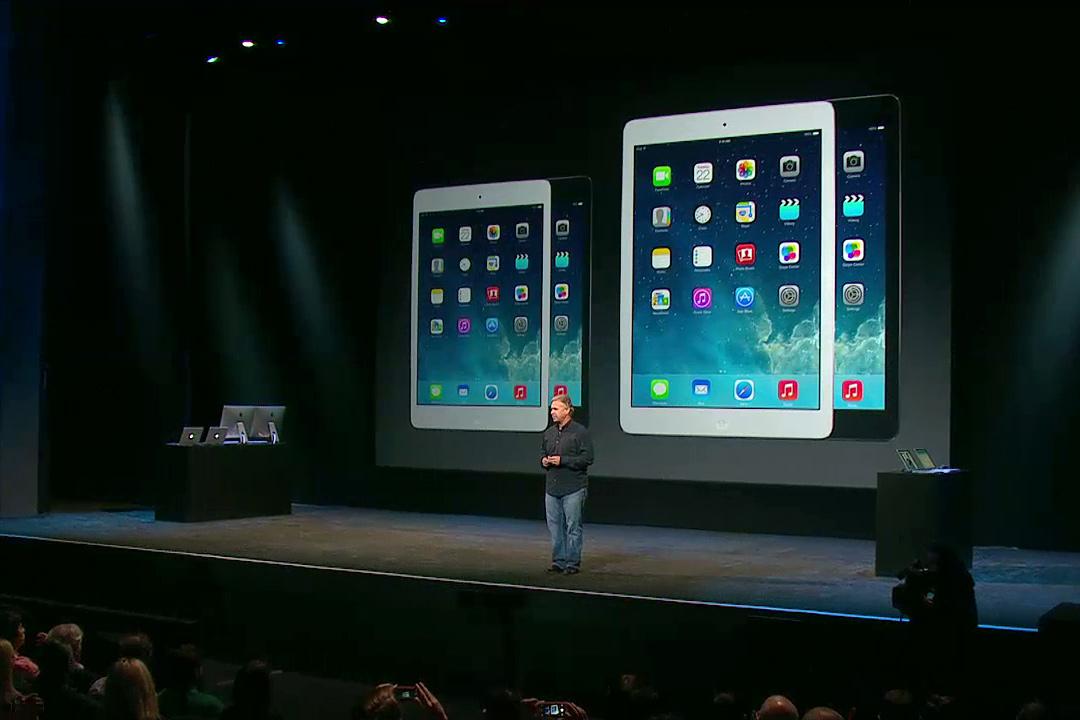 While Microsoft and Nokia divided and conquered what little oxygen remained in a news cycle waiting with baited breath for Apple’s announcement, the Cupertino Kids untucked their shirts, strode across the stage at San Francisco’s Yerba Buena Center for the Arts and unleashed another volley of mainstream consumer-pleasing devices and software. Because, who are we kidding here? If the Surface 2 and Lumia 2520 are going to create a market for Windows 8.1 RT tablets, they’re going to have to discover a pretty rich vein of untapped consumers. According to Apple’s numbers, it owns 81 percent of all tablet use, and almost everything it doesn’t own is split up between Android manufacturers like Samsung and Asus. It’s been out a year, but hardly anyone is rocking a Surface.
Tuesday’s iPad announcement was in line with what we’ve come to expect from Apple over the past two years: iterative more than innovative and game-maintaining more than game-changing. The new iPad Air is a pretty awesome-looking, but it’s the result of the company’s ever-improving manufacturing prowess (43-percent slimmer bezel! .4 pounds lighter!) and cross-product seeding (yes, a 64-bit A7 chip has equally impressive potential in an iPad as it does in an iPhone). The same goes for the new iPad Mini, which now boasts the 64-bit A7 chip and Retina screen as well.
The number of Windows 8.1 RT tablets available to consumers has doubled, but it’s unclear if it doubled by addition or division.
As the dust settles on a busy day, what have we learned? Sure, there are now two Windows 8.1 RT tablets on the market, but they’re both from Microsoft and already seem bent on stepping on each other to get to the top … of nowhere. The Surface 2, which we will get our grubby mitts on later this week, may or may not save Microsoft’s bacon, but the fact that you can buy one now was totally buried in an Apple-lanche of iPad announcements. And that Apple-lanche, while stubbornly unremarkable like the four or five that came before it, had enough upgrades to make the most popular tablet on the market look more popular still.
Oh, and the Finns get up pretty early in the morning by our standards, but we wouldn’t side with them in a product fight. Of course, that’s a lesson just about everyone learned even before Nokia ever entered The Great Tablet Wars (everyone, that is, except Microsoft).
Today: Lumia 2520 gets a point and Surface loses a point. Apple gets two points, and another just for looking sharp. Looks like Apple wins this round.
COME AT ME APPLE HATERS!


