
At an analyst meeting in Korea this week, Samsung has revealed some of its plans for the future, specifically centered on mobile. While the focus of the event was to discuss financials, this was the first time it has gathered analysts this way since 2005, so it made the most of the opportunity. Here are five technologies Samsung intends to bring out in the next few years.
Flexible, foldable devices

Samsung’s CEO Kwon Oh-hyun spoke about the future of its mobile phones. What can we look forward to? Well, the recently introduced Samsung Galaxy Round is just the beginning, as the curved phone will be joined by flexible and foldable hardware in the future. According to SammyHub.com, the first bendable phones will come in mid-2014, with foldable devices nearer the end of 2015.
Way more wearable ones, too
The same slide also hinted at Samsung’s wearable technology plans. Fitting in somewhere between the Galaxy Round and the first bendable devices regarding timeframe, a presentation slide shows the Galaxy Gear and a pair of Google Glass-like spectacles. Samsung recently filed a patent for a product which looks very similar to the specs on show here, indicating it’s interested in challenging Google Glass soon.
Better software
Following a question from the floor, Kwon talked honestly about whether Samsung had plans to improve its software. He replied that he was aware the company’s software, “Wasn’t as good as its hardware.” Does this mean it has realized TouchWiz is bloated? It almost certainly indicates we’ll see an improved and possibly more streamlined version on future Galaxy smartphones.
Ultra HD screens
Touchscreens with a higher than 1080p resolution are one of the next big things in mobile, with LG and Japan Display both already trumpeting the development of 2560 x 1440 pixel panels. Samsung’s certainly not going to be left behind, and has said it’s looking at both that resolution and beyond, up to a massive 3840 x 2160 pixels. That’s a whopping 800ppi pixel density on the average phone. Overkill? Yes, probably. The first stage is for the 2560 x 1440 panels to arrive, and they may come in early 2014.
Custom 64-bit processors
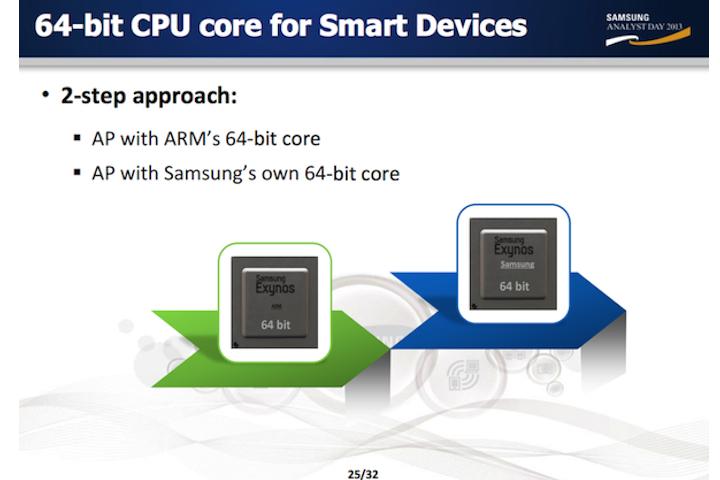
Moving beyond its Exynos chip range, Samsung could join Apple and Qualcomm in designing its own ARM-compatible chips from the ground up. A slide from the event shows Samsung is working on a 64-bit processor based on ARM’s own design (which is just like its current Exynos chips), along with a second 64-bit chip made with a Samsung developed core. Both the 64-bit chip and the above screen technology could become a part of the rumored Galaxy F.
In addition to all this, Samsung’s CFO admitted the firm has been “conservative” when it comes to buying up other companies, but said this could change in the future. Oh, and if you dislike the word “phablet,” then Samsung’s Head of Mobile, JK Shin, has retired the phrase in favor of one which is just as bad: Fonblet. He says fonblets are devices with a large display but still remaining portable, that include a stylus. That’d be the Galaxy Note series, then.
As we’ve still got at least a year before the flexible and bendable phones arrive, we’ll leave you with one of Samsung’s most cringe-worthy promo videos we’ve seen (which is quite a feat in itself) showing the potential of this type of technology.


