In a world where “Photoshopping” has become an ominous term synonymous with digital photography, one company seeks to bring more authenticity to the medium with a cleverly named application. Izitru (say it slow for a quick chuckle) is a new online service that tests the validity of the uploaded images belonging to specific users.
Using Izitru is fairly straightforward. First, take a photo and upload it onto the site. After a few seconds (depending on the image size), image testing begins automatically and displays a progress meter just below your upload. The image is then given its own page, showing the results of the test.
 To gain Izitru’s highest approval rating, all images must pass individual forensic tests that include analysis of device signature, JPEG structure, JPEG coefficient, sensor patterns, and double JPEG detection – all in under a minute. After the tests, uploaded images are rated from “High Trust” all the way down to “No Trust.” Users can flag questionable images using a “thumbs down” button a la Facebook (if Facebook had an unlike button, that is). Izitru stores any image you upload on its servers, showing a “prominent trust rating.” And, the site requires you to grant it access to your location data.
Izitru was created by Dartmouth College professor Hany Farid and Kevin Conner of San Jose-based Fourandsix Technologies (pronounced like “forensics”), a company that develops “mathematical and computational techniques” for detecting image manipulation. Fourandsix makes the claim that photo manipulation dates back almost to the advent of photography, and the company gives various examples of images that have been tampered with throughout history.
This new service has the potential to be a game-changer in the world of photography, especially when it comes to journalism. Imagine being able to quickly verify images as opposed to taking everything at face value. Not everyone is eagle-eyed when it comes to spotting a phony picture, so Izitru is sure to appeal to anyone with an interest in photography.
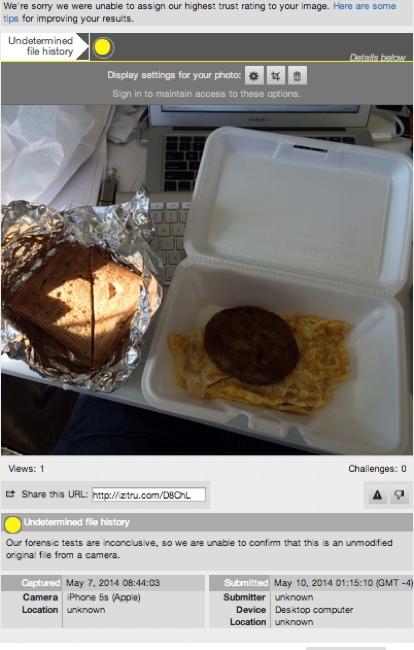
We gave the site a try and uploaded a few photos. It’s not perfect: An unedited photo we shot, straight from the camera, received a “medium trust” rating. It was able to detect the camera used, where it was uploaded from, and when it was taken. However, that information wasn’t enough to to earn the highest trust rating. Ditto for a photo we shot on a smartphone. Another photo taken with a different camera was able to pass the test, earning a high trust rating. We uploaded another photo we shot, but because the file had been edited in Adobe Photoshop Lightroom and re-saved as a new file, Izitru thought it was a fake – even though we knew that the photo is legitimate. Izitru was able to discern an image from the satirical news website, The Onion, as potentially modified, but couldn’t be sure. Obviously, the service still has some ways to go, but as the algorithms improve, so will the site.
According to CNET, Fourandsix hopes to generate revenue by allowing other sites to use Izitru through an application programming interface (API), which lets other software use the service automatically.
For now, Izitru is free to use online, and there’s also a free mobile app if an image arouses suspicion while you’re out and about, away from your computer.
(Additional reporting by Williams Pelegrin; via Imaging Resource)