

Cadillac may not have been the first luxury brand to embrace electric vehicles, but it quickly caught up with rivals thanks to an impressive lineup of electric SUVs based on parent General Motors’ flexible EV component set. This would be as good a time as any for a breather, but instead Cadillac is picking up speed — literally.
The 2026 Cadillac Lyriq-V is the first all-electric model in the luxury brand’s V-Series performance lineup. The V-Series has been instrumental in helping Cadillac shake off its stodgy image with fast-and-fun cars that go tire-to-tire with their counterparts from BMW M5 and Mercedes-AMG. But, more often than not, Cadillac V-Series models have been powered by loud-and-thirsty V8 engines — the opposite of the silent, zero-emission electric powertrains that are ostensibly Cadillac’s future.
That could make an electric V-Series a tougher sell, as could the fact that surplus horsepower and quick acceleration have been EV hallmarks from the get go. And while the Cadillac Lyriq is an impressive vehicle, that’s partly due to the way it leans into traditional luxury and puts aside performance pretensions. So can the Lyriq-V really be that good?
V-Series Q-Ship
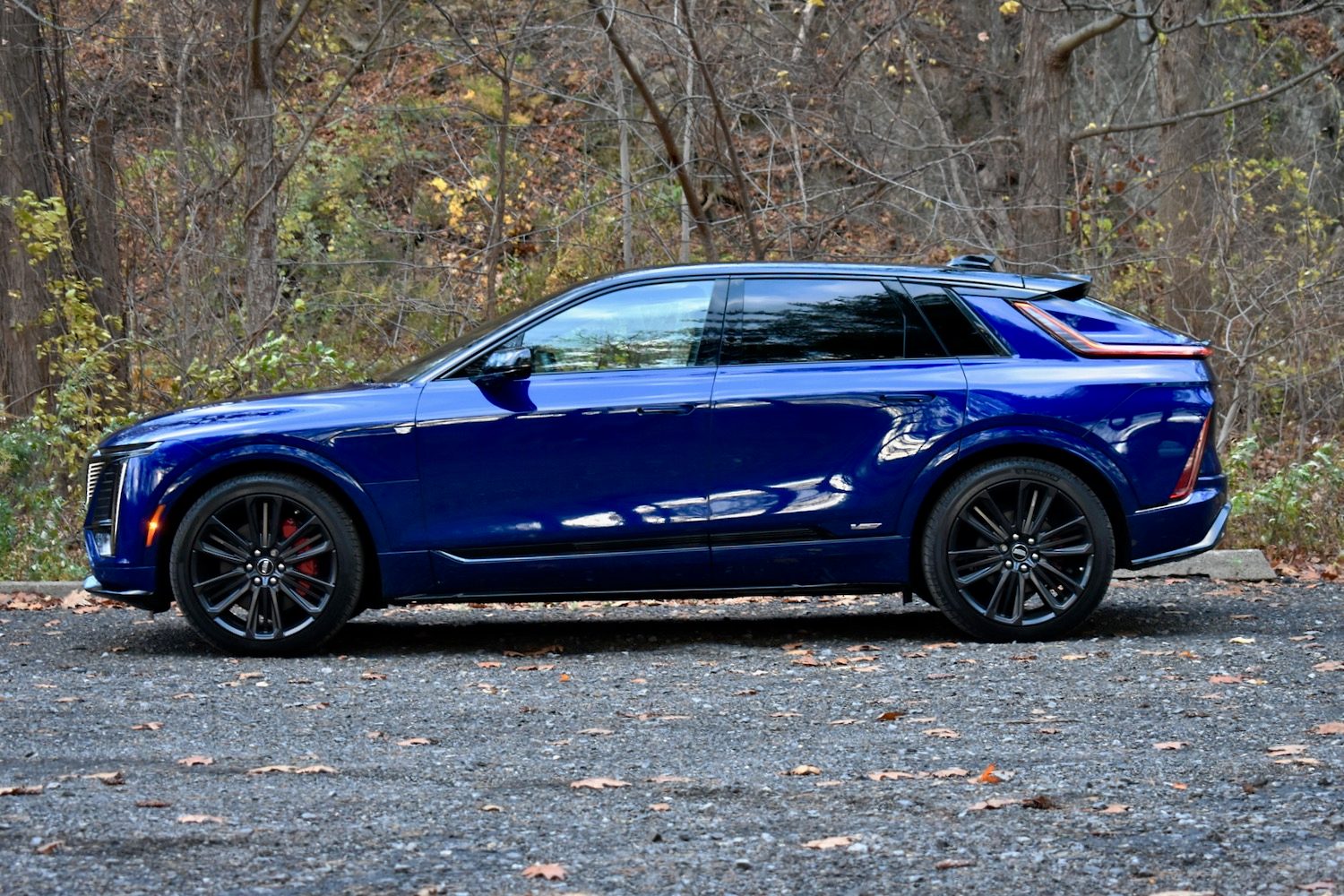
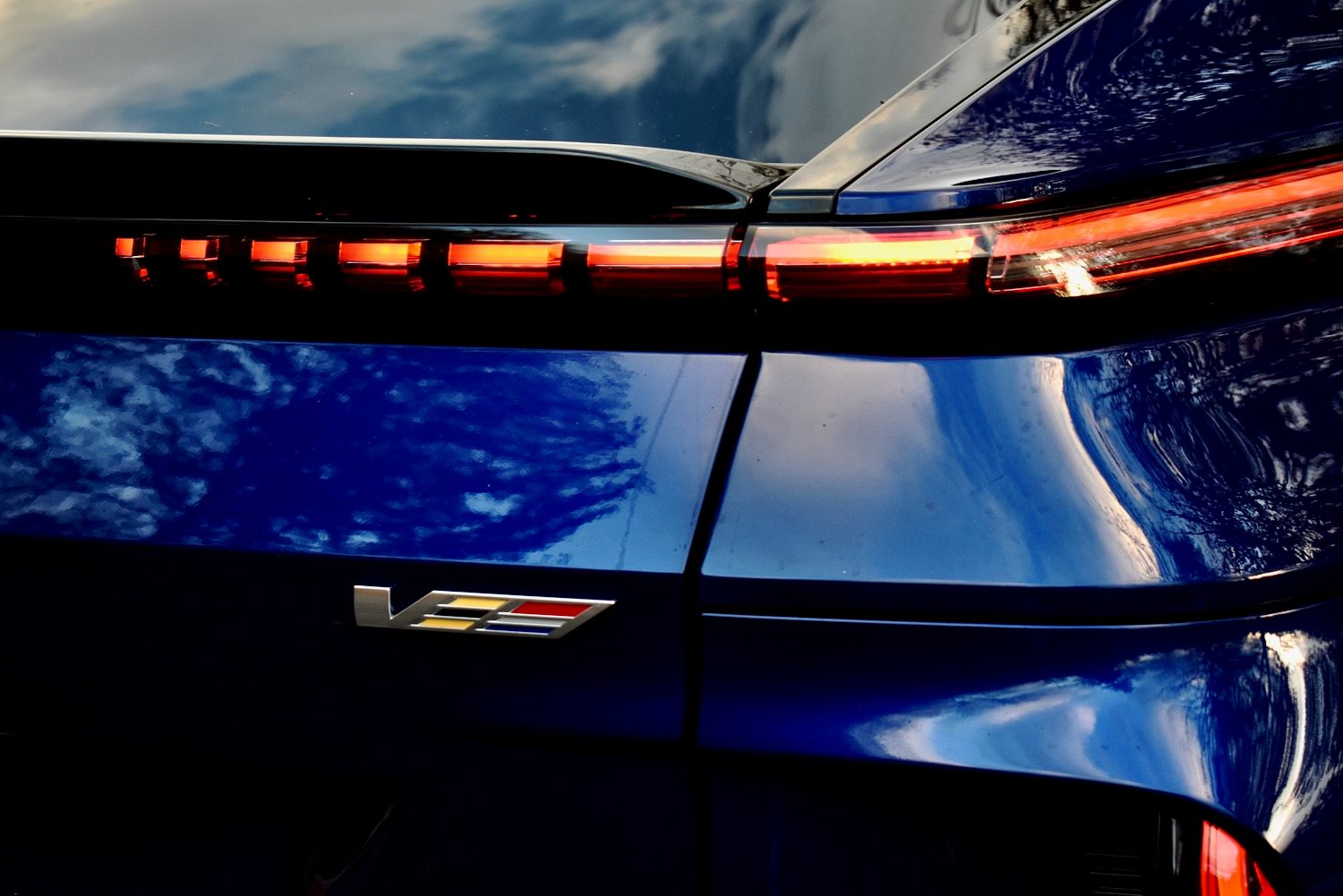
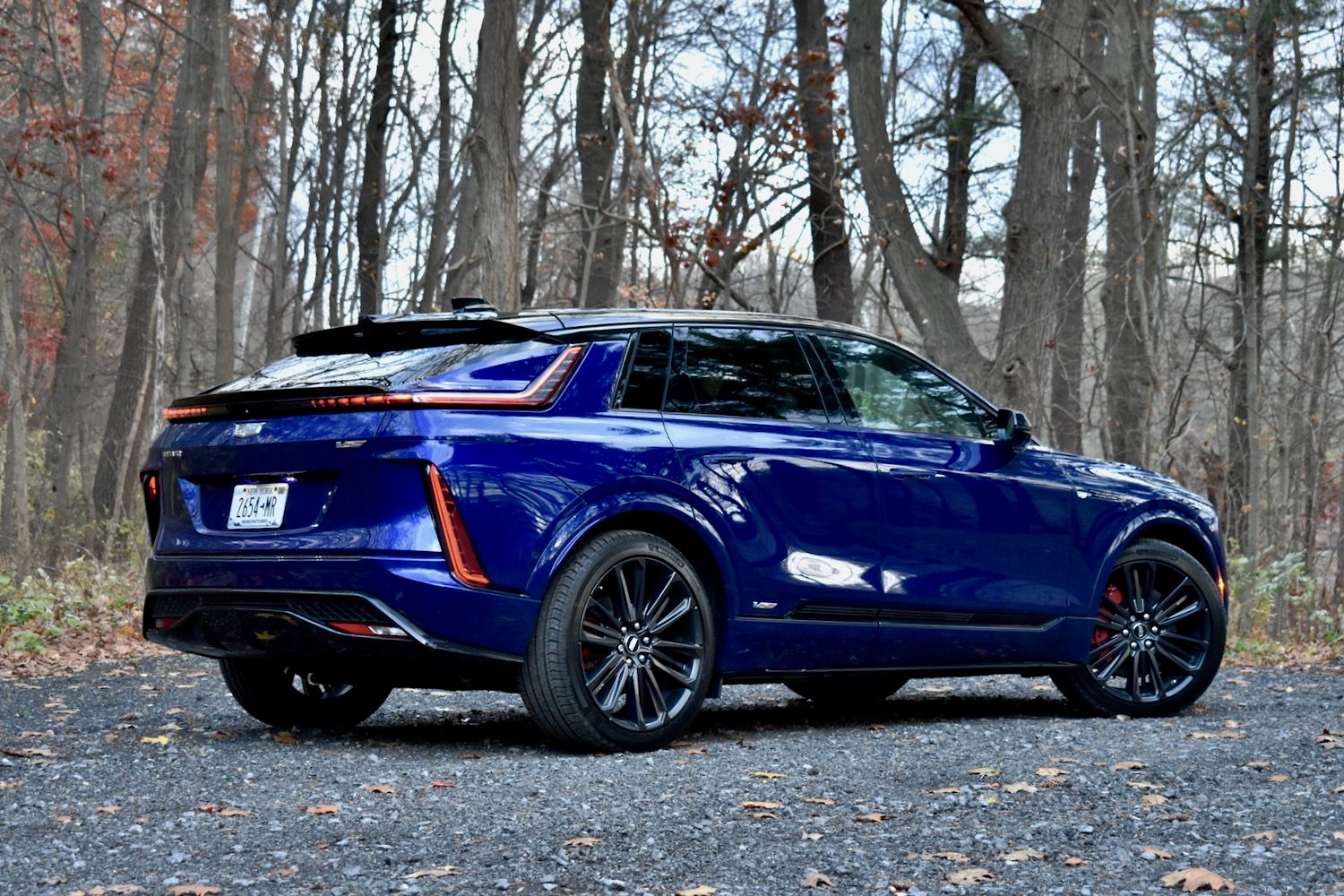
Cadillac has admittedly set a lower bar for itself. The V lineup is currently split into two tiers — V-Series and Blackwing — and the Lyriq-V isn’t one of the high-performance Blackwing models. That’s immediately apparent from the exterior styling, which mostly carries over from the standard Lyriq. The front fascia, rocker-panel trim, and 22-inch wheels (with summer performance tires) are new, but the “V” badge on the rear hatch is the clearest identifier.
That’s okay, because the Lyriq remains a stunning design. It looks like a sci-fi concept artist’s idea of a future Cadillac. A long wheelbase, low roofline, and imaginative lighting elements draped over the bodywork give the Lyriq the unusual proportions of a car that shouldn’t exist in the real world. That makes the Lyriq distinctive, so much so that bystanders couldn’t figure out what kind of car it was supposed to be. Cadillac markets it as an SUV but, in our random sampling at least, that wasn’t the impression people were getting.
And while the lack of visual differentiation might not be the best idea from a marketing perspective, it puts the Lyriq-V into a fun niche of low-key performance cars. Known as “sleepers” or “Q-ships” among car enthusiasts, they keep high-performance hardware hidden beneath unassuming styling. Or at least, styling that’s not terribly different from the ordinary models they’re based on. The Lyriq-V applies that concept to electric performance.
Quick and composed
The Lyriq-V earns its “V” badge with an uprated dual-motor all-wheel drive powertrain producing 615 horsepower and 650 pound-feet of torque. That’s 100 hp and 200 lb-ft more than the standard dual-motor Lyriq, but the same as you get in the Chevrolet Blazer EV SS and the three-row Cadillac Vistiq family hauler. And while the Lyriq-V is the quickest-accelerating Cadillac production vehicle ever, its factory-estimated zero to 60 mph time of 3.3 seconds (with the Velocity Max launch mode) is only 0.4 second quicker than that of the heavier Vistiq (and 0.1 second quicker than the Chevy).
The problem for the Lyriq-V is that it’s just too easy to make a quick electric SUV. Cadillac’s German rivals have already brought out sportier variants such as the Audi SQ6 e-tron, BMW iX M70 xDrive, and Mercedes-AMG EQE SUV. The Lyriq-V beats them all, as well as the base Tesla Model X, but only by a few tenths. Even the Rivian R1S Dual does zero to 60 mph in 3.4 seconds, despite not really being a performance vehicle. That doesn’t make flooring it any less thrilling, but that thrill is too common a feature in the Lyriq-V’s competitive set to make it a major selling point.
What really sets the Lyriq-V apart is its ability to blend everyday refinement with backroad agility. It’s not quite as waft-able as the standard Lyriq, but still plush enough to be a true Cadillac. But with the powertrain and dampers in their sportier settings, the Lyriq-V can dance through corners like a much smaller vehicle. The equivalent steering setting adds a bit too much weight, thankfully you can mix and match, and save your preferred configuration with the V Mode drive mode. With the steering lightened up, the Lyriq-V was much more engaging than its German equivalents.
Still luxurious inside
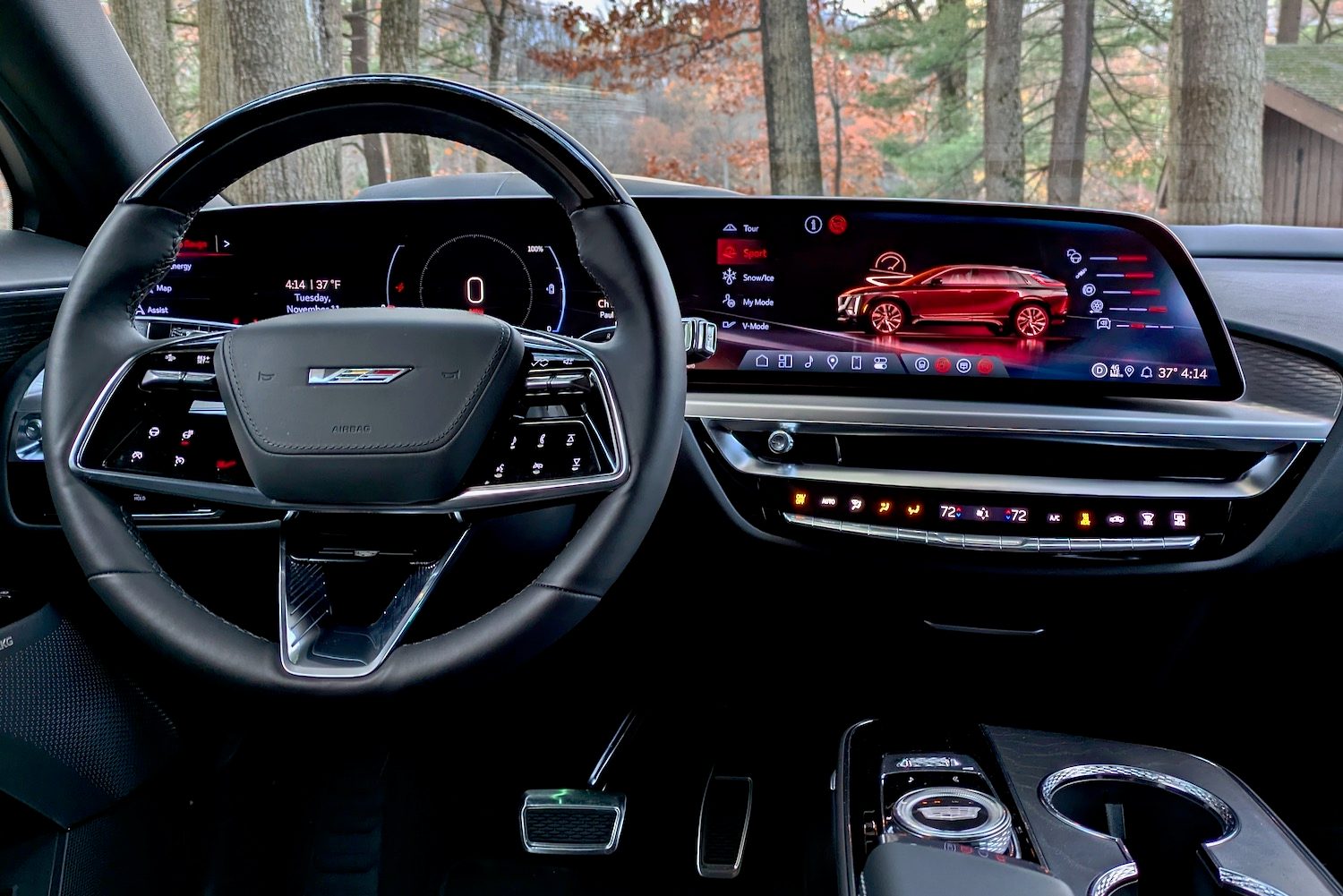
Just as engineers didn’t compromise ride quality to deliver sporty handling, the interior retains the luxurious design and generous feature content of other Lyriq models. While the color palette is muted, Cadillac didn’t drench the cabin in Alcantara and random bits of red trim to connote sportiness. The V-Series model does have front seats with added bolstering, but they were too narrow to be properly supportive. They do at least have heating, ventilation, and massage, and the outboard rear seats are also heated.
The Lyriq-V needs its 615 hp to lug around not only those seats but a host of other convenience features. A 23-speaker AKG audio system with Dolby Atmos is standard as well, along with the Super Cruise hands-free driving system, an augmented-reality head-up display and the curved 33-inch LED dashboard display from other Lyriq models. This combines the infotainment touchscreen and instrument cluster into one display, with a smaller bit off to the driver’s left for supplementary functions.
Impressive graphics — including a miniature Lyriq-V that pops up on the touchscreen when you switch drive modes — were paired with mostly-smooth functionality. Changing SiriusXM stations requires too many steps, and the lack of a start/stop button for the vehicle itself means you’ll be greeted by a seatbelt warning chime every time you get in. More importantly, while the Lyriq has the same Google Built-in app suite as other GM EVs, it also includes wireless Apple CarPlay and Android Auto.
A great EV for a very specific customer
With the same 102-kilowatt-hour battery pack as other Lyriq models, the Lyriq-V is EPA-rated at 285 miles of range. That’s 34 miles less than a non-V dual-motor Lyriq, but not too bad considering the extra power on tap. However, an observed 2.4 miles per kWh indicated that real-world range will suffer if you drive the Lyriq-V the way it was designed to be driven.
Charging hardware is the same as other Lyriq models. The standard 11.5-kilowatt AC charger can add up to 27 miles of range per hour of charging, according to Cadillac. The Premium trim level nets a 19.2-kW charger that can add an estimated 44 miles of range per hour. DC fast charging takes a somewhat-slow 40 minutes to take the pack from a 10% to 80% state of charge.
Pricing starts at $80,090, while the Premium grade adds the aforementioned more-powerful AC charger, Nappa leather upholstery, and a handful of other features for an additional $5,200. The V-Series is $6,795 more than the most-expensive non-V model, but considering that it retains all the bells and whistles while elevating performance, it’s hard to argue with that.
The Lyriq-V is also much cheaper than a BMW iX M70 xDrive or Mercedes-AMG EQE SUV, while offering similar performance and driving fun. The Audi SQ6 e-tron is about $10,000 less, but it’s not as well differentiated from the base Q6 as the V-Series is from the standard Lyriq. On the other hand, the Chevrolet Blazer EV SS boasts the same mechanical package as the Lyriq-V at a much lower price — with 303 miles of range. The driving experience shows the promise of electric V-Series performance models. Now Cadillac just needs to make those EVs as special as their internal-combustion predecessors.