1. Home
  2. Cars
  3. Legacy Archives

Mercedes-Benz G-Class undergoes a redesign for the first time in 35 years

Add as a preferred source on Google

The Mercedes-Benz G-Class has been a classic for military officials, hip-hop stars, and soccer moms alike for decades, but the boxy icon has remained relatively unchanged over its staggering 35-year production life.

Sure, the “G-Wagen” has featured some subtle aesthetic refreshes over the years, like a more angular grill and revised front bumper, but there hasn’t been a major redesign to the crossover SUV since its birth in 1979. Next year, that all changes.

Recommended Videos

Automobilemag reports that, for 2016, the Geländewagen will be wider by about four inches and will feature a subtly, but not aggressively redesigned body: the bodywork around the windows is slightly smoother, and the front bumper is much more balanced.

Furthermore, the wheel arches are less pronounced (likely due to the wider body), and the front grill is more symmetrical. The roof has also come down a bit to comfortably fit inside civilian garages.

The G-Class will also undergo major changes under the hood. The cheaper G500 will feature Merc’s new twin-turbo, 460-horsepower 4.0-liter V8. For a more … militant approach, there’s the G 63 AMG. The performance G-Class has the 5.5-liter, twin-turbo V8 from the current model, but it makes 570 horsepowers, 34 more than than today’s. More impressive, however, is its fuel economy, which sits at an impressive 20% better than before.

For improved offroad performance, the G-Wagen will feature three locking differentials, and will be much lighter: an all-aluminum frame cuts weight by a remarkable 825 pounds. This increases fuel efficiency significantly, but there are also unconfirmed reports of a plug-in hybrid in the works. Hopefully the gas savings will pay off, because the gas/electric powertrain would come at a $6000 premium. 

It is also worth noting that the G-Class sold directly to military officials will remain unchanged, as the new lightweight, aluminum frame is not ideal for areas of combat.

(Rendering via Automobilemag)

Andrew Hard
Andrew first started writing in middle school and hasn't put the pen down since. Whether it's technology, music, sports, or…
Volvo is rolling out Apple Music to over 2 million cars with a simple OTA update
Your Volvo may soon get Apple Music without needing CarPlay
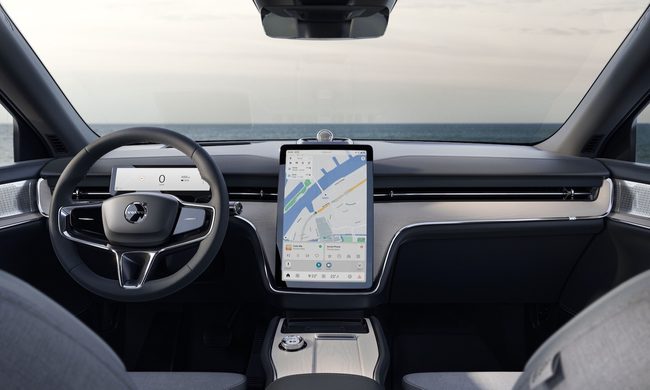
Interior view of the 2024 Volvo EX90.

The line between your smartphone and your car continues to blur. Volvo has announced that it is rolling out an over-the-air software update that brings Apple Music directly to the infotainment systems of more than 2 million vehicles worldwide. Instead of relying on Apple CarPlay or plugging in an iPhone, eligible drivers will be able to stream music natively from their car's built-in system, making Apple Music another integrated feature of Volvo's software experience.

The update is arriving for a wide range of Volvo models, including the EX90, ES90, XC90, S90, V90, XC60, S60, V60, XC40, EX40 and EC40, covering model year 2020 onwards. Availability, however, may vary depending on the vehicle.

Read more
Chery’s latest EV packs flagship tech for the price of a base Tesla, but you can’t buy it
Here's everything packed into Exeed's 2027 Exlantix ES, from its 27-sensor autonomous driving suite to its 860 km range, all starting under $31,000.
Car, Transportation, Vehicle

Chery's premium arm just dropped a sedan that makes you wonder why American EVs cost twice as much for half the tech.

Exeed's 2027 Exlantix ES ships with a driver-assist system called Falcon 700. It is built around an Nvidia Orin-Y chip and a genuinely stacked sensor suite.

Read more
A new AI model wants self-driving cars to think before they swerve
Forget guessing games, this self-driving AI actually shows its work.
Self driving car

Self-driving cars have gotten pretty good at driving. The harder problem is teaching them to drive safely in situations nobody planned for. We have heard horror stories of self-driving cars, behaving erratically in emergency situations, often times delaying first responders from reaching the scene.

A team at Seoul National University, led by professor Jun Won Choi from the Department of Electrical and Computer Engineering, thinks they have cracked part of that puzzle with a new AI model called SafeDrive. The research was recently selected as a highlight paper at CVPR 2026, a distinction that goes only to roughly 3% of all submissions.

Read more