1. Home
  2. Space
  3. News

The first possible exomoon is here, and it makes our Moon look hilariously tiny

Scientists may have found the first exomoon, except this one is the size of Jupiter

Add as a preferred source on Google
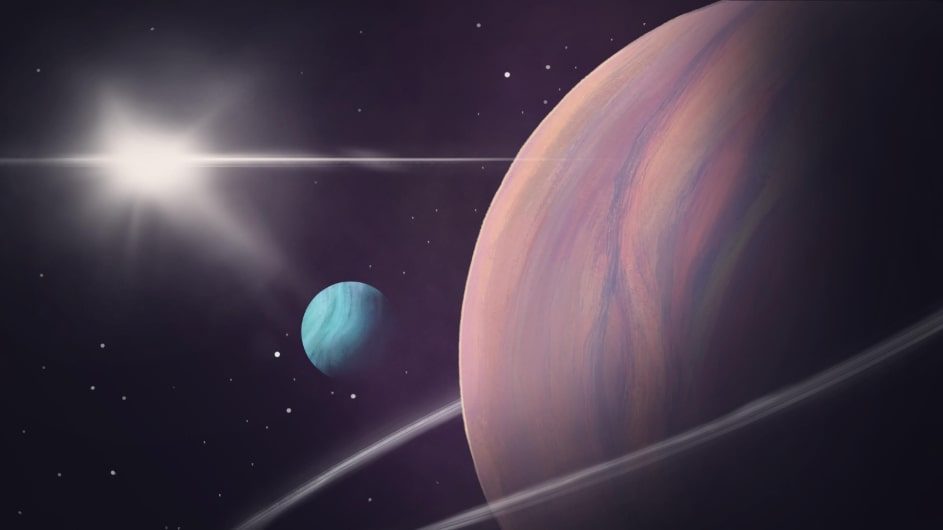
This artist’s concept depicts a potential volcanic moon between the exoplanet WASP-49 b, left, and its parent star. New evidence indicating that a massive sodium cloud observed near WASP-49 b is produced by neither the planet nor the star has prompted researchers to ask if its origin could be an exomoon.
This artist’s concept depicts a potential volcanic moon between the exoplanet WASP-49 b, left, and its parent star. New evidence indicating that a massive sodium cloud observed near WASP-49 b is produced by neither the planet nor the star has prompted researchers to ask if its origin could be an exomoon. NASA/JPL-Caltech

We have already discovered more than 6,000 planets outside of our immediate neighborhood. Yet, finding a moon orbiting one of those distant worlds has proved considerably harder. Astronomers may finally have something close to the real deal, but this particular object stretches the word “moon” almost beyond recognition.

Using the European Southern Observatory’s Very Large Telescope in Chile, researchers detected strong evidence for a moon-like object in the CD-35 2722 system. Further observations are still necessary to confirm the discovery, but it could become the first confidently detected natural satellite outside our solar system. There is still one tiny complication though. This moon is apparently massive.

Calling this thing a moon gets complicated
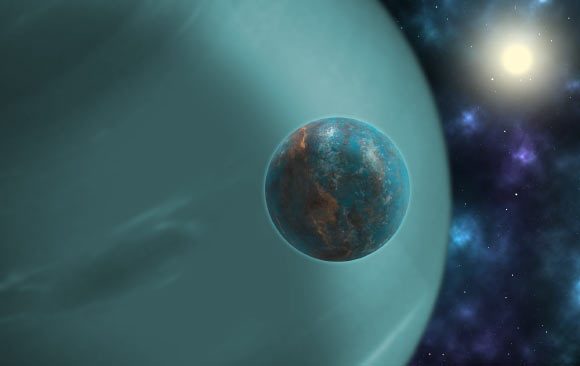
The system already looks wildly different from ours. CD-35 2722 is a young star with around half the Sun’s mass. Orbiting it is CD-35 2722 B, a brown dwarf with roughly 37 times Jupiter’s mass. Brown dwarfs sit in the murky territory between the largest planets and the smallest stars. The newly detected object then circles that brown dwarf.

Recommended Videos

Researchers estimate a minimum mass of around 0.9 Jupiter masses and an orbital period of roughly 170 days. Its location in this cosmic hierarchy makes “exosatellite” the safer term for now. There is currently no formally accepted definition of an exomoon, which makes classification especially awkward when the host itself is a brown dwarf.

How astronomers used an old-planet hunting technique to discover it
The team detected the object using radial velocity measurements with the CRIRES+ instrument on the VLT. The method watches for tiny gravitational wobbles caused by an unseen orbiting body and famously helped uncover the first exoplanet around a Sun-like star. Here, researchers applied the technique directly to a brown dwarf instead.

Researchers believe that improving instruments should eventually allow them to apply the same technique to smaller satellites and less massive hosts as well. ESO’s upcoming 39-meter Extremely Large Telescope should push that search considerably further. For now, CD-35 2722 has given astronomers an object massive enough to resemble a planet, orbiting something caught between planet and star.

Vikhyaat Vivek
Vikhyaat Vivek is a tech journalist and reviewer with seven years of experience covering consumer hardware, with a focus on…
China’s answer to SpaceX’s reusable rockets literally catches boosters in a net
SpaceX catches boosters on legs. China just used a net.
Ammunition, Missile, Weapon

SpaceX's playbook for recovering a rocket booster generally involves legs, a precisely controlled vertical landing, and either a concrete pad or a drone ship. 

China just managed to pull off something similar, but in a slightly different way, and on July 10, it tested the method as well.

Read more
Dimming the sun sounds unhinged, but this new study on El Niño makes a surprisingly good case for it
A natural test case, Australia's worst-ever wildfire season, suggests the idea deserves serious consideration.
Nature, Outdoors, Sky

When I first saw "scientists propose dimming the sun," I rolled my eyes. It sounds like a science fiction movie cooked up after watching many climate documentaries. But a new study, published on July 8, 2026, in the journal Science Advances, seems to have a genuinely compelling argument.

A Super El Niño is currently forming in the Pacific, feared to be the most intense in decades. It could escalate floods, wildfires, and extreme heat events worldwide. However, Researchers at UC San Diego's Scripps Institution of Oceanography, led by climate scientists Kate Ricke and Jessica Wan, are now proposing one of the most interesting solutions I’ve come across.

Read more
You can now walk through space and gaze into a black hole at this VR exhibit
Smithsonian Starstruck lets you drift past dying stars and see the origin point of the universe for as little as $18 a person.
Smithsonian Starstruck featured

Most planetarium shows ask you to sit still and look up. The Smithsonian's new VR exhibit takes a different approach, letting visitors walk through the vast expanse of the universe, drifting past stars, planets, and a black hole to get a physical sense of its true scale.

A $29 ticket to the edge of the galaxy

Read more