Earlier this week, a team of scientists from UK tech firm Surrey Nanosystems announced that it has created the world’s darkest material. How dark? Well, the material, dubbed Vantablack, is such a deep shade of black that it absorbs 99.965% of light that strikes it. In other words, it absorbs all but 0.035% of the incident light that bounces off it, meaning your eyes basically can’t see it — you can only see the space around it, and then infer that there must be something occupying that eerie black void.
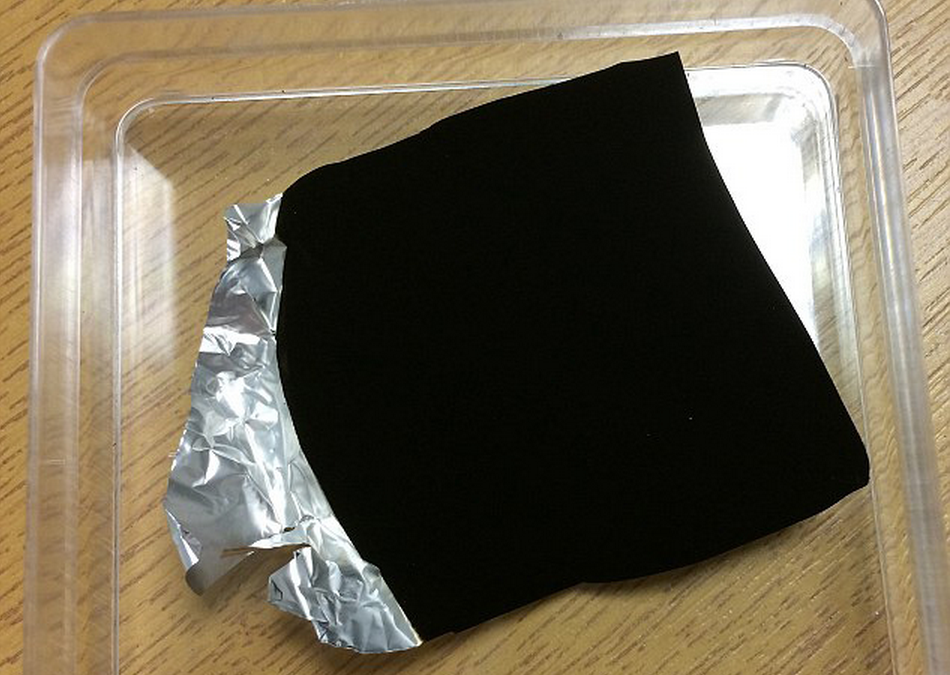
This material is so dark that when applied to a three-dimensional object or surface, Vantablack will make it appear two-dimensional. It traps so much light and prevents it from bouncing off the surface that, once applied, it’s nearly impossible to make out three-dimensional features. To demonstrate this property, the scientists behind the project used the substance to coat a crinkled sheet of tinfoil. As you can see in the picture above, even though it’s crumpled a bit, the coated section appears to be completely flat.
The best way to understand how this crazy new material works is to take a look at how it’s made. Short for Vertically Aligned Carbon Nanotube Arrays, Vantablack is created through a low-temperature carbon nanotube growth process that creates zillions of nanotubes, all standing straight up. If you were to get a really, really close look at it, it would look something like the hairs on your head, or a really densely-planted tree farm. Once light passes through the canopy of this tiny nanotube forest, it has a really tough time getting back out, which is precisely how it’s able to trap and absorb so much of the light that strikes it.
It took more than two years to work all the kinks out of the growing process, but now that Surrey Nanosystems has made Vantablack strong, stable, and easy to mass produce, the material is ready for a wide variety of commercial applications.
The first and most obvious application is stealth coatings for military vehicles and armor. If applied to helicopters, jets, tanks, or even the individual helmets and vests of soldiers, Vantablack could provide troops with a huge advantage, since it could render the wearer virtually invisible — especially when used during nighttime operations.

In addition to military applications, this material also has huge potential to improve the sensitivity of optical imaging systems used in space. When light enters a telescope and bounces off the mirrors inside of it, some of that light scatters and bounces around off the walls of the interior, ultimately producing extra noise in the image and reducing its quality. To mitigate this problem, astronomers typically coat the interior chambers of telescopes with black paint — but this paint still reflects a fair amount of light. Using Vantablack inside of a telescope would drastically reduce this reflection, and thereby help to create telescopes capable of collecting images at much higher resolutions than previously possible. This will ultimately enable astronomers to survey distant galaxies and other celestial bodies more effectively.
And the best part? Surrey Nanosystems is already mass producing and selling the material to customers. “We are now scaling up production to meet the requirements of our first customers in the defense and space sectors, and have already delivered our first orders,” said Ben Jensen, Surrey Nanosystems’ chief technology officer.
Normally when you hear about this kind of stuff, it’s years away from being applied and used in the real world, but Vantablack is already here making the world a darker place. Find out more here.