
On the first day, BMW said let there be charging stations. And there were. And they were good … also, cheap.
Today BMW unveiled two new programs to help get more EVs on the road. Not only has BMW partnered with automotive parts supplier Bosch to produce a game-changing new fast charger, BMW i3 EV purchasers will now have access to a year of fast charging from the nation’s largest private networks of fast chargers. It turns out that ze’ Germans are just as serious about electricity as everything else.
Let there be chargers
BMW had a question: Why were DC fast chargers so expensive? After all, while a DC fast charger is the size of a refrigerator and costs $30,000, the part that makes it work is just an AC to DC converter; BMW already makes those for its cars for less than a $1,000. So BMW brought this question to Bosch. After much thinking and tinkering, Bosch and BMW devised something rather clever.
Not only is the actual hardware only a third as expensive as previous chargers, it is significantly cheaper to install.
Thanks to its small size, 100-pound weight, and lower demand for electrical current, it won’t require nearly the same amount of infrastructure as current fast chargers. That is a big deal, considering a $30,000 fast charger can cost anywhere from $20,000 to a trouser-troubling $70,000 to install.
While the i DC charger may not have the same charging potential as the larger 50KWh stations, it can still charge the average EV to 80 percent of its full capacity in around 30 minutes.
The i DC charger will soon be appearing in all of BMW’s i Center charging stations, and are likely to be introduced in other locations.
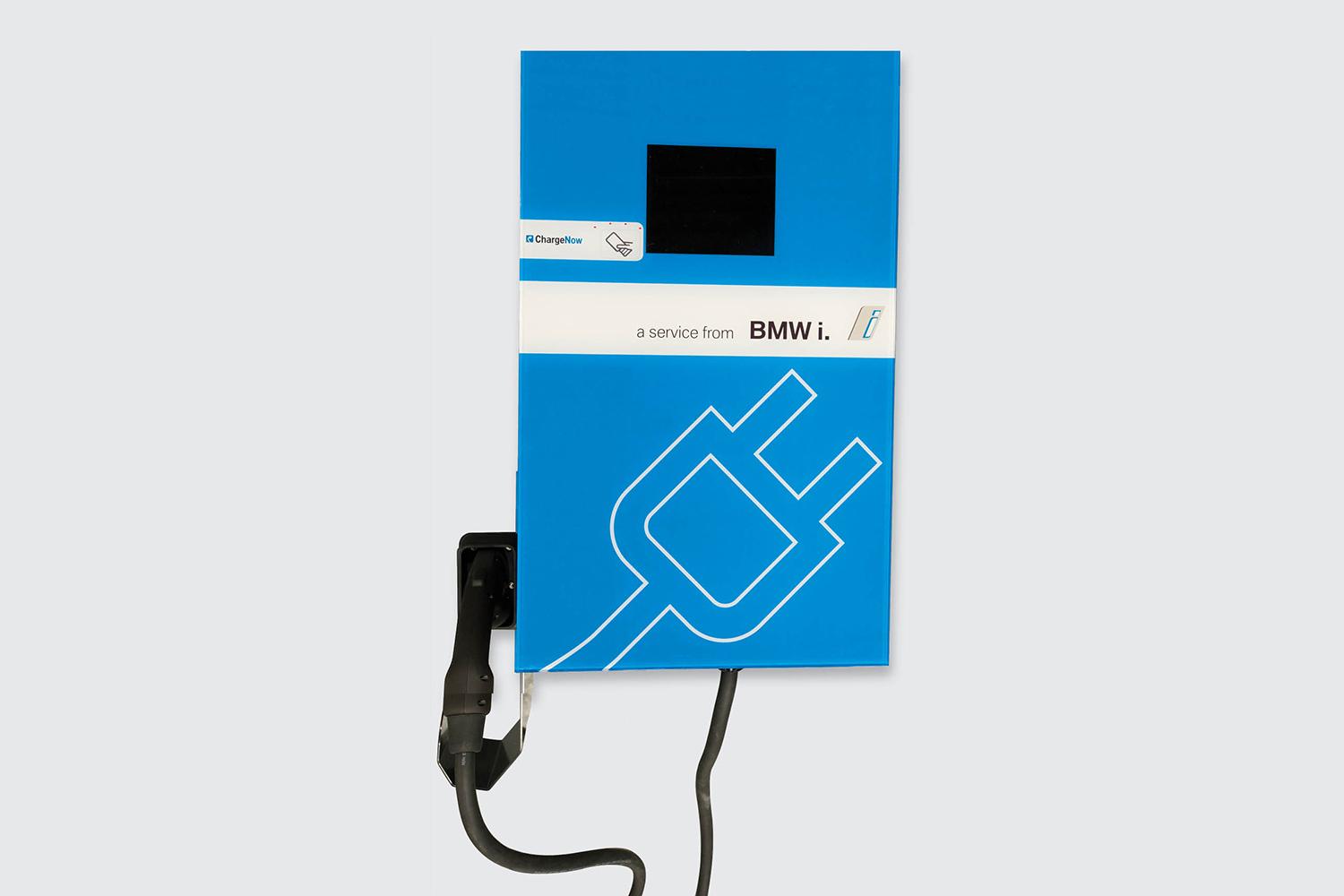
Perhaps the best part of this program is that the i DC chargers won’t be exclusive to BMW. The chargers use the SAE Combo 1 inlet, which is already in use by GM and VW, and looks to be the emerging industry standard for chargers.
BMW made clear to Digital Trends that it wants to see as many chargers out there as possible. And as such, wants to deliver a product with as broad a use as possible. In fact Bosch and BMW will be happy to sell these chargers to any interested party, including private companies or local governments.
One account to rule them all
BMW is also going beyond simply adding chargers, to giving expanded charging access to its customers. The new ChargeNow DC Fast program marks both a major expansion of BMW’s existing ChargeNow network, it is also a step toward the goal of interoperability among charging networks.
It can charge the average EV to 80 percent of its full charge in around 30 minutes.
BMW hopes that this program will help create the “premium” experience that BMW customers expect, by reducing complexity and anxiety over charging.
There is another important factor for i3 drivers: cost. The i3 is supposed to draw in middle-class customers who are hoping not just to save the polar bears, but also their bank accounts – and fast charging isn’t cheap.
Thanks to the 480 volts of juice needed to run a fast charger, a 30-minute session can cost as much as $4.95. That may not rival gas prices, but it shouldn’t be ignored either, particularly if used frequently.


In that sense, BMW may not draw in many customers who weren’t already interested in an EV, but they could help lure away customers from other EV makers by reducing the cost of ownership. And even if that doesn’t happen BMW has helped set the stage for more interoperability of EV infrastructure.
What does all this mean?
For BMW consumers, this news is unequivocally positive; BMW wants customers to buy EVs badly enough to actually engineer the landscape to make it appealing. This might seem like an obvious move. What it suggests, however, is that BMW genuinely believes that EVs are the future, and not simply a way to help meet the increasingly strict economy standards set by CAFE and the European Union.
BMW can afford to dabble and make mistakes. Tesla can’t.
Speaking of Tesla, this isn’t such great news for the company. BMW’s introduction of the i DC charger shows what a big influence established automakers could have when they flex their muscle. BMW may want to sell EVs ,but the i3 is a low-volume car from a company whose next decade will still be dominated by internal-combustion sales.
BMW can afford to throw what was undoubtedly tens – and possibly hundreds – of millions of dollars at redesigning a charger with Bosch for a car that represents a tiny fraction of its portfolio. This project may not be a whim, but it will be no more than a mere annoyance if it doesn’t work out. This difference in scale between a company like Tesla and BMW is instructive: BMW can afford to dabble and make mistakes. Tesla can’t.
If BMW can use a tiny fraction of its resources to dramatically improve charging infrastructure, then that does at least bode well for the future of EVs and their infrastructure.


