  1. Home
  2. Cars
  3. Legacy Archives

Hellcat calling: Dodge releases the world’s most powerful production ringtone

Add as a preferred source on Google

When the movie theater says, ‘Please turn off your cellphones and mobile devices,’ this is the type of thing they’re talking about.

Dodge has just released a free, speaker-shattering ringtone of the 2015 Dodge Challenger Hellcat. In the ten-second clip, you can hear the Challenger’s 707 throaty ponies rev up slowly and then unleash onto the pavement, basked in an audial cocktail of shredding tires, whining superchargers, and impending speeding tickets.

Recommended Videos

It sounds absolutely demonic, but, as we know, the Hellcat has the bite to go with its bark.

“When you name an engine ‘Hellcat,’ it had better have the performance to back it up and a sound that wakes up the devil,” said Tim Kuniskis, Dodge CEO. “The Hellcat’s signature sound is the unholy union of supercharger whine and 5.5 inches of unrestricted exhaust. Dodge/SRT fans can now make heads turn and people stop in their tracks, every time their phones ring.”

So you may drive a Prius, but at least your phone sounds mean.

The ringtone is available for Apple, Android and Blackberry mobile devices at www.drivesrt.com/hellcatringtone. Dodge has also made smartphone wallpaper images of the Challenger available there.

To continue the Hellcat’s handheld invasion, Dodge has posted a three-dimensional augmented reality app called “Dodge Revolution”, where enthusiasts can customize their Hellcat’s aesthetics. Wheels and exterior colors can be swapped, and virtual tours are part of the experience. Fans can also race their Hellcats on a virtual drag strip.

The supercharged, 6.2-liter V8-powered Challenger is the most powerful muscle car ever, and has the highest output of any vehicle in Dodge’s history. The impressive specs go beyond the engine bay, though; the Hellcat will lay down an 11.2-second quarter mile time and uses 1.5 gallons of fuel every minute. The Challenger Hellcat is currently in production and will start at $59,995.

Andrew Hard
Andrew first started writing in middle school and hasn't put the pen down since. Whether it's technology, music, sports, or…
Volvo is rolling out Apple Music to over 2 million cars with a simple OTA update
Your Volvo may soon get Apple Music without needing CarPlay
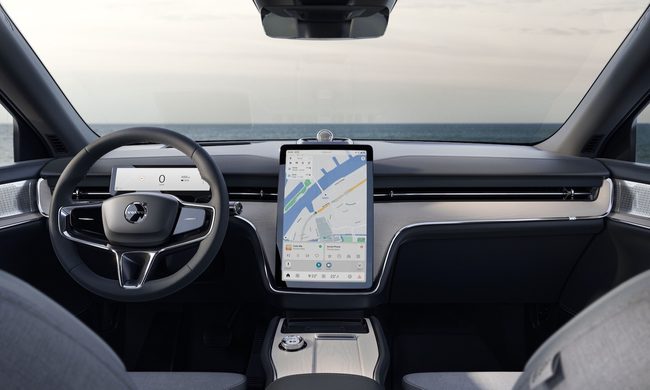
Interior view of the 2024 Volvo EX90.

The line between your smartphone and your car continues to blur. Volvo has announced that it is rolling out an over-the-air software update that brings Apple Music directly to the infotainment systems of more than 2 million vehicles worldwide. Instead of relying on Apple CarPlay or plugging in an iPhone, eligible drivers will be able to stream music natively from their car's built-in system, making Apple Music another integrated feature of Volvo's software experience.

The update is arriving for a wide range of Volvo models, including the EX90, ES90, XC90, S90, V90, XC60, S60, V60, XC40, EX40 and EC40, covering model year 2020 onwards. Availability, however, may vary depending on the vehicle.

Read more
Chery’s latest EV packs flagship tech for the price of a base Tesla, but you can’t buy it
Here's everything packed into Exeed's 2027 Exlantix ES, from its 27-sensor autonomous driving suite to its 860 km range, all starting under $31,000.
Car, Transportation, Vehicle

Chery's premium arm just dropped a sedan that makes you wonder why American EVs cost twice as much for half the tech.

Exeed's 2027 Exlantix ES ships with a driver-assist system called Falcon 700. It is built around an Nvidia Orin-Y chip and a genuinely stacked sensor suite.

Read more
A new AI model wants self-driving cars to think before they swerve
Forget guessing games, this self-driving AI actually shows its work.
Self driving car

Self-driving cars have gotten pretty good at driving. The harder problem is teaching them to drive safely in situations nobody planned for. We have heard horror stories of self-driving cars, behaving erratically in emergency situations, often times delaying first responders from reaching the scene.

A team at Seoul National University, led by professor Jun Won Choi from the Department of Electrical and Computer Engineering, thinks they have cracked part of that puzzle with a new AI model called SafeDrive. The research was recently selected as a highlight paper at CVPR 2026, a distinction that goes only to roughly 3% of all submissions.

Read more