Around a million Americans are today living with Parkinson’s disease and some five million with Alzheimer’s. While teams of experts continue to search for cures for the debilitating brain conditions, others have been looking at ways to detect the diseases sooner. Early detection and diagnosis is important as it can improve access to the appropriate medical services and support systems, as well as enable those affected to make plans regarding care, legal, and financial matters.
However, spotting changes in the brain early is a huge challenge as they can begin to occur a full 10 years before the first symptoms become apparent. Researchers at MIT’s Computer Science and Artificial Intelligence Laboratory (CSAIL) have been working in this area for some time and may have found an answer thanks to existing technology in the form of a digital pen.
Many of the existing tests for dementia are somewhat rudimentary, and involve, for example, getting patients to draw an analog clock-face from memory, or add numbers and clock hands showing a specific time inside a pre-drawn circle.
While the tests can certainly be useful in determining the existence of a brain condition and even which type, it’s hard for doctors to be totally objective when assessing the results. In addition, judgments are made mainly by assessing the final drawing and in most cases leaves aside the subject’s drawing behavior.
Believing that analyzing the drawing process could also help to detect early signs of dementia, CSAIL researchers combined existing technology with the pen-and-paper test.
Using an Anoto Live Pen – a camera-equipped digital device capable of measuring its position on the paper more than 80 times a second – researchers were able to compile much more data (and more accurate data) than via the traditional drawing test, with movements and hesitations detected as the subject goes about drawing the different clocks.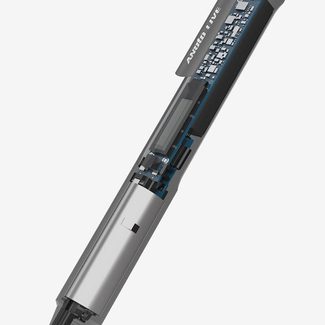
Software has been developed to provide rapid analysis of the collected data, giving the doctor an increased chance of making a more objective – and early – diagnosis.
The exciting news is that when comparing the digital pen test with the existing method, the digital process was “significantly more accurate,” MIT reported on its website.
Commenting on the breakthrough, CSAIL principal investigator Cynthia Rudin said, “We’ve improved the analysis so that it is automated and objective. With the right equipment, you can get results wherever you want, quickly, and with higher accuracy.”
The team is now simplifying the system’s interface to enable neurologists and non-specialists to make use of the technology in medical centers and hospitals.
Cures for these complex and insidious conditions may still be some way off, though in the meantime researchers are also trying to find effective ways of slowing the progression of the diseases. Considering this, any technology that can aid early detection is certain to be warmly welcomed by doctors as well as patients and their relatives.