“The new Tacoma is the off -road toy for those who find their fun beyond the city limits. Bred for dirt paths, the truck feels out-of-place wherever paved roads are found.”
- Capable, built-tough mid-size truck
- Handy crawl control for sticky situations
- Easy to use for all off-road skill levels
- Not more than meets the eye
- Limited seat adjustments available
- Feels better off-road than on
- Finicky automatic transmission
“Why you can trust Digital Trends – We have a 20-year history of testing, reviewing, and rating products, services and apps to help you make a sound buying decision. Find out more about how we test and score products.“
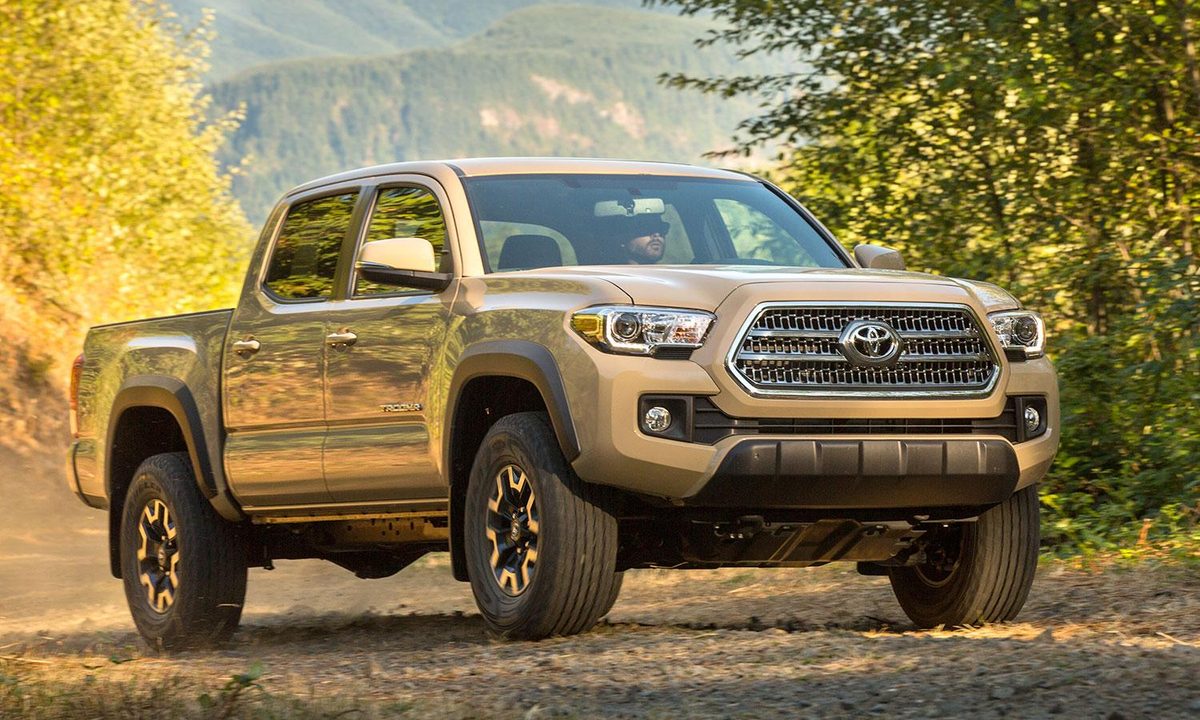
The new Tacoma is the off -road toy for those who find their fun beyond the city limits. Bred for dirt paths, the truck feels out-of-place wherever paved roads are found.
You’d be forgiven in thinking that Toyota’s mid-size Tacoma truck wouldn’t garner much attention, particularly since pickup culture has always leaned towards bigger and meaner. What it lacks in presence, however, it makes up with attitude, like a screaming punk band that prefers the raw, intimate gigs to the big stadium shows. Designed more for roughhousing than for work, yet still capable, Toyota’s 2016 Tacoma is the badass mid-size truck you didn’t know you really wanted.
Coming in a few flavors, from the bare-bones SR to the more fanciful Limited, the TRD Off-road is the model meant for those who seek out mud and dust. This one is exclusively powered by a brand new 3.5-liter engine that churns up 278 horsepower and 265 pound-feet of torque. Power is sent to either two or four wheels via a six-speed manual or automatic transmission.
Dune raider
Toyota’s overall mission statement for the 2016 Tacoma was to make it “badass,” and the first step was making the mid-size truck look as mean as its big brother, the Tundra. Designers gave it the same thick fascia contours and hexagonal grille. Its entire package was inspired by the desert racing tucks that have to endure the rough and tumble of the barren wilderness; with its high clearance and beefy front end, the Tacoma looks the part.


The Tacoma gets another Tundra hand-me-down in the form of the three-piece bumper system that makes swapping out damaged components cheaper and easier. TRD Sport models get a signature hood scoop (that is sadly just for show) as well as sharing a plastic front underbody guard with the Limited and SR trims. The TRD Off-road foregoes both affectations, relying on demonstrable trailblazing prowess alone.
The truck comes in three new colors as well: Blazing Blue Pearl, Inferno, and the unique Quicksand, which conveys a sense of specificity. In this color, the Tacoma doesn’t look like it’s trying to split its time between the wild and civilian life — its purpose is to get down and dirty.
Workout gear
What makes the new Tacoma more than just a small knock-around truck for work and play is the way it makes both easier. Taking it from the outskirts of Seattle to the off-road playground that awaits, the first thing that’s noticeable is the amount of noise reduction work done to quiet the cabin. As Spartan as the interior feels, it didn’t sound like I was in a stamped sheet-metal box on wheels.
The Tacoma doesn’t look like it’s trying to split time between the wild and civilized life — its purpose is to get down and dirty.
The cabin feels deliberately utilitarian, with surfaces that nobody would feel too bad getting filthy. Lack of decoration hammers home the Tacoma’s intent to go off the beaten path. That’s not to say the Tacoma isn’t packed with useful, modern features. Each Tacoma model comes with an Entune audio system, with the premium version installed on both TRDs Sport and Off-Road. The 6.1-inch screen is home to all the basic audio features as well as the navigation functions the premium version makes available. Along with Siri Eyes Free, Entune allows an app suite of useful tools like Yelp, Facebook, and Pandora to be accessed on the go.
Re-learning to crawl
As we left Seattle behind, the tarmac ahead gave way to a dusty trail leading us to many challenges set up to demonstrate the Tacoma’s capabilities in the rough. Here, I got to see the Toyota’s best tech feature at work: crawl control.
A locking rear differential, height settings and the usual host of off-road mechanicals mean a driver in the wild can tackle whatever they encounter manually if they’re up for the task. Crawl control is there to make their jobs a lot easier.
My first challenge was to allow crawl control to climb a route up a hill that looked like it was in the neighborhood of a 60-degree incline. Whatever it actually was, the Tacoma had its work cut out for itself, and crawl control was going to take over for me. The path up the side of the hill was also windy, complicating things further. Engaging the crawl control allowed the Tacoma to feel out the path, determine what traction was needed, applying throttle and brakes automatically while it crawled forth between one and five mph. The Tacoma does its thing while I steer up the path, laying back in my seat like an astronaut reclining in a Shuttle on the launchpad.


With no slippage, the Tacoma hefts me up the hill with no drama, other than the thumping in my chest. It turns out that going uphill is the easy part, and that downhill was going to be much harder.
Heading back down meant taking a different path that was just as steep, but the ground consisted of much looser dirt. Dialing the crawl-control settings, I’m told to lift off the brake and let crawl control take me downhill, between trees on its own. It was a big thing to ask.
I relent, and with a deep breath, I let go, feeling very much like I just drove off the edge of a cliff. Crawl control kicks in, sensing the looseness of the terrain, crawling ever so slightly forward, applying and disengaging the brakes several times a second — faster and more precise than any human driver is capable of. Me and the Tacoma land at the bottom of the hill safely and I pry my fingers off the steering wheel.
With a deep breath, I let go, feeling very much like I just drove off the edge of a cliff.
Even on level areas, crawl control proved its worth on a path through what looked like a quarry, with large boulders forming a trench that the Tacoma was expected to navigate. Again, with me simply steering, the truck crawled and inched over the boney “path” dutifully. Crawl control can even get the Tacoma out of a rut when it gets nice and stuck in sand. Working backwards, crawl control senses the traction, turning the wheels slowly and building a wedge with the sand for which it’ll crawl out of. When it senses there’s enough there to grip on to, the truck pulls itself out of trouble.
On paved roads, the Tacoma felt rigid, yet not back-breaking, and flowed over rough patches without rattling teeth. It rides on a double wishbone suspension up front while traditional leaf springs support the rear, aided by gas shock absorbers.
Atkin-what?
Pulling me along in the TRD Off-Road was the new 3.5-liter Atkinson Cycle V6. Traditionally, an engine with this setup uses less fuel in the combustion process, but produces less power for the trade-off. Because of this, engines with Atkinson cycles are found in hybrid setups.
Before the eye-rolling starts about why this is in a truck, Toyota makes it abundantly clear that this isn’t your average Atkinson engine. With sophisticated variable-valve timing, the engine switches to a traditional Otto cycle when power is needed, saving its fuel efficient mode when cruising. All told, the Tacoma’s new power plant will still give drivers all of its 278 hp and (most importantly) 265 lb-ft of torque while netting potential fuel economy of 18 city/23 highway/20 combined mpg.
Bad as I wanna be
On its own, the Tacoma isn’t a truck that musters up overwhelming feelings of excitement. Is it as badass as Toyota hoped? It ultimately depends on how it gets used.
Drivers can use it for work or nominally comfortable commutes, but they can also venture out to tackle the world beyond the tarmac. This is when the Tacoma becomes a handy tool for adventures, and a reliable piece of equipment will trump badass every time.
Highs
- Capable, built-tough mid-size truck
- Handy crawl control for sticky situations
- Easy to use for all off-road skill levels
Lows
- Not more than meets the eye
- Limited seat adjustments available
- Feels better off-road than on
- Finicky automatic transmission