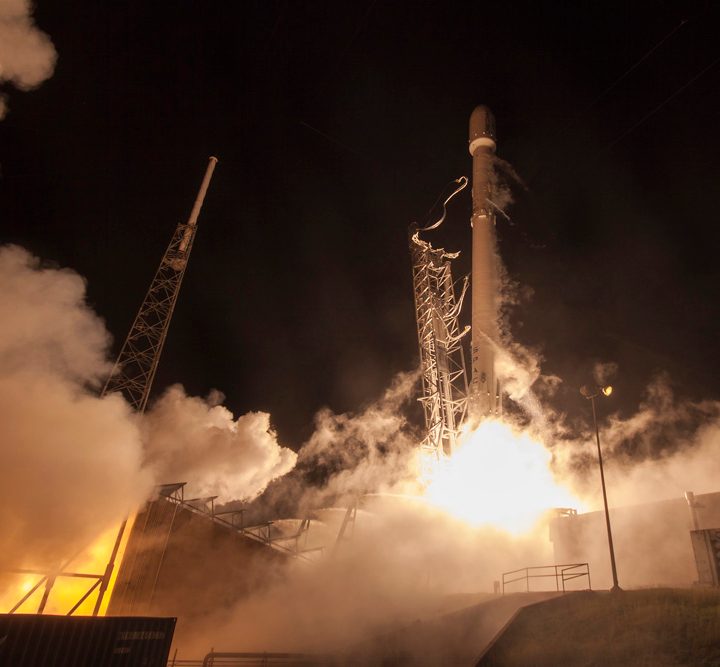
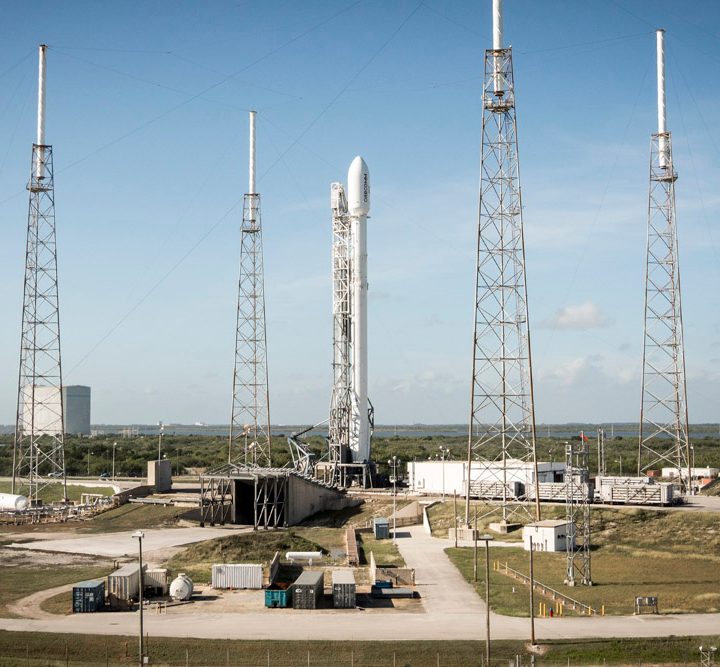
As it prepares to accomplish the near-impossible task of landing a rocket on a floating barge this week, Elon Musk’s aerospace company SpaceX says its doesn’t actually expect to pull off the thrillingly difficult feat. So who (or what) is to blame for ditching the typically confident and optimistic outlook of launches past? According to a recent press kit released by the agency, due to the mission’s unique geostationary transfer orbit (GTO), a successful landing on the floating barge known as “Of Course I Still Love You” appears unlikely. We have to imagine that wherever Jeff Bezos is right now, he’s surely smiling.
Despite its rather pessimistic attitude about re-landing the Falcon 9 rocket, SpaceX’s foremost goal for Wednesday’s launch is to deliver a commercial communications satellite for the Asia-based company, SES. Officially dubbed SES-9, the payload scheduled for launch will be SES’s largest satellite servicing the Asia-Pacific region, boasting 81 high-powered Ku-band transponders. All told, the satellite intends to provide coverage for more than 20 countries within the area, boosting the video, mobility, government, and enterprise divisions in sections of Asia and Indonesia.
“The additional capacity on SES-9 will enable direct-to-home operators to broadcast more local content and increase their SD and HDTV line-up to 22 million households across Asia-Pacific, in markets such as India, Indonesia, and the Philippines,” SpaceX’s release reads. “SES-9 will also deliver high-speed broadband services and mobile backhaul to remote regions to enable the deployment of communications networks, such a banking and e-government services.”
If all goes according to plan, Wednesday will represent SpaceX’s second launch of its upgraded Falcon 9 rocket which now boasts a higher ceiling of thrust as well as the ability to hold more fuel. Considering the payload figures to weigh just shy of 12,000 pounds, the agency will need every last drop of that extra fuel — especially if it wants an earnest shot at landing on the barge.
Prior failures notwithstanding, the fact SpaceX must cope with depositing the payload into a higher orbit than normal dramatically decreases the already low chances of success. Though the Falcon 9 will carry more fuel, it’s expected to use a sizable chunk of it during launch in order to gain the necessary speed to reach the desired GTO.
“This mission is going to a Geostationary Transfer Orbit,” the statement continues. “Following stage separation, the first stage of the Falcon 9 will attempt an experimental landing on the ‘Of Course I Still Love You’ droneship. Given this mission’s unique GTO profile, a successful landing is not expected.”
Just this past December, SpaceX did manage to notch a successful landing of its rocket, however, it occurred on land. After failing to bring a Falcon 9 back down on a floating barge last month, SpaceX CEO Elon Musk took to Twitter to set the record straight about the inherent difficulty of landing on water, as well as why it’s mission critical. Citing the fact it’s “just not physically possible” to always bring it back down on land, it’s clear SpaceX’s attempts to land on water aren’t just for kicks but for basic necessity.
Wednesday’s Falcon 9 launch is currently scheduled to take place at 3:46 p.m. PST from SpaceX’s Space Launch Complex at Cape Canaveral Air Force Station in Florida, and will be broadcast live via the SpaceX website.