  1. Home
  2. Cars
  3. Legacy Archives

BMW’s Vision Future Luxury concept brings tomorrow’s tech to Pebble Beach

Add as a preferred source on Google

BMW is bringing its technology-laden Vision Future Luxury concept to North America,

First unveiled at the Beijing Motor Show back in April, this potentially prophetic luxury sedan will be shown at the Pebble Beach Concours d’Elegance August 14.

Recommended Videos

The concept appears unchanged from when it was shown in Beijing. The styling is much more expressive than anything on current BMWs, and is rendered in weight-saving carbon fiber and aluminum.

Similar materials were used in the interior, but designers created the final shape using a process called “subtractive modeling.” Built-up layers of wood, leather, carbon fiber, and aluminum were “milled down,” as if the entire interior was machined by CNC.

The laser headlights – shared with the 2015 BMW i8 sports car – are the only parts of this car that are production ready, but the Vision Future Luxury articulates BMW’s interest in using more lightweight materials and, perhaps, adopting less-staid styling.

Those future BMWs will need to be light, because they will be loaded with technology.

The Vision Future Luxury features a suitably futuristic head up display, which projects images directly into the driver’s line of site for and augmented reality feel. Road signs, traffic hazards, or buildings can be highlighted in the real-world environment for maximum informative efficiency.

Unlike in most production cars, the passenger also gets a separate information display controlled by an iDrive rotary knob.

This displays secondary information the driver doesn’t need to see, although driver and passenger can also swipe things back and forth using a touch pad. BMW says it’s great for booking opera tickets.

Rear-seat passengers aren’t left out. The Vision Future Luxury concept features a “Rear Seat Touch Command Tablet” that streams digital media, and can control any secondary function, including anything that’s displayed to the driver and front-seat passenger.

Exactly how much of this will make it to production is unclear, but the Vision Future Luxury could influence the feel of the next 7 Series sedan, and eventually trickle down to lesser models.

Stephen Edelstein
Stephen is a freelance automotive journalist covering all things cars. He likes anything with four wheels, from classic cars…
Volvo is rolling out Apple Music to over 2 million cars with a simple OTA update
Your Volvo may soon get Apple Music without needing CarPlay
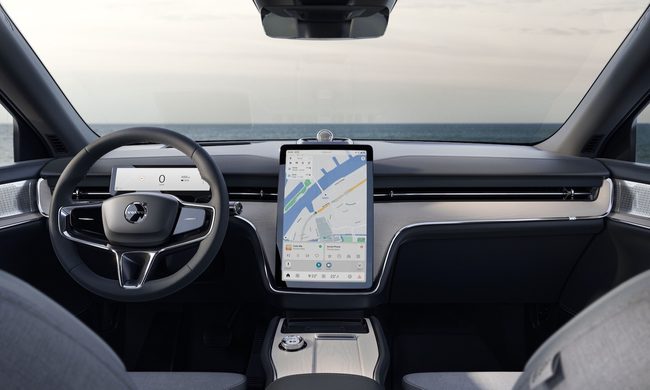
Interior view of the 2024 Volvo EX90.

The line between your smartphone and your car continues to blur. Volvo has announced that it is rolling out an over-the-air software update that brings Apple Music directly to the infotainment systems of more than 2 million vehicles worldwide. Instead of relying on Apple CarPlay or plugging in an iPhone, eligible drivers will be able to stream music natively from their car's built-in system, making Apple Music another integrated feature of Volvo's software experience.

The update is arriving for a wide range of Volvo models, including the EX90, ES90, XC90, S90, V90, XC60, S60, V60, XC40, EX40 and EC40, covering model year 2020 onwards. Availability, however, may vary depending on the vehicle.

Read more
Chery’s latest EV packs flagship tech for the price of a base Tesla, but you can’t buy it
Here's everything packed into Exeed's 2027 Exlantix ES, from its 27-sensor autonomous driving suite to its 860 km range, all starting under $31,000.
Car, Transportation, Vehicle

Chery's premium arm just dropped a sedan that makes you wonder why American EVs cost twice as much for half the tech.

Exeed's 2027 Exlantix ES ships with a driver-assist system called Falcon 700. It is built around an Nvidia Orin-Y chip and a genuinely stacked sensor suite.

Read more
A new AI model wants self-driving cars to think before they swerve
Forget guessing games, this self-driving AI actually shows its work.
Self driving car

Self-driving cars have gotten pretty good at driving. The harder problem is teaching them to drive safely in situations nobody planned for. We have heard horror stories of self-driving cars, behaving erratically in emergency situations, often times delaying first responders from reaching the scene.

A team at Seoul National University, led by professor Jun Won Choi from the Department of Electrical and Computer Engineering, thinks they have cracked part of that puzzle with a new AI model called SafeDrive. The research was recently selected as a highlight paper at CVPR 2026, a distinction that goes only to roughly 3% of all submissions.

Read more