  1. Home
  2. Cars
  3. Legacy Archives

What makes a ‘hyper cruiser’ go? Lamborghini breaks down the Asterion’s hybrid tech

Add as a preferred source on Google

Lamborghini’s Asterion ‘hyper cruiser’ is an amazing vehicle that will unfortunately never see the production line, but Lamborghini knew that from the start.

Designed as a ‘technology demonstrator,’ the Asterion uses a Huracan-sourced, 610-horsepower 5.2-liter V10 and three electric motors for thrust. Total output stands at a whopping 910 horsepower, but it’s delivered in a unique way.

Recommended Videos

In a short animated film, Lamborghini details the unique hybrid technology that propels the Asterion forward.

Related: Hybrid hypercars are here … but not to stay

In hybrid mode, the Asterion starts solely under battery power. Because two of the electric motors are mounted on the front axle (the third is a rear-mounted starter motor and generator), the Lamborghini works as a front-wheel drive EV until 37 mph. In this mode, it’s also capable of traveling 31 miles on a single charge.

After the 37 mph marker is hit, the monstrous V10 behind the driver ignites, transforming a zero emissions FWD EV into a four-wheel drive, 910-hp beast.

By pressing the steering wheel-mounted ‘Zero’ button, however, the car goes back into electric mode, where it can reach speeds of 78 mph with no interference from the gas engine as long as there’s a charge.

Lamborghini Asterion
Image used with permission by copyright holder

Under full acceleration, the Asterion travels from 0 to 60 mph just 3.0 seconds, an impressive figure offset by a combined fuel consumption rating of 56 mpg on the U.S. cycle.

Hypothetically, this allows the driver to travel quickly, quietly, and efficiently through traffic, while being able to access all 910 hp on the open road.

It’s an impressive ‘display’ to say the least, and as the only hybrid in Lamborghini’s lineup, it’s a poignant one. Company CEO Stephan Winkelmann is firmly against hybrid supercars, as he believes the added weight of the electric components (551 pounds in this case) takes away from a supercar’s true nature.

In the future, Lamborghini plans to meet increased emissions standards through turbocharging, rather than hybridization.

Andrew Hard
Andrew first started writing in middle school and hasn't put the pen down since. Whether it's technology, music, sports, or…
Volvo is rolling out Apple Music to over 2 million cars with a simple OTA update
Your Volvo may soon get Apple Music without needing CarPlay
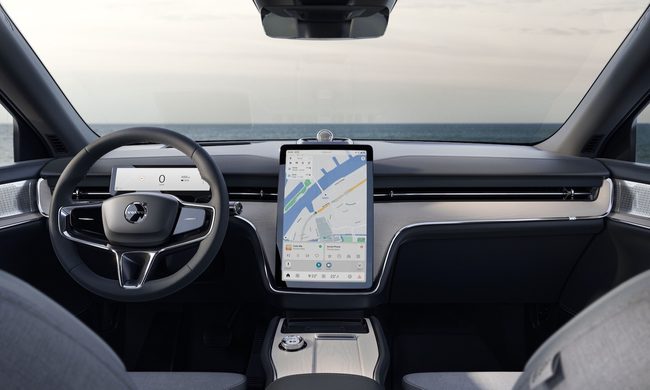
Interior view of the 2024 Volvo EX90.

The line between your smartphone and your car continues to blur. Volvo has announced that it is rolling out an over-the-air software update that brings Apple Music directly to the infotainment systems of more than 2 million vehicles worldwide. Instead of relying on Apple CarPlay or plugging in an iPhone, eligible drivers will be able to stream music natively from their car's built-in system, making Apple Music another integrated feature of Volvo's software experience.

The update is arriving for a wide range of Volvo models, including the EX90, ES90, XC90, S90, V90, XC60, S60, V60, XC40, EX40 and EC40, covering model year 2020 onwards. Availability, however, may vary depending on the vehicle.

Read more
Chery’s latest EV packs flagship tech for the price of a base Tesla, but you can’t buy it
Here's everything packed into Exeed's 2027 Exlantix ES, from its 27-sensor autonomous driving suite to its 860 km range, all starting under $31,000.
Car, Transportation, Vehicle

Chery's premium arm just dropped a sedan that makes you wonder why American EVs cost twice as much for half the tech.

Exeed's 2027 Exlantix ES ships with a driver-assist system called Falcon 700. It is built around an Nvidia Orin-Y chip and a genuinely stacked sensor suite.

Read more
A new AI model wants self-driving cars to think before they swerve
Forget guessing games, this self-driving AI actually shows its work.
Self driving car

Self-driving cars have gotten pretty good at driving. The harder problem is teaching them to drive safely in situations nobody planned for. We have heard horror stories of self-driving cars, behaving erratically in emergency situations, often times delaying first responders from reaching the scene.

A team at Seoul National University, led by professor Jun Won Choi from the Department of Electrical and Computer Engineering, thinks they have cracked part of that puzzle with a new AI model called SafeDrive. The research was recently selected as a highlight paper at CVPR 2026, a distinction that goes only to roughly 3% of all submissions.

Read more