1. Home
  2. Cars
  3. Photo Galleries
  4. Legacy Archives

BMW’s solar charging carport is elegantly practical

Add as a preferred source on Google

The automotive industry has always operated in a broad spectrum. Speed-craving, boundary-pushing gearheads usually occupy one end, while eco-friendly, gas-saving commuters typically occupy the other. And if we’re honest, that framework probably isn’t going anywhere.

Can we find a balance, a middle ground? BMW thinks so.

When BMW released the i3 last year, we called it a new type of car. It has a carbon fiber and aluminum chassis, a dashboard made out of recycled plants, a zero-emissions electric motor and it goes from 0 to 60 in 7.0 seconds. It’s these types of cars, like the upcoming BMW i8 and the Tesla Model S, that prove that polar bear-friendly vehicles don’t have to be a chore to drive.

So what’s the next step? People may be happy with the cars themselves, but are we really addressing the problem if the energy we pour into our cars still comes from fossil fuels? BMW has a solution for that, too. 

Enter BMW’s i Solar Carport Concept. It’s a poetically simple bamboo and carbon fiber structure that supports a cluster of solar panels, allowing you to skip the trip down to the 76 and let the sun do all the work.

Tom Allemann, of BMW Designworks USA explains, “With the solar carport concept we opted for a holistic approach: not only is the vehicle itself sustainable,” he said, “but so is its energy supply.” 

The carport is meant to be used in conjunction with the BMW i Wallbox Pro, which not only charges the car with solar energy, it can redistribute surplus power back into the customer’s home.

“This is therefore an entirely new generation of carports that allows energy to be produced in a simple and transparent way,” Allemann continued. “It renders the overarching theme of lightweight design both visible and palpable.” 

On top of that, just look at the thing. And who says art can’t be functional?

Andrew Hard
Andrew first started writing in middle school and hasn't put the pen down since. Whether it's technology, music, sports, or…
Volvo is rolling out Apple Music to over 2 million cars with a simple OTA update
Your Volvo may soon get Apple Music without needing CarPlay
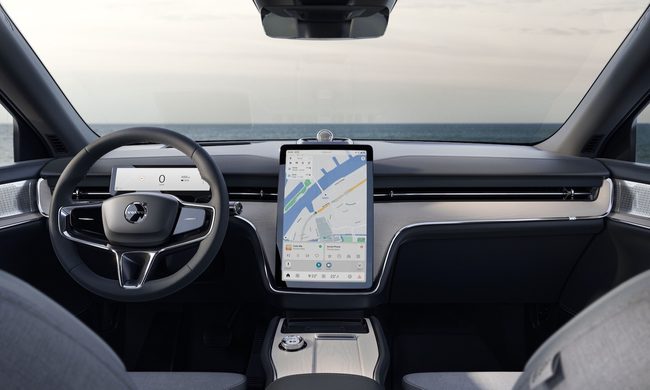
Interior view of the 2024 Volvo EX90.

The line between your smartphone and your car continues to blur. Volvo has announced that it is rolling out an over-the-air software update that brings Apple Music directly to the infotainment systems of more than 2 million vehicles worldwide. Instead of relying on Apple CarPlay or plugging in an iPhone, eligible drivers will be able to stream music natively from their car's built-in system, making Apple Music another integrated feature of Volvo's software experience.

The update is arriving for a wide range of Volvo models, including the EX90, ES90, XC90, S90, V90, XC60, S60, V60, XC40, EX40 and EC40, covering model year 2020 onwards. Availability, however, may vary depending on the vehicle.

Read more
Chery’s latest EV packs flagship tech for the price of a base Tesla, but you can’t buy it
Here's everything packed into Exeed's 2027 Exlantix ES, from its 27-sensor autonomous driving suite to its 860 km range, all starting under $31,000.
Car, Transportation, Vehicle

Chery's premium arm just dropped a sedan that makes you wonder why American EVs cost twice as much for half the tech.

Exeed's 2027 Exlantix ES ships with a driver-assist system called Falcon 700. It is built around an Nvidia Orin-Y chip and a genuinely stacked sensor suite.

Read more
A new AI model wants self-driving cars to think before they swerve
Forget guessing games, this self-driving AI actually shows its work.
Self driving car

Self-driving cars have gotten pretty good at driving. The harder problem is teaching them to drive safely in situations nobody planned for. We have heard horror stories of self-driving cars, behaving erratically in emergency situations, often times delaying first responders from reaching the scene.

A team at Seoul National University, led by professor Jun Won Choi from the Department of Electrical and Computer Engineering, thinks they have cracked part of that puzzle with a new AI model called SafeDrive. The research was recently selected as a highlight paper at CVPR 2026, a distinction that goes only to roughly 3% of all submissions.

Read more