AMD Ryzen 7 5800X3D was just tested in a gaming setting, and this time around, the results were positive: It managed to beat Intel Core i9-12900K by over 21%.
Previously, only synthetic benchmarks of the processor have been leaked. In those tests, the CPU failed to impress with its scores.
This test of the upcoming 3D V-Cache AMD Ryzen 7 5800XD comes as a follow-up to the benchmarks that have been posted yesterday. Peruvian website XanxoGaming was able to obtain the processor ahead of its official release. Most publications are under embargo, but XanxoGaming was blacklisted by AMD and didn’t receive a sample of the processor, so it’s free to test it and post the results.
So far, only one game has been tested: Shadow of the Tomb Raider. The settings used were optimized for CPU testing and not so much for actual gaming: The game was played at 720p resolution and on ultra settings with custom ultra shadows. As VideoCardz notes, this type of gaming setting is often used for these kinds of tests.
XanxoGaming used CapFrameX software to test the AMD Ryzen 7 5800X3D. For the sake of testing, the processor was paired with an Nvidia GeForce RTX 3080 Ti graphics card and DDR-3200 memory.
The system was able to hit an average of 231 frames per second (fps) in this test. To put these numbers into perspective, XanxoGaming also tested a setup with one of Intel’s best CPUs, the Core i9-12900KF, Nvidia GeForce RTX 3090 Ti, and DDR5-4800 RAM.
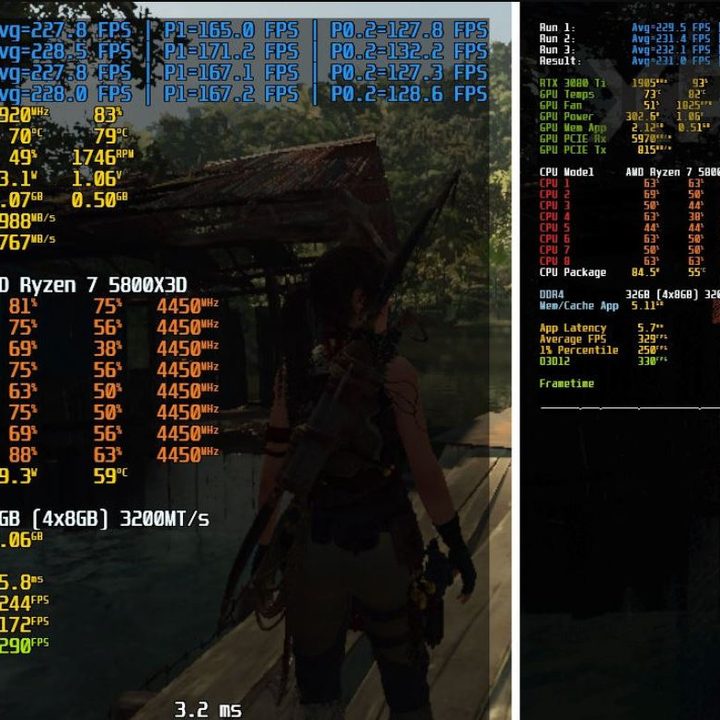
Despite the fact that the Intel rig was better on paper — down to the best GPU currently offered — AMD Ryzen 7 5800X3D still wins the match by a good amount. The Core i9-12900KF-based system only maintained an average of 190 fps. This means that AMD was able to defeat Intel in this test, outperforming the Core i9-12900KF by 21.58%.
Of course, the test was very CPU-oriented, as proven by the fact that AMD still won in a technically worse gaming setup. AMD predicted that its new 3D V-Cache beast would be beating Intel’s best: The company promised an increase of about 10% over the Core i9-12900K. However, synthetic benchmarks were not favorable for the Ryzen 7 5800X3D, and in those, the processor didn’t perform as well. It’s clear that it excels in a gaming setting, though, and even sustained testing might support AMD’s predictions.
XanxoGaming will continue testing the CPU in various games, so hopefully, we will soon get a report that paints a clearer picture of the AMD Ryzen 7 5800X3D. So far, where gaming is concerned, things are looking up.