  1. Home
  2. Computing
  3. Emerging Tech
  4. Web
  5. News

Conspiracy theorists think this ancient Greek statue depicts a laptop user

Add as a preferred source on Google

Did the Ancient Greek have laptops? Of course not, but that isn’t stopping some people from looking at an ancient statue and thinking they see one.

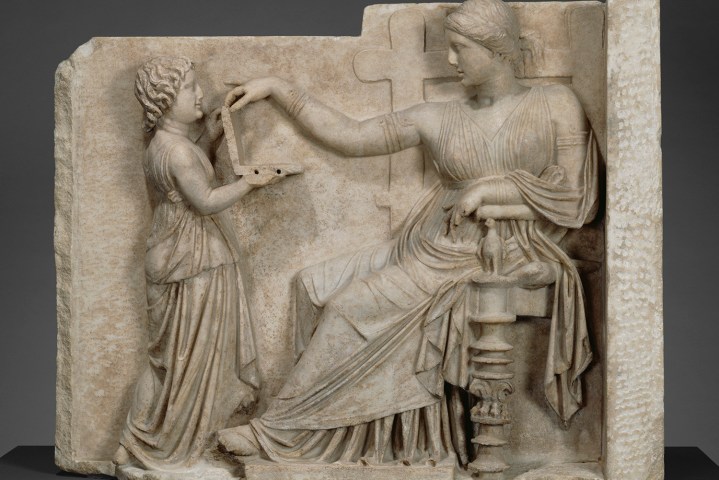
The marble sculpture, created around 100 BC, is called “Grave Naiskos of an Enthroned Woman with an Attendant.” According to The J. Paul Getty Museum it depicts a woman reaching out to the lid of a shallow chest held by a servant girl. Or is it a laptop?

Recommended Videos

It isn’t, but that hasn’t stopped British tabloid The Daily Mail from asking “Is this ancient Greek statue proof someone took a laptop back in time (or is it just a TABLET?)” in a headline earlier this week. The story has been bouncing around for a few years now, when conspiracy theorist and YouTuber StillSpeakingOut contemplated it in a somewhat rambling video.

Ancient Greek sculpture depicting a.... laptop???

“When I look at the sculpture I can’t help but think about the Oracle of Delphi, which was supposed to allow the priests to connect with the gods to retrieve advanced information and various aspects,” he said in a video, while also stating that he is “not saying that this is depicting an ancient laptop computer.”

Historians say the statue was once part of a grave naiskos, or three-sided grave monument. It was common at the time for depictions of deceased wealthy people to include them reaching for items. The J. Paul Getty Museum says this “probably alludes to the hope of continuing earthly pleasures in the afterlife”.

Whatever the servant was holding — some think it was a jewelry box, some think it was a writing tablet — it’s clear that most of it, including a chunk of the servants hand, has fallen away. We’re not seeing the full picture right now, and thinking it’s a laptop probably has more to do with the viewer than it does the piece itself.

But let’s assume this is a laptop, delivered by TARDIS or a plutonium-powered DeLorean to the ancient Greeks. We’ve got a few important questions:

  • Why is a servant holding this laptop for the user? Shouldn’t it be on her … lap?
  • Why is this woman holding the screen? Has the hinge gone bad?
  • Why is this laptop so narrow? We know some people don’t like widescreen laptops, but this might be the narrowest aspect ratio we’ve ever seen.
  • Why are the supposed USB ports circular, and the exact same size as circles seen in other broken statues?

Sadly, we’ll likely never know.

Justin Pot
Justin's always had a passion for trying out new software, asking questions, and explaining things – tech journalism is the…
You can now check if a Google ad was made using AI
Google will auto-label its own AI ads, but third-party AI ads still rely on advertisers to come clean.
google-ads-ai-label

Ever looked at an ad and wondered if a real person made it or if it was AI generated in seconds? Google is now giving you a way to find out.

The company just announced a new AI transparency label that tells you whether an ad was created or edited using generative AI tools. The label lives inside Google's My Ad Center, and it is rolling out across Google Search, YouTube, and Discover globally.

Read more
Outlook will soon warn you before you answer an outdated email
Microsoft is bringing reply alerts, rule-based templates, and improved categories to Outlook
Computer, Electronics, Laptop

Microsoft has recently been cleaning up some longstanding Windows 11 pain points, including parts of the Start menu and Search. According to a new report from Windows Latest, the company is also preparing several useful changes for the new Outlook app on Windows 10 and Windows 11, which became generally available in 2024.

Microsoft is adding a warning for users who start replying to an older email after a newer response has arrived in the same conversation. The alert is meant to stop people from replying without seeing the latest information in the thread.

Read more
Google just changed how it grades the AI models you use for Android coding
Android Bench has a new testing framework and eight new models, so the rankings you remember are now out of date.
Android Bench featured.

Google just changed how it measures which AI models are best at writing Android app code, and the update has shuffled the rankings developers use to pick their tools. The company's Android Bench leaderboard, which launched in March, now runs on a new testing system called Harbor. Google says this replaces the older, more generic testing tool it used before, and gives a better read on how models perform on real Android tasks, like updating old code to Jetpack Compose or handling wearable device networking.

New models shake up the top of the list

Read more