
  1. Home
  2. Computing
  3. Social Media
  4. Legacy Archives

Facebook is more addictive than sex and cigarettes

Add as a preferred source on Google
facebook-addiction-pill
Image used with permission by copyright holder

While we already knew that social networks like Facebook produce drugged-up, sex-crazed teenagers, new research shows that Facebook addiction may be soon be more prevalent than offline addictions like sex. The Internet Time Machine, a company that searches for trends across the Web through its extensive cloud computing network, is reporting that Facebook may be more popular than sex.

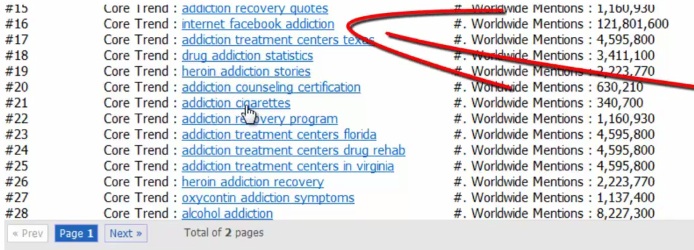
Addiction to social media, specifically Facebook, is one of the top ranked digital addictions, says the trending company. More people are searching for help with Facebook addiction than sex addiction.
internet-facebook-addiction-trending-topic
Image used with permission by copyright holder

“The rise of social media and the fear/need to be in constant contact with status updates and tweets has created a problem for people with addictive personalities,” says ITM. “The fact that accessing Facebook is so easy no on mobile or tablet devices only feed the addiction.  New TV sets are being sold now with Facebook and social media widgets built into the remote control.  The need to be updating and “in a loop” is growing ever more important as websites and people flood social media with messages, drowning out personal accounts and peoples interests.”

Recommended Videos

Unfortunately, still topping the list of addictions is alcohol addiction. Drug addictions like heroin and Oxycotin rank highly as well. Facebook ranked as the 16th highest search trend, ranking above cigarettes, sex, and many other forms of addiction. Worldwide, people have searched for “Internet Facebook addiction” 121.8 million times in recent days.

Do you know anyone who is addicted to the Internet or addicted to a social networking site like Facebook, or is this more of a fad than anything else? And what about the news that Facebook actually kickstarts sex in a relationship? Could Facebook be fueling other forms of addiction?

Jeffrey Van Camp
As DT's Deputy Editor, Jeff helps oversee editorial operations at Digital Trends. Previously, he ran the site's…
Apple will finally stop making iPhone-to-Windows copy-paste such a chore
Your iPhone may finally copy and paste with a Windows PC like it should
Apple Universal Clipboard feature

Copying something on an iPhone and pasting it onto a Windows PC should be one of the least remarkable features imaginable. While this simple process seems effortless between an iPhone and Mac, Windows users are still left waiting.

Now, Microsoft is formally asking Apple to provide interoperable clipboard access through the company’s European Union interoperability process. The request, submitted on March 25, argues that iOS restrictions prevent third-party platforms from creating an experience comparable to Apple’s Universal Clipboard. Apple has now reached Phase III and committed to developing a solution.

Read more
Chrome wants more extension reviews, but good ratings won’t keep malware out
Google is testing built-in extension review prompts, but good ratings can still hide malware
malicious-google-chrome-extensions-on-web-store

Google is preparing to add extension review links directly inside Chrome, putting feedback closer to the menus people already use to manage their add-ons.

A Chromium change, first spotted by Windows Report, points to review options in the Extensions menu, the chrome://extensions management page, and extension context menus. Only eligible Chrome Web Store extensions in good standing would qualify, and the feature is still under development.

Read more
Passkeys were pushed as a safer future. Hackers have figured out ways to break those synced to Google
Google’s “uncopyable” passkeys may be easier to steal than promised
google-lawsuite-AI-Scams

Passkeys have been pushed as the safer successor to passwords. It promised protection from phishing, credential reuse, and password leaks. Google even claims that it cannot be copied or accidentally handed to someone else. But it might not be as secure as the company wants it to be.

Security researchers (Via BleepingComputer) have now found three ways malware can undermine those promises for passkeys synced through Google Password Manager. The techniques, collectively named Pass-ta-key, target Google Password Manager inside Chrome on Windows computers equipped with a Trusted Platform Module. Every attack requires malware to already be running on the victim’s computer.

Read more