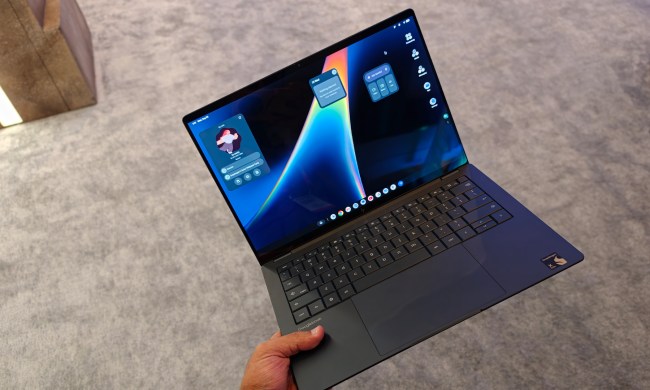
Intel has just announced the release of its 12th-gen Intel Alder Lake P-series and U-series laptop chips. These new chips are made to offer a good blend of performance and energy efficiency, which Intel says will result in an up to 70% performance boost.
The new iterations of Alder Lake will power next-gen ultrathin laptops, and Intel expects more than 250 new laptop designs of this kind to launch in 2022. Intel also shared its Evo Third Edition specification.

Intel shared the news in a press release accompanied by several slides that further explain what we can expect from the new chips. With the new laptop processors, Intel is aiming to minimize power requirements while still offering a noticeable jump in terms of productivity and performance. Intel refers to this as a “massive leap forward” for both ultrathin notebooks and high-performance laptops with lightweight designs.
Much like the rest of the Alder Lake lineup, the new U-series and P-series mobile processors feature Intel’s hybrid architecture, offering a mix of big performance (P) and small efficiency (E) cores. The most high-end processor in these lineups comes with a total of 14 cores, 6 of which are P-cores, with the rest being E-cores.
Intel has definitely scaled back in terms of power requirements. The P-series laptops will offer a greater balance of energy efficiency and performance, while the U-series chips are even more energy-efficient, dropping as low as 9 watts in terms of processor base power. Even though P-series CPUs require more power, they’re still fairly conservative, with up to 28W base and 64W turbo mode requirements.
The new Intel Alder Lake laptops will come with the full range of support offered by the platform, including DDR5/LPDDR5, Wi-Fi 6E, and Thunderbolt 4. Intel promises that we can expect an up to 70% boost in multi-threaded performance compared to its previous-gen Tiger Lake processors.

In addition to the new chips, the laptops come equipped with Intel Iris Xe graphics with up to 96 execution units (EUs.) According to Intel, such improvements can offer up to 30% faster photo editing, making the new notebooks a viable option for creatives. Of course, until these claims are confirmed by independent benchmarks, it’s important to view them with some skepticism. We had already heard good things about P-series notebooks in late 2021.
Intel Alder Lake P-series and U-series laptops are set to arrive in March 2022, and Intel expects more than 250 new notebooks during the course of the year, manufactured by Acer, Asus, Lenovo, HP, Dell, and others. The new chips are following the desktop release of Intel’s 12th-gen CPUs in late 2021, but also its flagship laptop CPUs, the high-performance H-series. Intel Alder Lake H-series is much more power-hungry than its energy-efficient P and U siblings.
TechPowerUp shared Intel’s full press release earlier today. Intel has also announced the third edition of Intel Evo, which is Intel’s specification detailing a set of requirements laptops have to meet in order to be Evo-certified. Intel names conditions such as intelligent collaboration, consistent responsiveness, instant wake, fast charge, at least nine hours of battery life, and dynamic background noise suppression. Laptops will also have to feature 12th-gen Intel Core and provide Wi-Fi 6E connectivity to become certified. Intel expects up to 100 such new laptops to arrive this year.