At its keynote at CES 2018, Intel slid in mentions of its more experimental forms of data processing that could be coming down the pipeline. Amidst talk of the importance of data in virtually every aspect of life, the company believes that the future of computing resides within two key areas: Neuromorphic and quantum computing.
Intel CEO Brian Krzanich made this revelation during his keynote Monday night during CES, showing off two new processors built for these computing segments.
Processors that act like brains
The new neuromorphic computing processor throws out the conventional desktop processor architecture, and instead attempts to mimic how the brain learns and grows on its own. The prototype chip, called Loihi, simulates the brain in silicon by implementing digital circuits (artificial neurons) and pathways. But according to Krzanich, these pathways will change as the chip receives data and self-learns as a result, just like our own brains.
Krzanich said the prototype chip learned how to perform simple object recognition in the company’s labs in just several weeks. He believes this technology will influence “future products and innovations,” and that will start by placing prototype chips in the hands of researchers to discover the true potential of neuromorphic computing. Even more, the chip promises faster machine learning with better power efficiency.
“The Loihi test chip offers highly flexible on-chip learning and combines training and inference on a single chip,” added Intel Labs’ Dr. Michael Mayberry. “This allows machines to be autonomous and to adapt in real time instead of waiting for the next update from the cloud. The self-learning capabilities prototyped by this test chip have enormous potential to improve automotive and industrial applications as well as personal robotics.”
The Loihi prototype chip will be shared with universities and research institutions in the first half of 2018 with a focus on advancing the artificial intelligence field.
The 49-quabit quantum chip
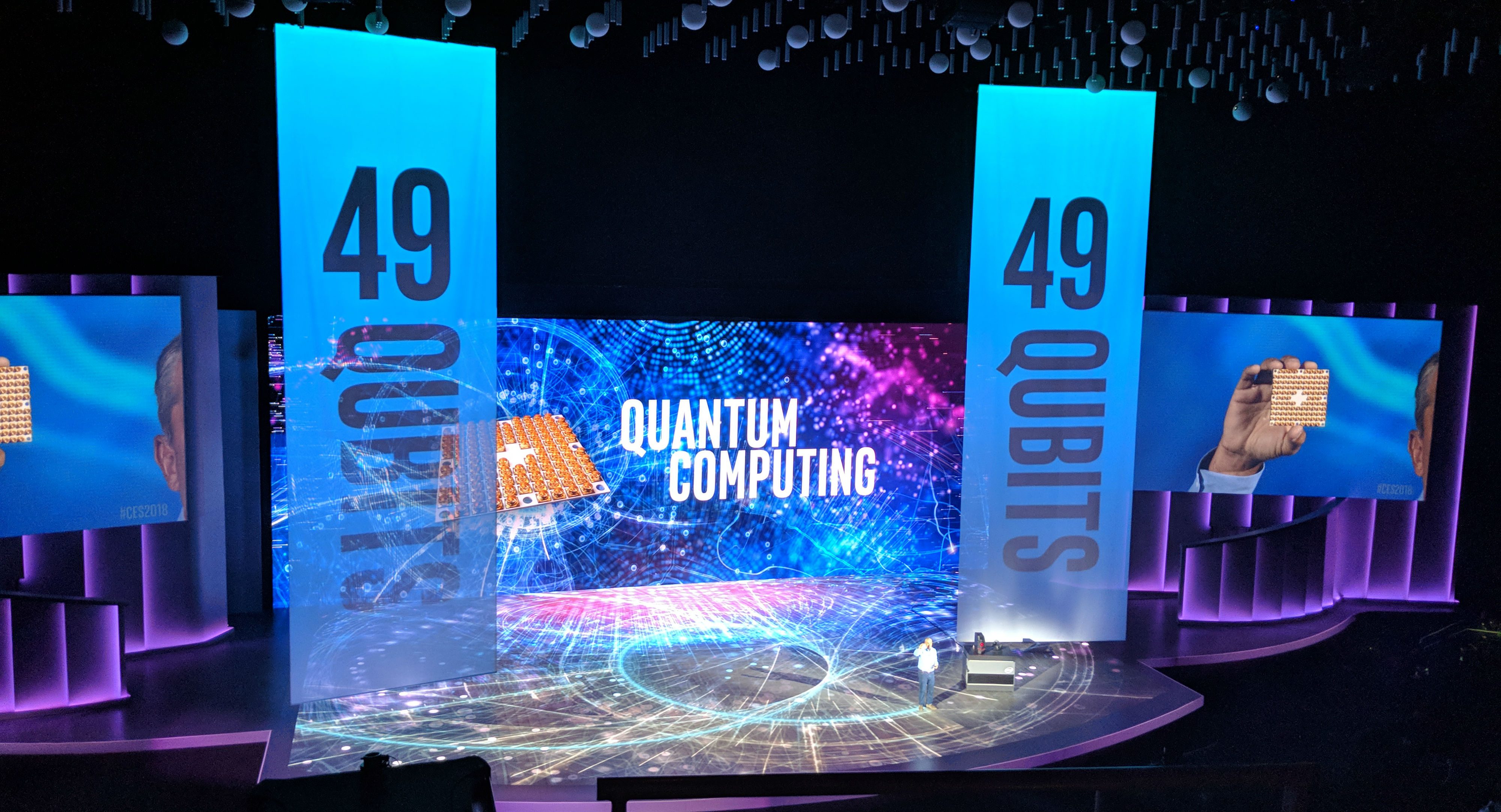
As for the quantum computing aspect, Krzanich predicates that quantum computing could solve problems that the current best supercomputers on the planet could take months or even years to resolve. That’s the driving force behind Intel’s latest quantum computing solution: Its new 49-qubit superconducting quantum test chip dubbed as “Tangle Lake.” The label means the chip contains 49 quantum bits (aka qubits), which are units of quantum information.
Unlike a single “normal” bit that’s either a one or a zero, a quantum bit can be both at the same time. A watered-down definition implies that this dual-personality allows a quantum bit to hold more information. This is why quantum computing is a hot topic regarding the future: As our chunks of data grow larger each day, we’ll need computers that can handle the increasing load in as little time as possible.
With the new Tangle Lake processor, researchers can energize an otherwise “nascent field” to simulate computational problems, and improve error correction techniques. We still have a very long way to go before quantum computing reaches “commercial relevance,” but Intel’s research and development into Tangle Lake seems to be pushing quantum computing forward.
“In the quest to deliver a commercially viable quantum computing system, it’s anyone’s game,” Mayberry added. “We expect it will be five to seven years before the industry gets to tackling engineering-scale problems, and it will likely require 1 million or more qubits to achieve commercial relevance.”