
Lenovo appears to be working on a follow-up to its Yoga Book according to a listing on the Bluetooth SIG website. It’s labeled as the Yoga Book 2 Pro along with the Yoga Book Pen 2. This is a 2-in-1 we’ll likely see this fall during the back-to-school season although the “pro” branding seemingly suggests older students much like the original target audience for the Surface Laptop sporting Windows 10 S.
We don’t know any of the hardware specifics associated with the Yoga Book 2 Pro just yet outside the obvious Bluetooth connectivity. The original version launched in August 2016 during the IFA show in Germany packing either Windows 10 Pro or Android Marshmallow (aka Book UI). It was followed by the A12 in 2017 sporting a larger screen and a smaller price, but without the Yoga Book branding.
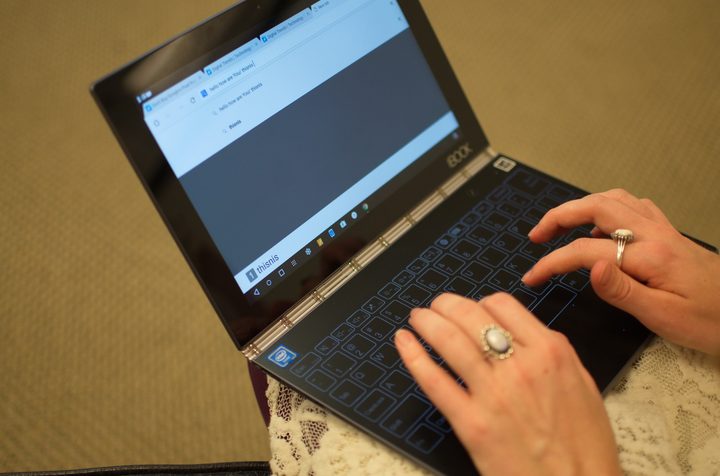
At its heart, the Yoga Book is a 2-in-1 device although Lenovo heavily uses the “tablet” term. It sports a tablet-like 10.1-inch screen that is connected to an all-black “touchscreen” of the same size using a unique, 360-degree three-axis hinge.
“The hinge is engineered to be smaller and features a custom-made three-axis hinge, with 130 different mechanical pieces comprising five different materials,” the company says. “Lab tested more than 25,000 times, the Yoga Book form offers a smooth, seamless transition between the four modes — Browse, Watch, Create and Type.”
It’s this touchscreen that makes the Yoga Book unique: It replaces a physical keyboard with a touch-based Halo Keyboard that appears when needed. Want to draw or manually write? The Halo Keyboard will convert into the Create Pad supporting the included Real Pen stylus. Lenovo’s peripheral supports 2,048 levels of pressure so that every stroke looks just as good in digital form as it does on paper. The benefit here is that, unlike tablets, your hand isn’t blocking the screen when you draw.
The current model still in stock relies on Intel’s Atom x5-Z8550 “Cherry Trail” mobile processor, 4GB of system memory (LPDDR3), and 128GB of storage. The screen itself is based on IPS technology providing wide viewing angles and rich colors. It packs a 1,920 x 1,080 resolution, 16.7 million colors, and a brightness of 400 nits. The screen is joined by an 8MP auto-focus camera on the back and a 5MP fixed-focus camera on the front.
As for other specifications, the Yoga Book measures just 0.38 inches thin, provides Wireless AC (433Mbps) and Bluetooth 4.0 connectivity, and relies on an 8,500mAh battery promising up to 13 hours on a single charge. The Windows 10 Pro version ships in Carbon Black while the now-depleted Android stock shipped in Gold or Gunmetal.
What Lenovo plans to shove into the Yoga Book 2 Pro is anyone’s guess although you’ll likely not see an Atom processor in this installment. Given the A12 was a larger 12.2 inches, perhaps we will see the Yoga Book 2 Pro move up into laptop territory with a 13.3-inch screen, an eighth-generation Intel Core processor, and maybe even discrete graphics. A Chrome OS-based version is possible, too, even though the rumored first-generation Yoga Book version never showed up in 2017.