  1. Home
  2. Computing
  3. Legacy Archives

Symantec finds new worm with ‘Here you have’ e-mails

Add as a preferred source on Google
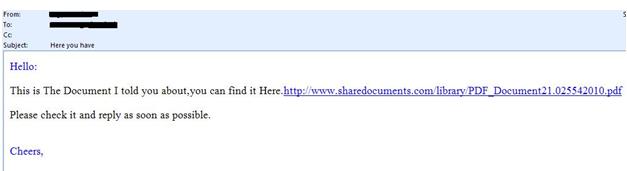
Email with Subject Here You Have
Image used with permission by copyright holder

A new malicious worm is being spread through e-mails with the subject line, “Here you have,” said security giant Symantec on its Security Response blog. The Security Response team is actively monitoring the threat.

The e-mail asks the recipient to click on a link embedded in the message. Disguised as a PDF file, this link points to a malicious program file online. When the user clicks on this link, the program file is downloaded and executed, installing the worm on the computer. The Security Response team identified the worm as W32.Imsolk.B@mm, and noted it may disable antivirus products, so the user remains unaware of the attack. W32.Imsolk.B@mm is also known as W32/Autorun-BHO by Sophos, W32/VBMania@MM by McAfee, and WORM_MEYLME.B by Trend Micro.

Recommended Videos

Once the computer is compromised, the worm attempts to send the original e-mail to all addresses found in the user’s addressbook, or to hop through the LAN infecting other computers by copying to open drive shares on the network. Merely opening the folder containing the worm executes it. E-mail servers are getting overwhelmed as the compromised machines automatically create and send a large volume of messages.

In addition to removable and mapped drives, the mass-mailing worm spreads through shared folders and instant messaging. If you suspect your computer has been infected, take it offline immediately and disconnect devices to prevent spreading the worm through the local network.

Just as an aside, even though the link appears to be a PDF file, this latest attack is not the zero-day exploit for Adobe Acrobat and Reader. This is pure social engineering, where the attack requires the user to click on a link in an e-mail. While not new, hackers continue to find it effective.

Fahmida Y. Rashid
Former Digital Trends Contributor
TSMC might set up a price hike that could come straight for your next phone, laptop, or tablet
Here's what TSMC's rumored 10% chip price increase actually means in dollar terms, and why your next phone or laptop could end up costing more.
TSMC Fab

My wallet flinched the second I saw the words "TSMC" and "price increase" in the same headline, and honestly, yours should too.

Turns out the company behind the silicon powering basically every flagship device out there, including Apple’s A-series and Qualcomm’s Snapdragon processors, is reportedly about to make all of it a little pricier.

Read more
Apple fixes Hide My Email bug that exposed users’ real email addresses
Here's how Apple's Hide My Email flaw leaked real addresses for over a year, and why it only got fixed once the story went public.
apple-merging-sign-in-with-apple-hide-my-email-icloud+

Turns out the "Hide" part of Hide My Email wasn't doing its job quite as advertised, something that I covered early in July. Security researcher Tyler Murphy reported the flaw in June 2025, but despite Apple claiming it was resolved in March 2026, independent tests confirmed it remained exploitable, at least until July 3, 2026.

So how did this bug actually work?

Read more
Gemini Notebook’s new Collections arrive just as Google turns it into a bigger workspace
Google is cleaning up notebook organization as the former NotebookLM expands across Gemini and Search
Gemini Notebook branding on a MacBook

Google has barely finished renaming NotebookLM, and it’s already addressing one of the headaches that comes with building a large research library.

Collections are rolling out to all Gemini Notebook users, giving them a way to group related notebooks while keeping everything visible under My Notebooks. The dashboard gets some structure without asking users to rearrange the library they’ve already built.

Read more