  1. Home
  2. Computing
  3. Mobile
  4. Legacy Archives

$99 UDOO mini ARM computer has 4 times the power of a Raspberry Pi

UDOO_kickstarter2A Raspberry Pi may be cheap, but it also isn’t very powerful. You’re really out of luck if you want to work on a project that has a touchscreen or needs Wi-Fi connectivity because the $25 mini computer just isn’t equipped to handle those technologies.

UDOO, the newest single-board computer to take Kickstarter by storm, aims to give ambitious DIYers the computing oomph they need to turn their ideas into reality (or at least be able to test them out cheaply and easily).

Recommended Videos

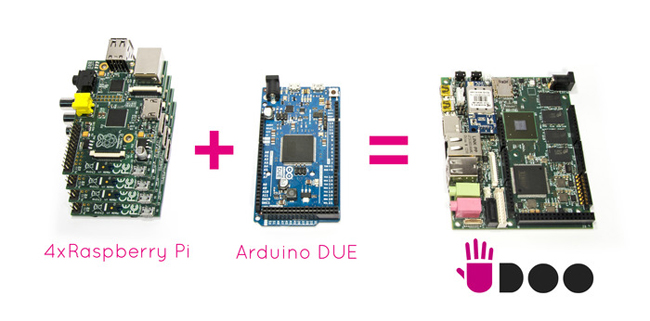
Just how powerful is the UDOO? According to its Kickstarter project page, one UDOO is equivalent to four Raspberry Pis, combined. As you can see in this illustration from Team UDOO, the mini computer is literally crammed with all the latest components you can imagine: an ARM-based processor, support for the Ardurino DUE board, an Ethernet port, Wi-Fi chip, an HDMI out, and touchscreen support. On the software side, this mini computer runs both Android 4.0 and Linux, which is ideal for projects that need to work on both platforms.
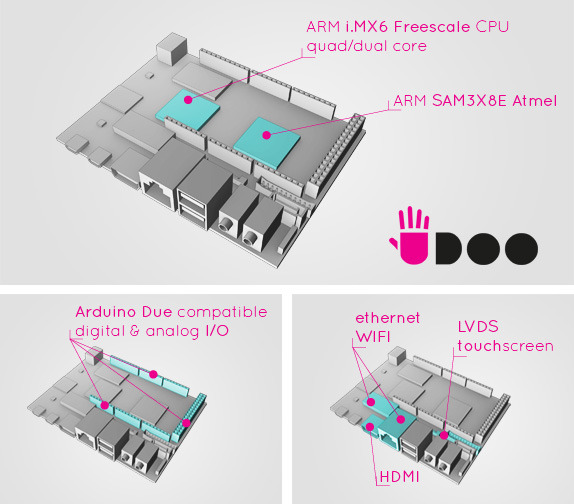
UDOO specs
Image used with permission by copyright holder

There are two basic configurations of the UDOO that you can back, depending on how much you want to pledge.

You need to hand over at least $99 to get the entry-level “Early Bird” UDOO, which uses the dual-core cortex-A9 Freescale processor and has both Wi-Fi chip and Ethernet plug. Only 77 units are available at this price point as of this writing, so you’ll have to pay $109 for the same device once this “Early Bird” category sells out. If you rather have the variant with the  quad-core chip, you’ll need to pledge no less than $129. The cheaper “Early Bird” special for this more powerful configuration has already sold out.

UDOO has already met its modest funding goal of $27,000, even though its campaign won’t wrap until June 8, so backers don’t have to worry about this product not making it past Kickstarter. In fact, it has already raised over $147,000 and the number keeps increasing as we write this post. According to the team behind this device, UDOO is about 80 percent ready to be manufactured, which means it should be able to meet its estimated ship date of September 2013.


Gloria Sin
Former Contributor
Gloria’s tech journey really began when she was studying user centered design in university, and developed a love for…
Google Lens is becoming part of Chrome’s native AI interface
Google is testing a new AI-powered side panel experience in Chrome
Google Lens brings visual searches to the phone.

Google is trying out a major tweak to how AI works inside Chrome, specifically by mashing up Google Lens with the browser's native AI side panel. Right now, this is popping up in Chrome Canary - the experimental playground where Google tests new features before they go mainstream.

The big shift here is that Lens isn't just acting as a standalone tool for looking up images anymore. Instead, it now triggers Chrome's full AI interface right in the side panel, blending image search, page reading, and chat into one unified spot.

Read more
You can now ask Gemini questions about your NotebookLM notebooks
The NotebookLM integration is currently limited to Gemini on the web.
NotebookLM research results

We recently learned that Google was prepping a new feature that would allow users to ask Gemini questions about their NotebookLM notebooks. Although Google still hasn't made anything official, this feature now appears to be rolling out to users.

According to recent X posts from Sai Nemani and TestingCatalog, the attachment menu in Gemini on the web now includes a NotebookLM button. This option lets users attach a notebook and ask Gemini questions about the attached notebook to get more relevant responses.

Read more
Asus is now offering the Nvidia GeForce RTX 5060 in two new flavors
New RTX 5060 EVO cards introduce a slimmer 2.1-slot design
asus-nvidia-GeForce-RTX-5060-evo

ASUS has quietly added two new models to its GeForce RTX 5060 lineup that look almost identical to existing cards at first glance but come with several hardware tweaks. Without any formal announcement, ASUS has listed the Dual GeForce RTX 5060 EVO and Dual GeForce RTX 5060 Ti EVO on its website. These cards sit alongside the standard RTX 5060 and 5060 Ti, offering the same core performance while reworking the physical design and internal layout.

The most noticeable change is size. Both EVO cards use a slimmer 2.1 slot design instead of the 2.5 slot layout used by earlier versions, making them more suitable for compact PC builds. ASUS also redesigned the PCB to use a shorter PCIe x8 edge connector rather than a full length x16 connector (via Vortez).

Read more