1. Home
  2. Computing
  3. Trash
  4. News

This 240W USB-C cable opens up new charging possibilities

Add as a preferred source on Google

The first USB Type-C cables capable of providing huge amounts of power are here: Small retailer Club 3D launched three new cables that can each deliver up to 240 watts of power.

Such a power draw means that you should be able to charge most laptops with the new 240W USB-C cable, marking a huge change from the current maximum capabilities of this technology.
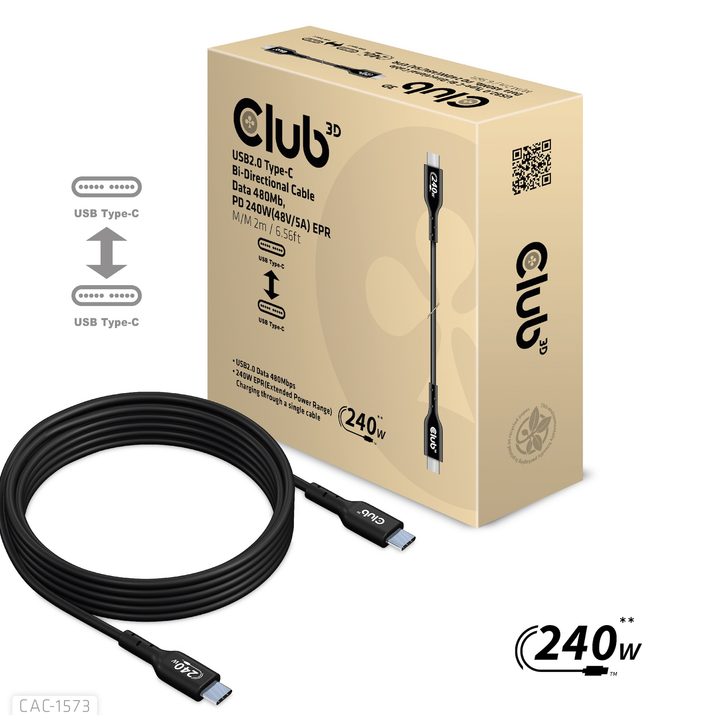
USB-C cable from Club3D.
Club3D

USB Type-C cables have been gaining in popularity consistently over the past few years, and the only thing that held them back was their relatively low power delivery. This should slowly begin to change after the introduction of the updated USB Type-C 2.1 specification released last year by the USB Implementers Forum (USB-IF). The new spec brought the power delivery from 100W up to 240W, but up until now, such cables haven’t made it to market. Club 3D changes that by introducing three new USB-C cables, each with 240W power delivery.

The three cables vary in their specifications and capabilities, and only the top cable (CAC-1576) can support a 240W peak wattage (48 volts and 5 amps) while maintaining the full USB4 40Gbps data-transfer rate. This is done through the Thunderbolt 3 protocol. It can also provide video through DisplayPort alt mode at a maximum quality of 8K 60Hz.

The remaining two models, CAC-1575 and CAC-1573, offer lower specifications. The midtier offering brings USB4 20Gbps data transfer and up to 4K/60Hz video, while the presumably cheapest model supports the 240W power delivery, but the data-transfer capabilities are largely reduced, all the way down to USB 2.0 and 480Mbps.

The previous maximum of 100W (20 volts and 5 amps) was insufficient for a lot of tasks, making something like charging a laptop via USB-C a bit of a chore — it could take a while for the device to charge up to full, and the best gaming laptops likely required more wattage than the cable could provide. However, with the upgrade to 240W, we may soon be able to charge our laptops through a USB-C cable.
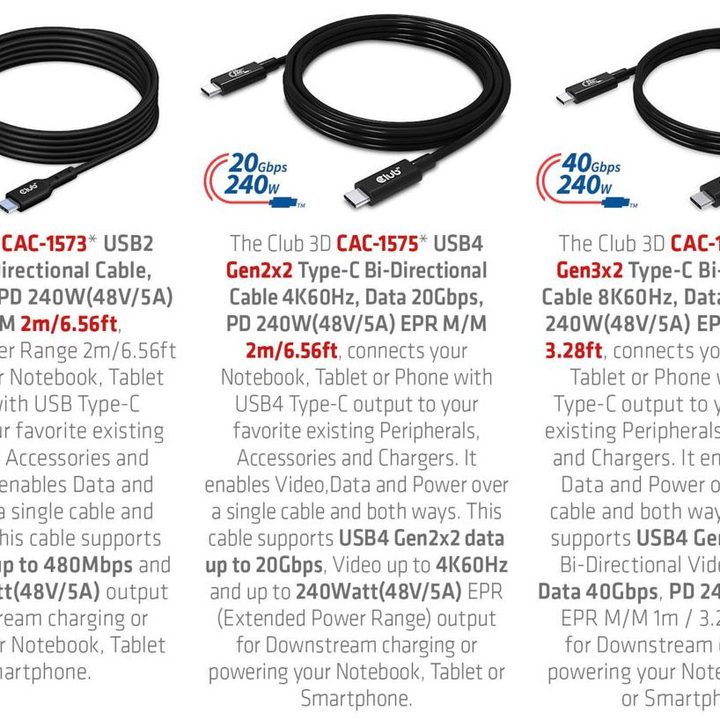
Club3D USB-C cables.
Club3D

It’s exciting to see new emerging tech, and the fact that we’re seeing these cables bodes well for the future of USB-C. However, before you jump the gun and buy one of Club 3D’s new products, be warned — you may not be able to utilize them to their maximum potential just yet.

As of right now, there don’t seem to be any compatible chargers that will support the 240W power draw of the new cables. According to Tom’s Hardware, Club3D’s top charger maxes out at 132W. Without a matching charger, the cable alone won’t be able to provide the full 240W output. On the other hand, with the emergence of these new USB-C cables, the chargers are soon likely to follow.

Club 3D lists a number of retailers on its website, but at the time of writing, none seem to have the product in stock just yet. If you want to get your hands on the new USB-C cable, make sure to check back soon.

Monica J. White
Monica is a computing writer at Digital Trends, focusing on PC hardware. Since joining the team in 2021, Monica has written…
HP has a new $799 mini PC for fans of the Mac mini form factor
The OmniDesk Mini puts Wildcat Lake inside a tiny desktop that starts at $799
HP OmniDesk Mini Desktop

HP has a new mini PC on sale in the U.S., and it is difficult to look at the machine without thinking of Apple's Mac mini. The OmniDesk Mini has a similarly compact footprint and starts at $799.99, making it $100 cheaper than the recently announced M6 Mac mini.

The similarities mostly stop there. The base OmniDesk Mini is powered by Intel's Core 3 304, a five-core, five-thread Wildcat Lake processor. It comes with 8GB of LPDDR5X memory and a 256GB SSD. HP also offers Core 5 320 configurations with up to 16GB of memory. So, despite the Mac mini-like dimensions, this is better viewed as a compact Windows PC than a direct rival to Apple's latest desktop.

Read more
Exclusive: Microsoft explains why RTX Spark’s Prism emulation is about more than higher FPS
Because an erratic 80 FPS will always feel worse than a silky-smooth 60.
ARC Raiders with Anti-Cheat Support running on NVIDIA RTX Spark Laptop

NVIDIA’s RTX Spark may pack a powerful Blackwell GPU, but its ability to run the massive library of existing PC games on Arm depends on a quieter piece of technology: Microsoft’s Prism emulator. Prism allows x64 Windows games and applications to run on RTX Spark’s Arm-based CPU without requiring developers to immediately rewrite them for ARM64.

During an exclusive conversation at NVIDIA’s private IFA 2026 demo, Microsoft’s Peter Dawoud explained that the latest Prism work isn't just about pushing emulated workloads to higher FPS. Microsoft is also focused on performance consistency, particularly in GPU-heavy games where the CPU still has to coordinate frames, physics, and rendering. Because a higher average FPS doesn't always mean a smoother experience, that could prove to be one of Prism’s most important improvements yet.

Read more
The best screenshot app for Mac just became a screen recording powerhouse
CleanShot X already made screenshots easy. Now it wants to make screen recording and editing just as painless.
CleanShot-X-version-5-running-on-Mac

CleanShot X is the best screenshot app for Mac. It's one of my favorite Mac apps, and I've already covered all its features in a previous article. The app just received its 5.0 update, and it's such a massive release that I had to write about it.

CleanShot X already had a built-in screen recording feature, but it was pretty bare-bones. With this update, the app has grown into a proper screen recording studio. You can now record your Mac's screen, edit that recording, add zooms and backgrounds, and do a whole lot more without ever leaving the app.

Read more