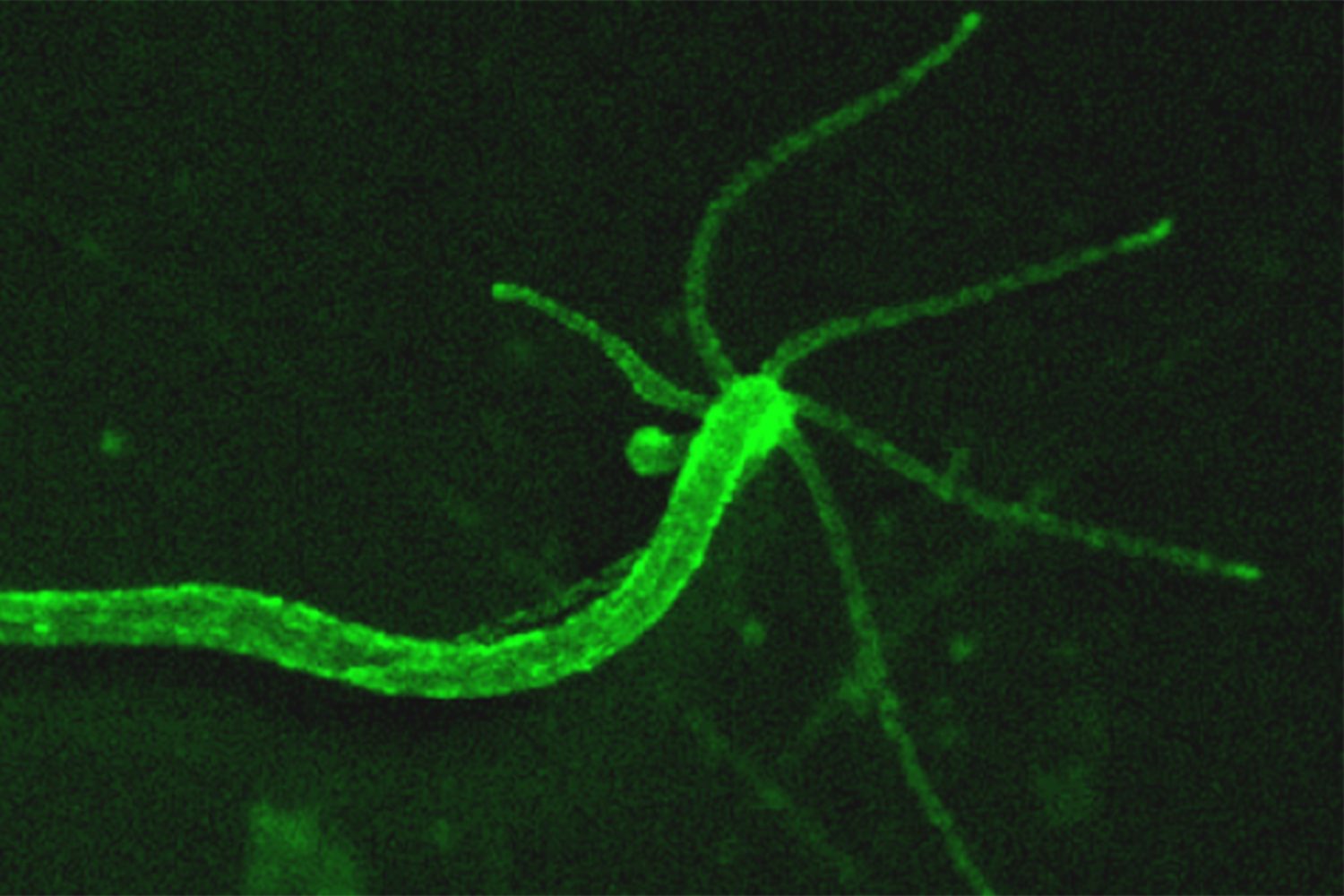
Like the sentient toys in Toy Story, animals seem to lead exciting lives when humans aren’t watching. Ancient creatures called Hydra, on the other hand, don’t seem to do much at all. But that’s what makes them so interesting.
In a recent study, researchers used a machine learning algorithm — one that is usually used to filter spam email — to catalog Hydra behavior. With one of the simplest nervous system on Earth, Hydra give scientists a basic sample to study how neural activity relates to physical activity, potentially paving the way for future research into predicting animal behavior.
“Learning animal behaviors from videos is just like learning topics from the text in a document,” Rafael Yuste, a neuroscientist at Columbia University who led the study, told Digital Trends. “Hours and hours of videos of animal behavior can be considered as documents, and each behavior can be considered as a ‘topic.’ Spam-filtering algorithms are used for automatic text recognition and learn to first classify the potential topics of each document, then pick out topics that could be spam related, for example. It is essentially the same here — we treated videos as collections of visual words … and trained spam-filtering algorithms to pick out the behaviors in each video.”
In prior research, Yuste and his team were able to record the full range of the Hydra’s neural firing in real time, helping them illuminate how the animal’s nervous system controls its behavior.
In this study, they fed the unblinking, spam-filtering algorithm hours of Hydra video — not unlike Alex strapped into a cinema chair in A Clockwork Orange — and programmed it to spot things like motion and shapes, to determine behavioral activities, as the animals were introduced to various environments.
Their hope is that by comparing the animal’s behaviors to the firing of its neurons, they can unlock the link between it’s neural and physical activity.
The method the researchers used is flexible enough to apply larger, more complex animals, Yuste said, “therefore [it] could be widely generalized to any animals of interest, including humans.”
The end goal is to crack the “neural code,” or the connection between nervous system activity and behavior. “If we could do this, we should be able to look at the neuronal activity and predict what the animal is doing and what it wants to do,” Yuste said.
In the more immediate future, the research could help support engineering projects that need stability and control through variable conditions. That’s because, throughout the many hours of video, the Hydra barely changed its behavior.
“This robustness in behaviors implies a robust control from the nervous system, which could be useful for a branch of engineering concerned with maintaining stability and precise control in machines, from ships to planes, navigating in highly variable conditions,” Yuste said.
A paper detailing the research was published in March in the journal eLife.