1. Home
  2. Emerging Tech
  3. News

This vending machine sells pixels, not Pepsis, to help digital artists

Add as a preferred source on Google

It seems like just about every aspect of our lives has adapted to technology, and now even art is morphing into a more digital form to become more accessible to artists and art seekers alike. 

To capitalize on the digital art world, artist Danner Milliken came up with the idea for a digital art vending machine, marrying technology and art into one device that not only serves as a product, but as an art exhibition in and of itself. 

Recommended Videos

Milliken came up unNETceptional, a digital art vending machine, to help popularize digital art in a world where physical and tangible art pieces are still people’s only idea of art. 

“This original meaning of the word is what this whole art project is about, normalizing the collecting of digital art in digital formats — such as JPEGs, GIFs, PNGs — and getting the people to view these formats by digital art screens, projectors, VR headsets, and so on,” Miliken explains in the campaign’s Kickstarter. (As always, be wary of the risks of crowdfunding before committing your hard-earned money.)

He’s hoping to raise $168,000 to get the vending machine manufactured and running by summer 2020. Once it’s created, people will be able to walk up and purchase digital art in the form of USBs from the vending machine, which will be located on a New York City street. Milliken has chosen six different contemporary artists to showcase in the first vending machine. 
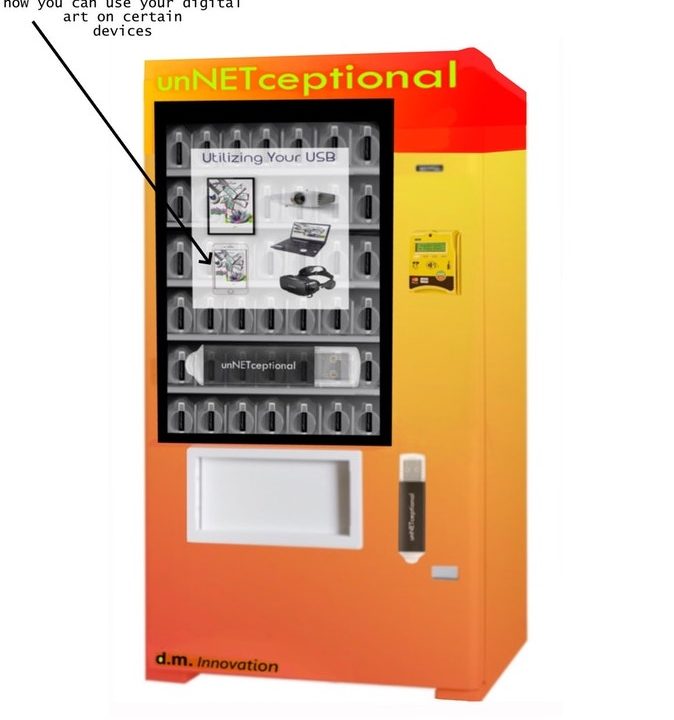
Image used with permission by copyright holder

In the future, Milliken hopes that his digital art vending machine will be of use to places like museums and art galleries, where people can have better access to quality art in the digital form. 

“Thinking outside the box is essential and will push digital art more and make it more respectable,” Milliken told Digital Trends. “Sometimes, it can get a bad look just because it’s got the word digital in it, but there’s a lot of really great, interesting stuff people can collect.”

He added that in the realm of augmented or virtual reality, digital art really has its own space in both the art world and the tech world. 

“What better way though to ‘normalize’ collecting digital art than setting up a vending machine on the sidewalk for the public to come across,” he said. 

Milliken is confident that the art world will open up to new digital horizons. 

“People can take technology and find something inside that maybe we haven’t ever seen, and it just opens up new doors for everyone,” Milliken said. 

Allison Matyus
Former Digital Trends Contributor
Allison Matyus is a general news reporter at Digital Trends. She covers any and all tech news, including issues around social…
Anti-surveillance clothing is getting cheaper, but don’t expect an invisibility cloak
Affordable shirts now claim to confuse facial recognition, although their protection depends heavily on the camera and software watching you
Chart, Plot, Adult

Anti-surveillance clothing is starting to look less like an art-school experiment and more like something you could actually wear outside. Shirts designed to confuse facial recognition systems now cost about as much as ordinary streetwear, although buying one won’t make you disappear.

The Guardian reports that designers are using face-like prints, unusual cuts and infrared lights to interfere with computer vision. These techniques target specific weaknesses, so their success depends on what happens to be watching you.

Read more
This spinning drone hides in plain sight using a visual illusion
This drone doesn't turn invisible. It tricks your brain into thinking it has.
Phantom Twist

For decades, engineers have chased the dream of an invisible drone. The usual approaches have involved transparent materials, camouflage coatings, or complex optical systems that bend light around an object. Researchers at Northwestern University decided to take a completely different route. Instead of hiding the drone itself, they chose to fool the human eye.

The result is Phantom Twist, an experimental drone that spins so rapidly it almost disappears into the background. It's not technically invisible, but to anyone watching, it looks more like a faint blur than a flying machine.

Read more
This smart knitted fabric can flip switches, count your steps, and even change shape
Grandma's knitting just entered its Iron Man era
Representative Image

For most of us, knitting brings to mind sweaters, scarves, and perhaps an ambitious grandmother determined to make winter more fashionable. Researchers at Harvard University, however, have a far more futuristic vision. They've transformed ordinary knitted fabric into a programmable material capable of changing shape, acting as an electrical switch, sensing movement, and potentially forming the foundation of tomorrow's wearable technology.

The research, published in Advanced Functional Materials by scientists at the Harvard John A. Paulson School of Engineering and Applied Sciences (SEAS), demonstrates how machine-knitted textiles can "snap" between multiple stable shapes without relying on motors or rigid mechanical parts.

Read more