1. Home
  2. Emerging Tech
  3. Outdoors
  4. News

Awesome new 'drone in a box' system can launch, land, and recharge itself autonomously

Add as a preferred source on Google

A bit like a twenty-first century “jack in the box,” a bold new all-in-one drone solution takes the form of a box, which opens up to act as a launch pad for a drone, capable of carrying out autonomous missions, before returning to its home to have its batteries automatically swapped out.

It’s the product of excellently-named startup Airmada, and promises to take the current meaning of unmanned aerial vehicle (UAV) to the next level.

Recommended Videos

“The Ground Station enables commercial drone applications at a fraction of the cost,” Airmada’s business development manager Jacqueline Khoury told Digital Trends. “It is the last essential element to enable the widespread use of drones. This Ground Station allows for autonomous drone applications in the commercial space. It eliminates the need for a human operator to [act as the] pilot.”

In terms of possible applications, Khoury said the company’s new drone offers the added benefit of 24/7 possible operation.
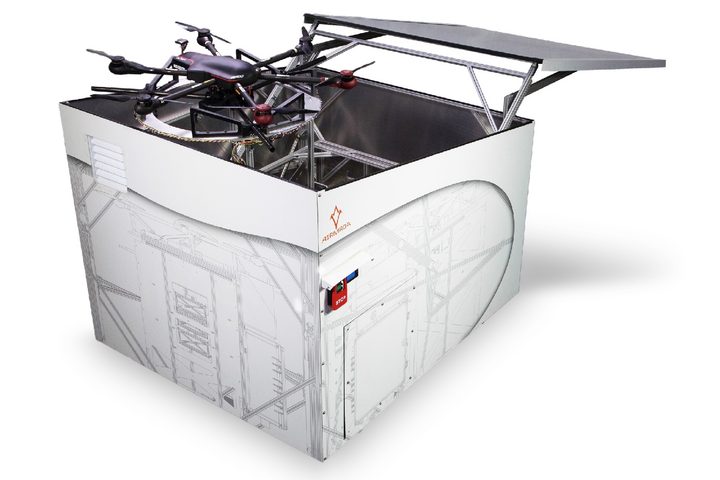
Image used with permission by copyright holder

“The main application for this technology is on-demand surveillance for CIP (Critical Infrastructure Protection),” she continued. “In the face of safety and security risks of industrial physical assets and infrastructure, industrial operators need better data – situational and spacial awareness to make better calculated decisions. With a drone on standby, the Ground Station provides the possibility to automatically deploy a drone flight attain situational awareness. It addresses time sensitive on-demand missions, as well as recurring events that need to be addressed.”

This could make it an invaluable tool for everything from agriculture and construction to deliveries: basically any area that would benefit from scaling its drone operations, while cutting costs.

In terms of availability, Khoury said that Airmada is currently working with a number of groups requiring on-demand security surveillance. “We foresee the adoption of our stations in several industries moving forward,” she noted.


Luke Dormehl
I'm a UK-based tech writer covering Cool Tech at Digital Trends. I've also written for Fast Company, Wired, the Guardian…
Students who use AI every day may be falling behind, while moderate users pull ahead
New global testing data suggests more AI in the classroom isn't automatically better.
Logo, Text

I assumed more AI access might help students learn faster. However, a new OECD study dispels that misconception for me and everyone else who gave their children a paid version of AI chatbots, thinking it would help them through their educational journey. 

According to PISA 2025 data from 760,000 students in 91 countries, students who use AI daily score meaningfully worse on standardized tests than their peers. The full picture is more complicated than a simple ban would fix.

Read more
XPENG just put its humanoid robot on the production line, and it walked itself out
IRON clocks in for its first shift
XPENG Iron

XPENG’s humanoid robot has officially joined the workforce, and it even got an employee badge. The Chinese automaker announced on September 8 that its next-generation IRON had completed assembly and autonomously walked off its newly commissioned humanoid robot production line in Guangzhou.

CEO He Xiaopeng then pinned a staff badge onto the robot, symbolically welcoming it to the XPENG team. It is a charming little ceremony for a machine that the company hopes will eventually become a regular part of everyday life. XPENG is moving IRON beyond R&D prototypes toward production-line manufacturing, applying the quality-control systems and manufacturing experience it has developed through its electric vehicle business.

Read more
An AI-designed drug might help slow aging, but we’re not there yet
The results hint at a possible anti-aging effect, but there’s still a long way to go before we know what it means.
medical test tubes

Rentosertib, a drug Insilico Medicine designed almost entirely using AI, was created to treat idiopathic pulmonary fibrosis, a disease that scars and stiffens the lungs over time. But fighting lung disease was only half the plan from the start.

According to a new study published in Nature Biotechnology, the drug's target was chosen specifically because it overlaps heavily with the biology of aging, and the whole trial was designed to test whether treating the lungs could also mean turning back the body's biological clock.

Read more