
  1. Home
  2. Emerging Tech
  3. Legacy Archives

MIT students develop wearable cooling device that could make air conditioning obsolete

Add as a preferred source on Google

We come across quite a lot of cool technology here at DT, but it’s not every day that we find something that can literally cool you down. 

Developed by four engineering students at MIT, Wristify is a prototype wearable device that leverages the physical phenomenon known as the Peltier effect to reduce your body temperature.

Recommended Videos

The Peltier effect, named for French physicist Jean Charles Athanase Peltier who discovered it in 1834, describes the phenomenon of heating or cooling caused by an electric current flowing across the junction of two different conductors. As the current moves from one conductor to another, the transfer of energy causes one side to heat up and the other to cool down.
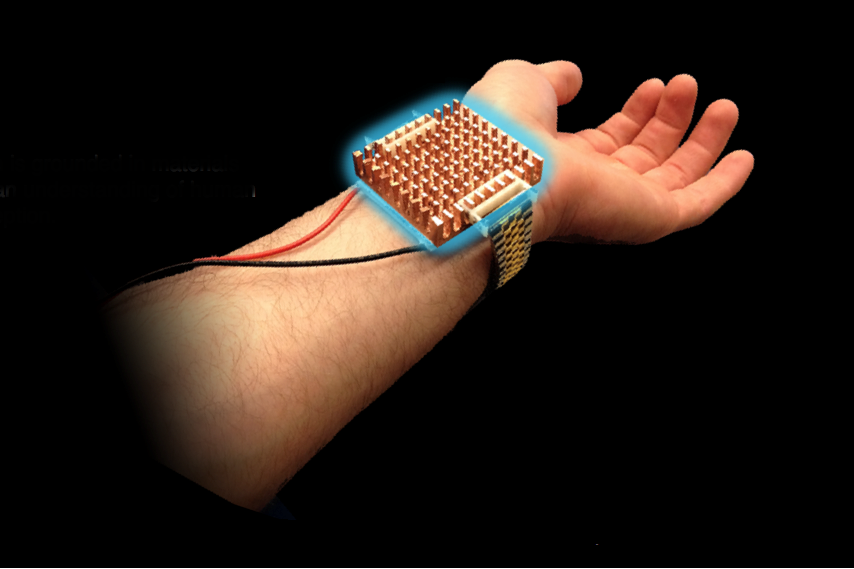
wristify MITWristify is basically a series of these junctions (called a Peltier cooler) powered by a small battery and attached to a wrist strap. When placed against the skin, the device makes you feel cooler by reducing the temperature of your wrist a few fractions of a degree per second for a couple seconds at a time. Over the course of a few minutes, this process will cause you to perceive a whole-body cooling of a couple degrees celsius. The team developing the device is still tinkering with it to figure out the optimal cooling cycle, but at this point in time they say the most effective method is to cool your wrist by 0.4 degrees Celsius (0.7F) per second for five seconds, and then turn off for 10 seconds.

The chief benefit of this device is that it offers a more personalized approach to temperature control, one that’s vastly more efficient than current heating and cooling methods. It takes millions of watts to raise or lower the temperature of an entire building, but Wristify can run on a small lithium battery. If everybody had one of these things on their wrist instead of relying on air conditioning or heaters all the time, the potential energy savings could be massive.

Of course, it’s still just a prototype, but the idea recently won the $10,000 top prize in MIT’s annual Making And Designing Materials Engineering Competition, and the team plans to put all that cheddar toward further development of the device. Find out more here.

Drew Prindle
Former Senior Editor, Features
Drew Prindle is an award-winning writer, editor, and storyteller who currently serves as Senior Features Editor for Digital…
AI bots are now trying to sabotage public health policies, like banning disposable vapes
Thousands of AI bots voted in a public health poll to block sales restriction on disposable vapes. It's like Big Tobacco is back from the dead.
Woman smoking a vape.

In the broad context of AI and its perceived harms, health and medical risks often pop up in the conversation. The warnings even come from frontier AI labs, such as ChatGPT-maker OpenAI and Anthropic, both of which have warned about misusing AI to cook up bioweapons. Security experts have already spotted a few such incidents in the wild, especially with the usage of AI models without any solid guardrails. 

Well, it appears that the risks run deeper. As per an analysis appearing in the British Medical Journal (BMJ), AI bots are now being deployed to influence public policies governing health risks to citizens. In this instance, an attempt was made using AI bots to thwart regulations that aim to restrict the sale of disposable vapes, all while disguising the manipulation efforts as a response from real humans. 

Read more
A tiny smartphone gadget can detect some of the nastiest chemicals in your water
Scientists built a tiny smartphone gadget that can spot toxic 'forever chemicals'
Smartphone-connected drinking water safety sensor Featured

What if checking your drinking water for dangerous chemicals were as simple as plugging a tiny gadget into your smartphone? Researchers in Japan have developed a compact sensor that could make that possible, potentially bringing sophisticated water contamination testing out of expensive laboratories and into people's hands.

Scientists at the Okinawa Institute of Science and Technology (OIST) have created a portable device capable of detecting extremely low concentrations of PFAS, commonly known as "forever chemicals." The findings were published in the journal Biosensors and Bioelectronics, which demonstrate how an inexpensive sensor and a smartphone could make identifying potentially harmful chemicals in water a lot easier.

Read more
Did comets help life begin on Earth? New simulations challenge the idea
A Cambridge-led study finds that impact speed and angle made successful delivery extremely unlikely
Comet

Comets probably weren’t reliable couriers for the ingredients that helped life begin on Earth. A new Cambridge-led study found that fragile organic molecules would usually have been destroyed when the comets carrying them struck the surface.

Published in Scientific Reports, the research tracked hydrogen cyanide, a molecule involved in chemistry that can precede life. Rare successful deliveries remain possible, but the simulations offered little support for a steady supply from comets.

Read more