  1. Home
  2. Emerging Tech
  3. News

Spooky NASA posters highlight the mysterious world of exoplanets

Add as a preferred source on Google
Image used with permission by copyright holder

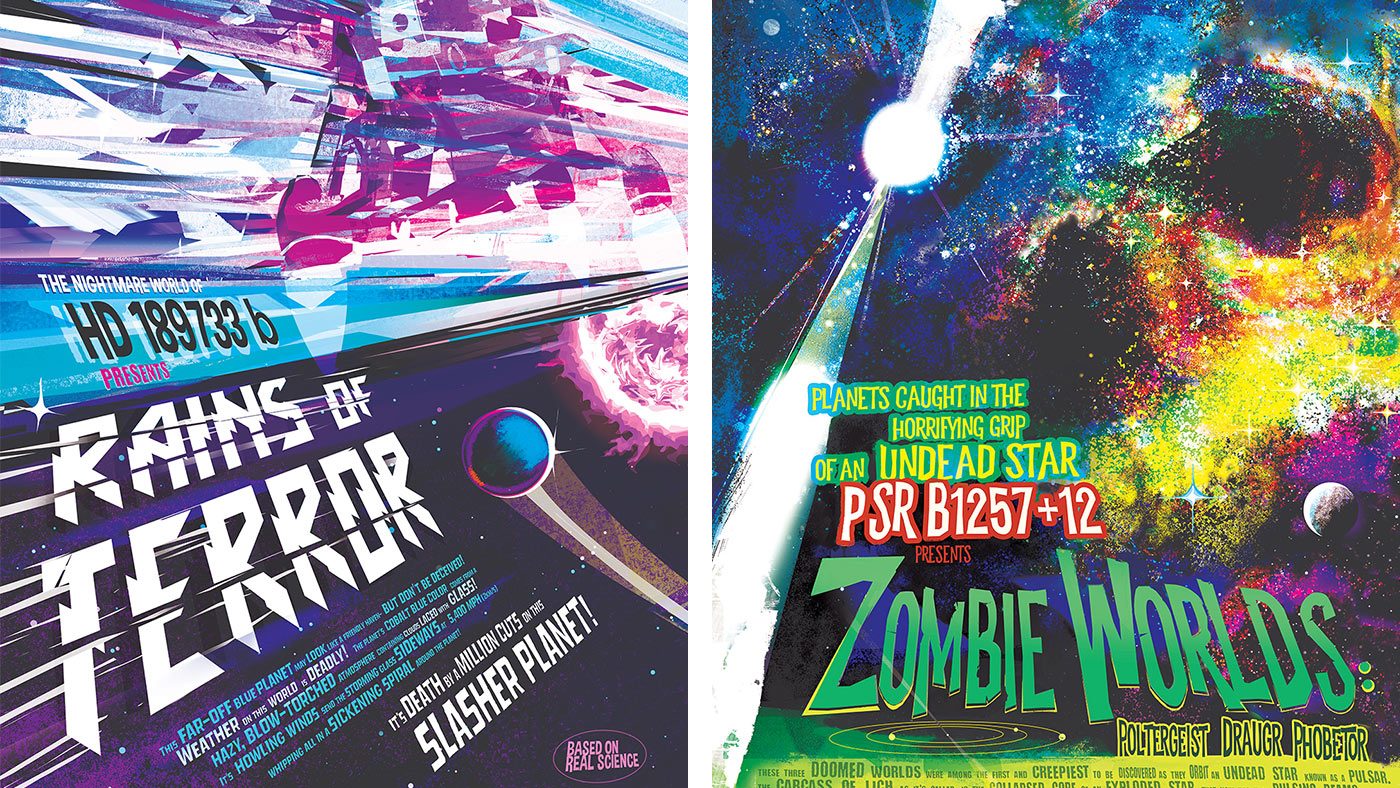
NASA’s newly released posters have a vintage horror movie look just in time for Halloween, and highlight exoplanets in a series called Galaxy of Horrors. 

The posters, created in collaboration with scientists and artists at NASA’s Jet Propulsion Laboratory (JPL), are meant to be informative about different exoplanets that have been discovered outside of our galaxy. The colorful posters are free to download. 

Recommended Videos

“In practical terms, I think for many people, the posters are an entryway,” said Gary Blackwood, manager of the Exoplanet Exploration Program, in a press release. “They make exoplanet science cool, and that opens a door for many members of the public — especially students — to learn more about the science behind the posters.”

There’s even a Galaxy of Horrors fake trailer to go along with the retro posters that explains exoplanets further. 

One poster is dubbed “Rains of Terror,” a play on the exoplanet’s atmosphere that is full of harsh winds of sand and glass, which NASA refers to as a “hellscape.” 

The other poster, called “Zombie Worlds.” focuses on PSR B1257+12, the remains of what used to be a star that isn’t quite dead yet and that has three exoplanets orbiting it. The dead star produces such intense radiation that it can be seen across its galaxy. 

The posters showcase that there’s more to exoplanets than finding planets similar to Earth. The exoplanets that harbor treacherous conditions are still equally important discoveries. 

“People are often most interested in finding exoplanets that could resemble Earth or potentially support life as we know it,” said Thalia Rivera, an outreach specialist at JPL who led the development of the new poster series. “But there are so many other amazing, mystifying planets out there that are completely unlike Earth and that show us the huge variety of ways planets can form and evolve. My favorite thing about exoplanets is how extreme they can get!”

NASA has confirmed the existence of more than 4,000 planets outside our solar system, like the recently discovered K2-18b Earth-like exoplanet. The sheer number of exoplanets is impressive, but even more so if you take into consideration that before 1992, we couldn’t find any exoplanets. 

Allison Matyus
Former Digital Trends Contributor
Allison Matyus is a general news reporter at Digital Trends. She covers any and all tech news, including issues around social…
Starlink V5 is here, and it’s lighter, smarter, and far more efficient
The next-generation satellite internet kit promises improved efficiency while maintaining high-speed connectivity.
Starlink V4 vs V5

Not every hardware upgrade needs to be about speed. With Starlink V5, SpaceX is betting that a lighter design and lower power consumption matter just as much. The company has officially introduced its next-generation Starlink V5 kit, featuring a smaller and lighter design with significantly improved power efficiency.

Smaller, lighter, and far more efficient

Read more
Frontier joins the Starlink club with high-speed in-flight internet
The carrier plans to roll out SpaceX's satellite-powered Wi-Fi across its fleet starting in 2027.
Frontier Starlink partnership featured

If there's one thing budget airlines aren't exactly known for, it's great onboard Wi-Fi. In Frontier Airlines' case, it hasn't offered in-flight internet at all. That's about to change. Frontier Airlines has announced a partnership with SpaceX's Starlink to bring high-speed, low-latency internet across its fleet. Installations will begin in early 2027, making Frontier the first ultra-low-cost carrier in the United States to adopt Starlink's satellite-powered connectivity.

Streaming, browsing, and even gaming at 35,000 feet

Read more
OpenAI’s first hardware product sounds more like a companion than a speaker
The AI company is reportedly building a mobile home device that understands context and proactively helps users.
OpenAI press image

For months, rumors have suggested that OpenAI's first hardware product could be a wearable AI device, or perhaps even the beginning of its long-term smartphone ambitions. As it turns out, the company's first gadget may be something far simpler, yet arguably far more ambitious. It will help control smart-home appliances, play media, answer questions, respond to messages, and tap into the range of capabilities offered by OpenAI's ChatGPT, according to people familiar with the matter.

OpenAI's first AI device could end up being a speaker, following plenty of hype that the company is actually working on a wearable AI device and might even launch a smartphone down the road. According to a Bloomberg report, the speaker will serve as a human-like AI companion that will integrate directly with the smart home ecosystem.

Read more