1. Home
  2. Space
  3. Emerging Tech
  4. News

Asgardia invites you to become a citizen of space and a cosmic defender

Add as a preferred source on Google

The next member of the United Nations may be the first nation state in space.

Not much is known about the nation of Asgardia. Yesterday, chairman of United Nations Organization for Education, Science and Culture’s (UNESCO) Science of Space committee, founder of the Aerospace International Research Center (AIRC), and mastermind behind the nation of Asgardia, Igor Ashurbeiyli, announced some minor details about his brainchild through a translator.

Recommended Videos

“Physically the citizens of that nation state will be on Earth,” Ashurbeiyli told the Guardian through an interpreter, “they will be living in different countries on Earth, so they will be a citizen of their own country and at the same time they will be citizens of Asgardia.”

Anyone over 18 can apply for Asgardian citizenship by filling in basic contact details online. Nearly 55,000 people have reportedly already applied by the time this article was published, bringing Asgardia more than halfway to the 100,000 citizens needed to officially apply to the UN. At that point, it would be up to a majority vote by UN members to give Asgardia the designation.

But that vote is unlikely, according to professor of space law at the University of Nebraska, Frans von der Dunk, who spoke to Popular Science about Asgardia. For one thing, nationhood does not necessarily satisfy statehood.

“A state in the classical sense has a territory and has a significant portion of its population living on that territory,” von der Dunk said. “As long as nobody’s going into space, you can have as many signatures as you want, but you are not a state.”

The Outer Space Treaty, which governs both private and public space activity, would only bar Asgardia from from attempting to claim territory on some celestial body like an asteroid or the moon. Otherwise, the nation is technically legal. Von der Dunk admires the project’s optimism but does not see it as particularly timely.

“This may be the germ that 50 years from now will create a true nation in outer space,” he said, “but I don’t see that happening overnight, or even in the next 10 or 20 years.”

Asgardia’s only professed mission is as ambitious, vague, and lofty as its bid for statehood — it wants to be our first line of defense against cosmic threats. Once the nation establishes itself in space, it will attempt to create a shield to protect Earth from things like asteroids and coronal mass ejections from the sun. Though the technology to achieve this is a long way off, Asgardia says it plans to launch its first satellite sometime next year.

Dyllan Furness
Former Contributor
Dyllan Furness is a freelance writer from Florida. He covers strange science and emerging tech for Digital Trends, focusing…
Amazon’s Starlink rival is set to launch satellite internet later this year
After launching nearly 400 satellites, Amazon says its Leo broadband service will go live later this year.
Atlas V launches 29 Amazon Leo satellites from Cape Canaveral, Florida

Amazon's long-awaited answer to SpaceX's Starlink is finally nearing liftoff. According to an exclusive report from Reuters, the company plans to begin offering its Leo satellite internet service later this year, after its latest rocket launch pushed the constellation to 394 satellites in orbit.

The pieces are finally falling into place for Project Kuiper

Read more
NASA is investing $590 million in private contractors to build humanity’s first Moon outpost
NASA is counting on private companies to land its Moon Base dream.
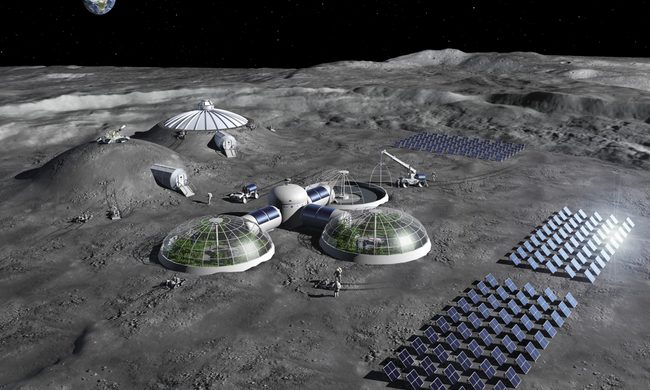
Artist impression of a Moon Base concept, with solar arrays for energy generation, greenhouses for food production, and habitats shielded with regolith.

Building a permanent base on the Moon sounds like science fiction, but NASA is making it feel a lot more real. The agency just handed $590 million in contracts to three private companies for four uncrewed lunar lander missions launching in late 2028.

These missions are part of Phase 1 of NASA's broader $30 billion Moon Base program, which needs to deliver landers, rovers, and scientific cargo up there before astronauts eventually move in. These efforts are closely tied NASA's Artemis program, which sent humans on a lunar flyby in April for the first time since the Apollo era.

Read more
Getting to Mars may require a pit stop in orbit, and NASA just tested the nozzle to make that happen
A gas pump nozzle for spacecraft sounds simple. It is not, and that's what makes this test worth paying attention to.
Architecture, Building, Factory

Getting a spacecraft to Mars or beyond requires an enormous amount of fuel, most of which has to be hauled from Earth, adding to the overall cost and weight of the spacecraft. NASA has been working on a different approach, one that could be more efficient and effective.

It wants to refuel a spacecraft in orbit before heading out for the mission. What’s even more interesting is that the space agency just finished testing a component that could make that possible: a cryocoupler.

Read more